
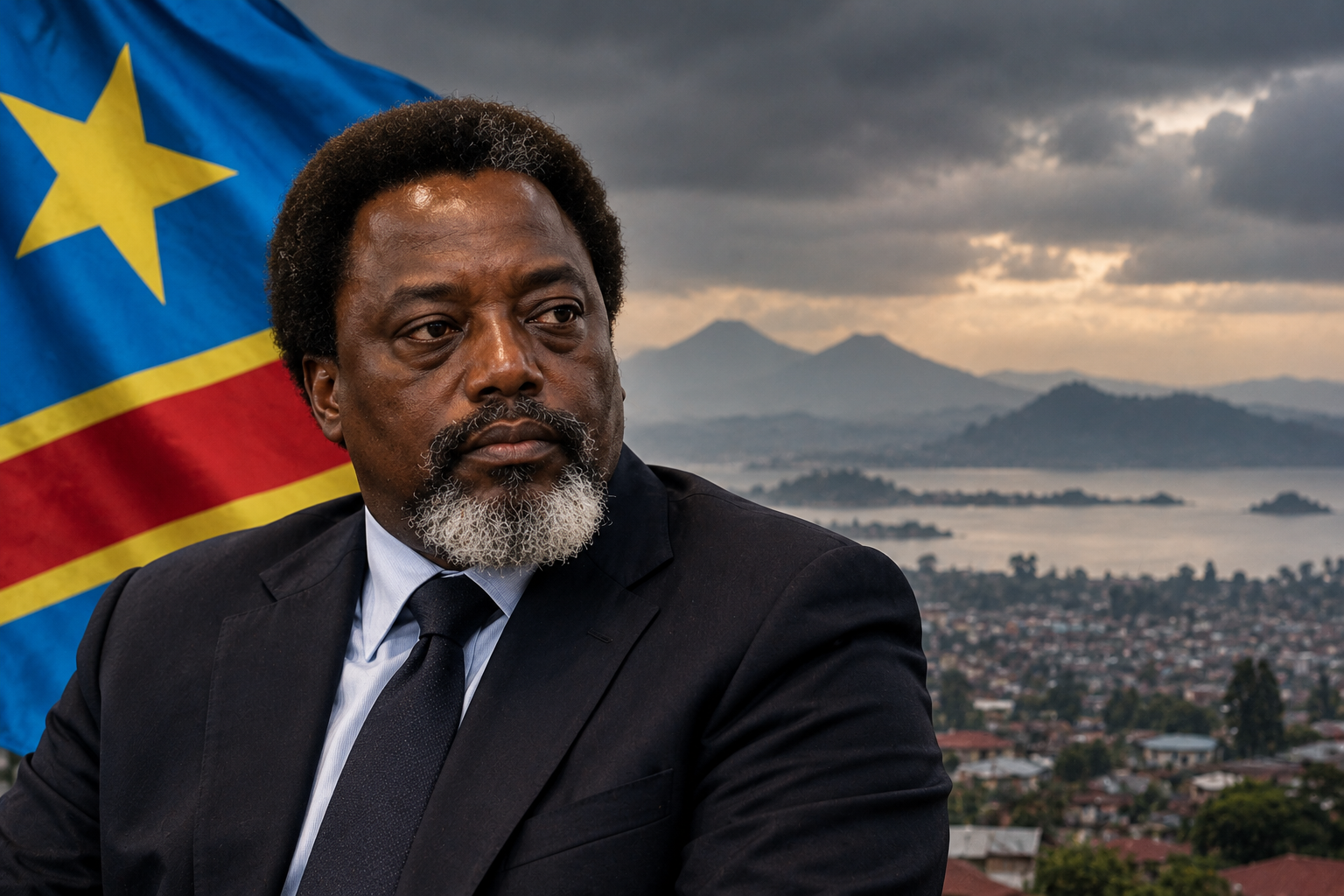
The DR Congo government has accused former President Joseph Kabila of planning a major armed offensive against the country following his alliance with the M23 rebel movement.
Government spokesperson Patrick Muyaya made the allegations after Kabila took leadership of a newly announced political-military coalition.
According to AFP, the government believes the alliance could intensify fighting in eastern Democratic Republic of Congo.
However, Kabila has denied previous allegations linking him to the M23 rebellion.
The accusations come amid growing political tensions and continued violence in eastern DR Congo.
DR Congo government accuses Kabila of armed plans
On Friday, October 16, government spokesperson Patrick Muyaya accused Kabila of preparing a wider military campaign.
Speaking to AFP, Muyaya said the former president had formalised plans to confront the Congolese state.
He argued that the new alliance represented an attempt to capture territory through force.
Furthermore, Muyaya questioned the intentions behind the coalition’s creation.
However, the government’s allegations have not been independently established.
Kabila has previously rejected accusations that he helped organise the M23 rebellion.
Kabila takes leadership of new political-military group
On October 12, Kabila announced his involvement in the Front for the Refoundation of the Nation (FRN).
The group brings together the former president and figures associated with the M23 movement.
According to its announcement, the FRN intends to combine political and military resources.
The coalition says its objective is to challenge what it describes as authoritarian rule.
It has also indicated that it may use force to pursue its goals.
Kabila is expected to lead the organisation, while M23 figures will serve as deputies.
The development marks a more direct political role for Kabila in the conflict affecting eastern Congo.
Former president faces longstanding allegations
Kabila governed DR Congo from 2001 until 2019.
He later spent several years outside the country.
In May 2025, he returned to public view in Goma, a major eastern city under M23 control.
Since then, he has reportedly visited other rebel-held areas.
Congolese authorities have accused him of helping establish the Congo River Alliance, also known as AFC.
The alliance previously served as the political wing of the M23 movement.
However, Kabila has denied those allegations.
In 2025, a Congolese court sentenced him to death in absentia over alleged complicity with the M23.
The ruling added to tensions between the former president and the government.
Fighting continues in eastern DR Congo
Eastern Congo has experienced prolonged fighting involving the M23 movement and government forces.
In early 2025, M23 fighters, supported by Rwandan forces according to AFP, captured Goma and Bukavu.
Both cities are important political and economic centres in eastern Congo.
Although front lines have since become more stable, fighting continues in several areas.
South Kivu province has experienced particularly intense clashes.
Reports have described artillery attacks and drone strikes during recent confrontations.
Meanwhile, the conflict continues to threaten civilian communities.
The latest political developments have raised concerns about further instability.
Political tensions grow ahead of 2028 elections
Kabila’s return to political activity comes as DR Congo faces disagreements over its political future.
Opposition demonstrations took place in June and September over a proposed constitutional amendment.
Critics fear the proposal could create a path for President Félix Tshisekedi to seek a third term.
Tshisekedi succeeded Kabila in 2019.
His second five-year presidential term is scheduled to end in 2028.
Under the current constitution, he cannot seek a third consecutive term.
However, the government and opposition remain divided over constitutional reform.
The main opposition coalition has so far maintained its distance from Kabila.
Nevertheless, Kabila has publicly expressed support for opposition political activity.
In a speech published online on Friday, he accused the government of seeking to remain in power.
What happens next in DR Congo?
The accusations against Kabila add another layer of uncertainty to DR Congo’s political and security situation.
The government views his new alliance with M23 figures as a threat to national stability.
Meanwhile, Kabila and his allies present their movement as a challenge to the current political leadership.
However, the coalition’s future actions remain uncertain.
Continued fighting in eastern Congo could further complicate the country’s political situation.
For civilians, the priority remains security, access to essential services and protection from further violence.
The coming weeks may provide a clearer picture of how the new alliance affects the conflict.