
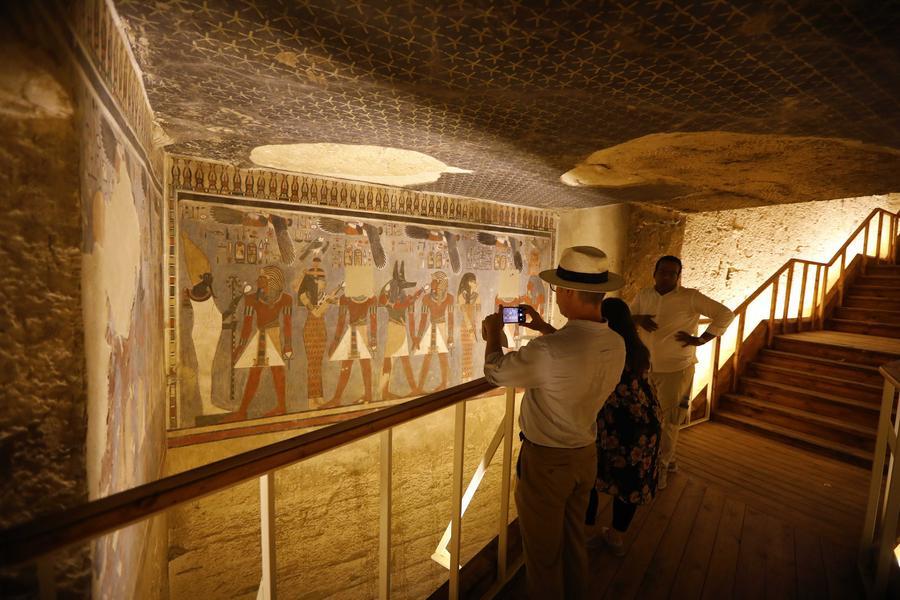
Egyptian authorities on Thursday unveiled two newly restored tombs dating back to the New Kingdom era on Luxor’s West Bank, highlighting scenes of daily life and ancient funerary traditions from more than 3,000 years ago.
The tombs belonged to Rabuya and his son Samut, officials said. Both men served as doorkeepers of the deity Amun during Egypt’s 18th Dynasty, the first dynasty of the New Kingdom period.
“Today we are inaugurating two very important tombs that were discovered by chance in 2015,” Hisham El-Leithy, secretary-general of Egypt’s Supreme Council of Antiquities, said during the unveiling ceremony.
According to Egypt’s Ministry of Tourism and Antiquities, the tombs feature detailed wall scenes depicting agricultural work, harvesting, craft production, bread-making, pottery and wine production, alongside traditional funerary rituals.
The restored burial sites are located on Luxor’s famed West Bank along the Nile River, home to the Valley of the Kings, where many pharaohs and nobles of the New Kingdom were buried in elaborate rock-cut tombs.
The Valley of the Kings includes the tomb of the pharaoh Tutankhamun, widely known as King Tut, whose nearly intact burial chamber and treasures were discovered in 1922, becoming one of the most famous archaeological finds in history.
Egypt has increasingly promoted archaeological discoveries and restoration projects as part of broader efforts to boost tourism and showcase the country’s ancient heritage.