
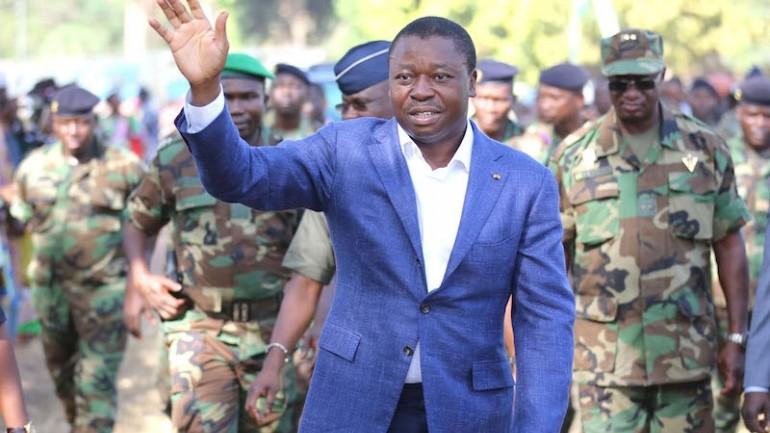
Togo has carried out a sweeping overhaul of its military and intelligence leadership, a move driven both by the growing extremist threat in the country’s north and by Prime Minister Faure Essozimna Gnassingbé’s efforts to strengthen his control over the armed forces.
The reshuffle, announced through eight decrees on August 17, had been expected for several weeks, according to French magazine Jeune Afrique. Togo’s current military leadership structure, established in 2024, was nearing the end of a two-year cycle.
Regular changes at the top of the security establishment have also become an informal practice since the killing of Colonel Toussaint Bitala Madjoulba in May 2020, an incident that deeply shook the country’s military hierarchy.
The latest restructuring comes as northern Togo continues to face armed attacks spilling across the border from neighbouring Burkina Faso.
Security sources cited by Jeune Afrique said the backgrounds of the officers promoted to senior positions suggest the government wants to improve coordination between intelligence services and troops deployed on the front lines.
At the same time, the appointments are seen as an attempt by Gnassingbé to consolidate his influence over the military by placing trusted figures in key commands.
The most significant appointment is Brigadier General Tchakpélé Aklesso as chief of staff of the Togolese Armed Forces.
Aklesso, regarded as a discreet but influential figure, was appointed head of the National Intelligence Agency in 2018 after replacing Colonel Koulemaga Kassawa. He has also overseen Gnassingbé’s personal protection team.
Like the prime minister, Aklesso is from the Kara region and has extensive experience across Togo’s security apparatus.
He is expected to play a central role in improving coordination between operational units and intelligence agencies in the northern Savanes region, while also managing security cooperation with foreign partners.
A Jeune Afrique investigation published in early July reported that Turkish military trainers were operating at the Dapaong-area Dihiaga base in northern Togo, where they were involved in training special forces and supporting military operations.
The report also said around 300 Russian soldiers from the Africa Corps had been deployed to Togo since January, highlighting the increasingly diverse foreign partnerships supporting Lomé’s campaign against militant incursions.
Colonel Akakpo Ayéwalani has meanwhile been appointed to replace Aklesso as head of the National Intelligence Agency.
Ayéwalani, an officer in the gendarmerie, is considered an experienced intelligence official and previously headed the Research and Investigation Department between 2008 and 2014.
He will be assisted by Samaro Essowe, who has been named deputy director.
Another important appointment is Colonel Latembi Kombaté as commander of the army.
Kombaté previously led the Parachute Commando Regiment and later the 2nd Rapid Intervention Battalion, currently commanded by Lieutenant Colonel Kodjo Sou Abé.
He has also been one of the key officers involved in Togo’s counter-extremism campaign and was responsible for leading Operation Koundjoaré, the country’s main military deployment in the north, from its launch in 2018.
Elsewhere in the reshuffle, Colonel Abdou Ahabou Idrissou has left the National Civil Aviation Agency to take command of the air force, while Air Brigadier General Mama Agnidoufi Essomna has moved in the opposite direction.
Since the killing of Colonel Madjoulba on the night of May 4, 2020, Gnassingbé has increasingly rotated senior security officials.
According to security sources, the policy is intended to prevent officers from remaining in powerful positions for extended periods and building independent networks of influence within the armed forces.
The sensitivity surrounding control of the military was reinforced earlier this year.
At the end of February 2026, former chief of the general staff General Félix Abalo Kadanga was sentenced on appeal to 30 years in prison after being convicted of complicity in murder and conspiracy against state security.
The latest appointments therefore serve two purposes for Lomé: strengthening Togo’s ability to confront armed groups operating along its northern frontier, while ensuring that the country’s most powerful security institutions remain firmly under Gnassingbé’s control.