
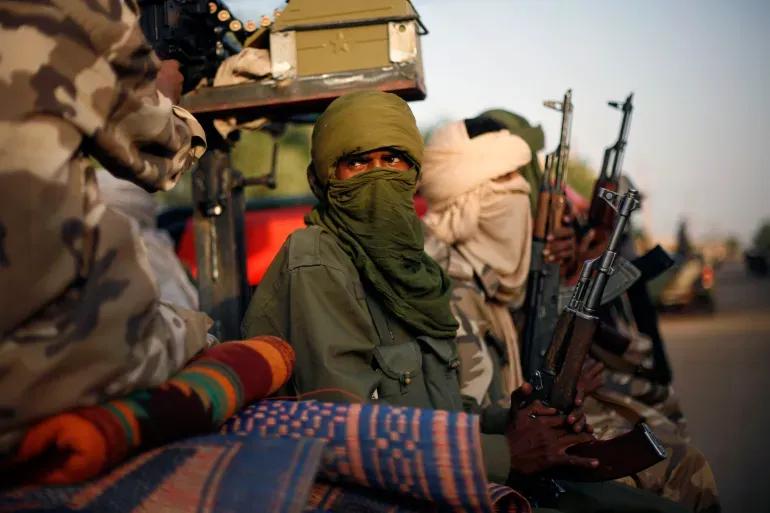
Mali has been shaken by another assassination blamed on Jama’at Nusrat al-Islam wal-Muslimin, or JNIM, marking the fourth such killing reported in the country within months.
The al-Qaeda-linked group executed Abdallah Tandina, a senior member of the butchers’ union in the town of Tonka, in Mali’s northern Timbuktu region, Radio France Internationale reported.
The motive for Tandina’s killing remains unclear, while his family has been left grieving and in shock, according to the report.
The incident follows a series of targeted killings blamed on JNIM.
A leader of a local youth association was killed in late March, while a Quran teacher was reportedly murdered by members of the group in June.
In November 2025, the public execution of Mariam Cissé, a young TikTok user known for expressing support for the Malian army, sparked widespread outrage across the country.
African security specialist Amr Diallo said the group was using the killings to intimidate communities and demonstrate the weakness of the authorities.
“JNIM is trying to send several messages by targeting prominent local figures, with one of the most important being the intimidation of the population,” Diallo told Erem News.
He said the group was also seeking to capitalise on recent battlefield gains by portraying the central government in Bamako as incapable of protecting local officials and community leaders.
Diallo added that the strategy was placing further pressure on Mali’s military leadership under General Assimi Goïta, despite the army’s recent recapture of the strategically important town of Anefis.
“This is another face of the war, and one that is even more brutal,” he said.
Government accused of security failure
On April 25, JNIM claimed responsibility for the assassination of Mali’s defence minister, General Sadio Camara, according to the report. The killing caused widespread alarm and coincided with deadly attacks reportedly carried out alongside the separatist Azawad Liberation Front.
Political analyst Eric Eziba said the assassination campaign exposed what he described as an unprecedented failure by the government to protect state officials.
“The killings carried out by JNIM reveal an unprecedented government failure to protect state personnel,” Eziba told Erem News, warning that the consequences would become increasingly difficult to contain if the attacks continued.
He said the inability to protect officials in remote regions such as Timbuktu, as well as in areas closer to Bamako, risked further weakening public confidence in the state.
“The assassination of the defence minister was the most prominent case, but even the targeting of lower-ranking officials carries a heavy cost for Mali’s security and political stability,” Eziba said.
Mali has faced years of violence involving armed groups linked to al-Qaeda and Daesh, separatist movements and government forces. The latest targeted killings have raised fresh concerns that militant organisations are increasingly using assassinations to undermine local administration and expand their influence over vulnerable communities.