
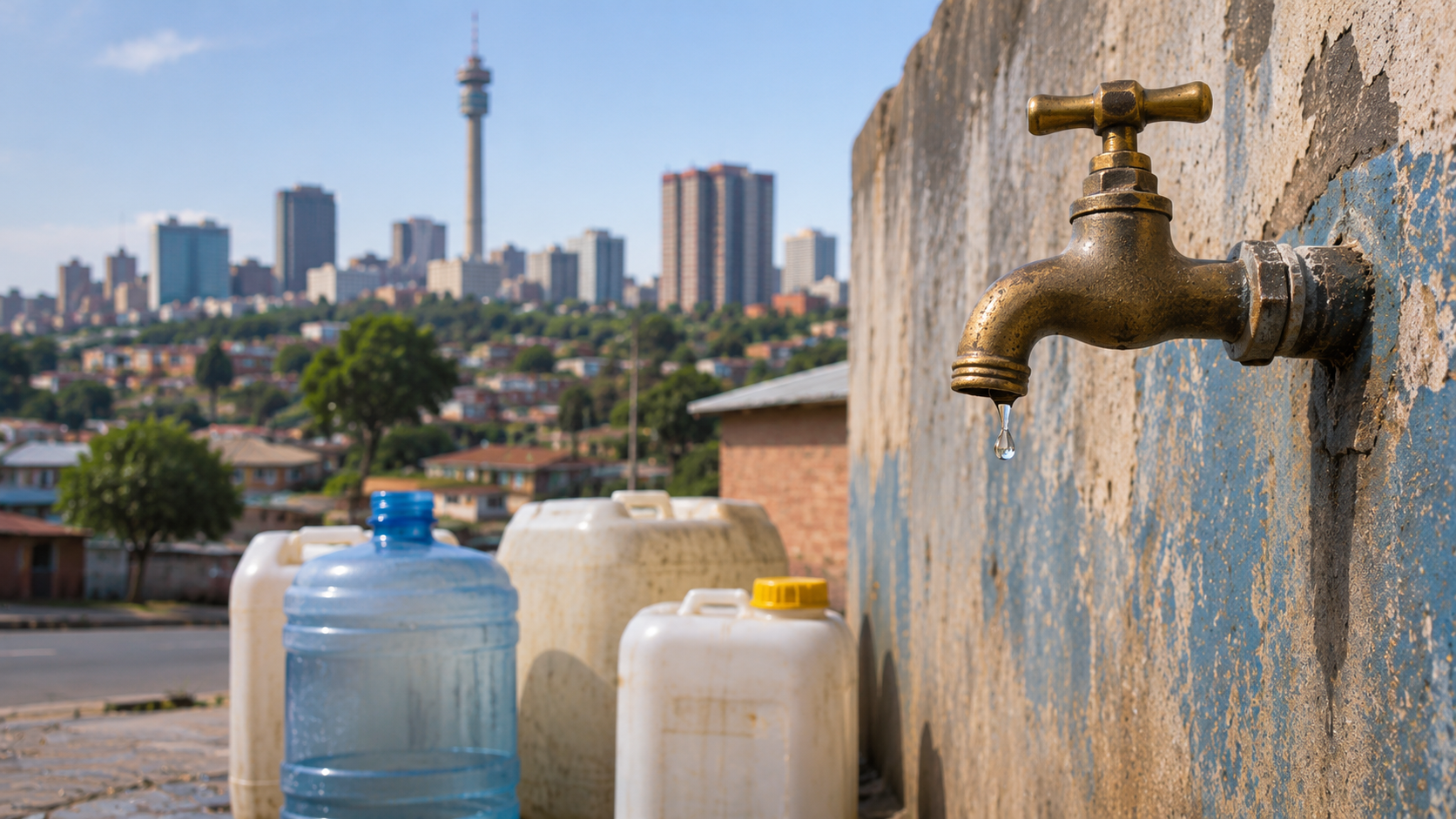
Johannesburg’s water crisis has left thousands of residents facing prolonged disruptions as South Africa prepares for local government elections on Wednesday, November 4.
Some neighbourhoods have experienced dry taps for at least 10 days, prompting protests and growing frustration over the delivery of essential services.
The disruptions have placed renewed attention on ageing infrastructure, water management and municipal accountability.
Water shortages are not the only concern. Electricity interruptions and unreliable waste collection have also emerged as important issues ahead of the vote.
Johannesburg water crisis disrupts daily life
Johannesburg Mayor Dada Morero acknowledged that several parts of the city have experienced severe water shortages and low pressure since October 19.
The disruptions have affected communities across South Africa’s economic hub, which has a population of approximately five million.
According to AFP, authorities said Monday that restoring reliable water supplies remained a priority.
Morero attributed the shortages partly to high consumption and leaks in the city’s ageing water infrastructure.
He warned that repairing the network would require billions of rand in investment.
However, the mayor said Johannesburg’s overall water storage levels had improved to 41% by Monday.
Despite that improvement, residents in several areas continued to face uncertainty over when normal supplies would return.
Ageing infrastructure contributes to water losses
A new investigation by the South African Human Rights Commission has highlighted the scale of Johannesburg’s infrastructure problems.
The commission’s findings, released Monday, indicated that nearly 45% of water flowing through municipal pipelines was being lost because of deteriorating infrastructure.
These losses place additional pressure on a system already struggling to meet demand.
The inquiry also identified weak financial management and shortages of qualified personnel, including engineers, in several Gauteng municipalities.
Such challenges can delay maintenance, reduce operational efficiency and complicate efforts to restore reliable services.
Meanwhile, Gauteng Premier Panyaza Lesufi said unexpectedly high temperatures had contributed to falling water reserves.
He also referred to the El Niño weather pattern while discussing the city’s difficulties.
However, infrastructure problems remain a major concern regardless of weather conditions.
Water shortages extend beyond Johannesburg
Johannesburg is not the only South African city experiencing water supply difficulties.
Other urban centres, including Durban, have reportedly faced prolonged shortages.
In the Tshwane municipality, which includes the administrative capital Pretoria, residents in some areas were advised approximately two weeks ago not to drink tap water.
The warning followed reports that around 800 people had fallen ill.
These incidents have raised broader concerns about water safety, infrastructure maintenance and the ability of municipalities to provide essential services.
Reliable access to clean water is particularly important for public health, sanitation and household wellbeing.
For families experiencing repeated disruptions, the consequences can extend beyond inconvenience.
Residents may need to find alternative water sources, adjust daily routines or spend additional money securing basic supplies.
Basic services become central election issue
The water crisis comes at a politically sensitive moment.
South Africans are preparing to vote in local government elections on November 4, with municipal performance under increased scrutiny.
Access to water, electricity and regular rubbish collection has become a prominent concern for voters.
These services directly affect daily life and are among the responsibilities associated with local government.
The African National Congress (ANC), which remains the largest party in South Africa’s national unity government, faces a test of its public support.
The election will also offer an indication of political sentiment ahead of the country’s next national elections in 2029.
However, the outcome will depend on voters across municipalities with differing local circumstances and priorities.
Residents demand reliable municipal services
Public frustration over Johannesburg’s water shortages has already led to protests.
Residents have expressed concern about prolonged disruptions and the uncertainty surrounding restoration efforts.
For municipal authorities, the challenge extends beyond responding to the immediate shortages.
Long-term improvements will require investment in infrastructure, effective maintenance and stronger technical capacity.
The Human Rights Commission’s findings suggest that reducing water losses could be an important part of improving supply reliability.
Financial management and the availability of skilled personnel will also remain central to the response.
As voting approaches, the Johannesburg water crisis has become a visible example of the pressures facing South Africa’s municipalities.
For affected residents, however, the most immediate priority remains straightforward: restoring safe, dependable water supplies to their homes and communities.