
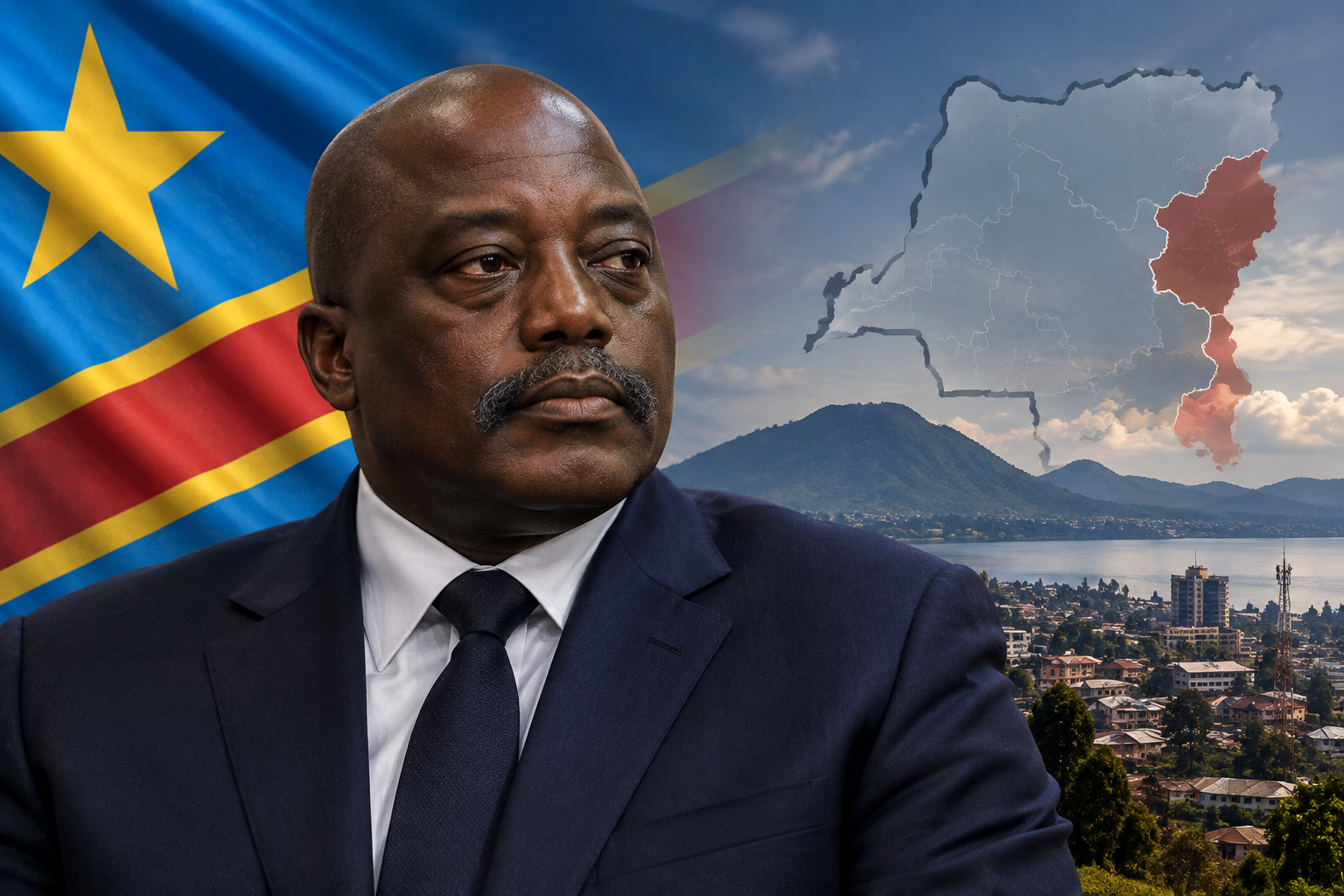
Former DR Congo president Kabila joins M23 in new alliance
Former Democratic Republic of the Congo (DRC) President Joseph Kabila has announced a new alliance with the M23 rebel movement. The move could reshape the conflict in eastern Congo and complicate ongoing peace negotiations.
Kabila unveiled the coalition on Monday, October 12, in Goma, a city controlled by M23 and its allies.
The new movement, called the Front for the Refoundation of the Nation (FRN), brings together Kabila and senior figures from the existing M23-Congo River Alliance (AFC).
According to Al Jazeera, the announcement marks a significant political development in a conflict that has displaced millions of people.
Kabila takes leadership of new M23 alliance
Kabila will lead the newly established FRN coalition.
Corneille Nangaa, a former Congolese election official and leader of the AFC, will serve as one of his deputies.
M23 political representative Bertrand Bisimwa will also hold a deputy leadership position.
Meanwhile, senior M23 official Freddy Kaniki will become secretary-general.
Sultani Makenga, a leading M23 commander, will oversee the coalition’s military wing.
The new structure brings political and armed figures under a single leadership.
Coalition spokesperson Claude Ibalanky said the movement intends to challenge the government in Kinshasa, including through the possible use of force.
However, the coalition has not explained how its formation will affect existing peace commitments.
Why has Joseph Kabila joined M23?
Kabila served as DRC president from 2001 until 2019.
He came to power following the assassination of his father, former President Laurent-Désiré Kabila.
During his presidency, Kabila oversaw several political transitions and faced criticism over governance, elections and human rights.
His relationship with current President Félix Tshisekedi deteriorated after the 2018 presidential election.
Although their political groups initially cooperated, the arrangement collapsed as Tshisekedi consolidated power.
In recent years, the Congolese government has repeatedly accused Kabila of supporting armed groups operating in eastern DRC.
Kabila’s new alliance publicly confirms his cooperation with senior M23 figures. However, it does not independently establish every allegation previously made against him.
Last year, a Congolese military court sentenced Kabila to death following proceedings involving accusations of treason and collaboration with armed groups.
The United States also imposed sanctions on him in April 2026 over allegations that he financed rebel activities.
These legal and political developments have deepened divisions between Kabila and the government in Kinshasa.
M23 conflict continues in eastern Congo
Eastern DRC has experienced decades of armed conflict involving numerous groups.
The M23 movement first emerged in 2012 and has repeatedly fought Congolese government forces.
Its leaders say they seek to protect the rights of Congolese Tutsi communities and address longstanding political grievances.
However, the Congolese government regards M23 as an armed rebellion threatening the country’s territorial integrity.
The United Nations and the United States have accused Rwanda of supporting M23.
Rwanda denies the accusations and has raised concerns about armed groups operating near its border.
M23 and its allies expanded their territorial control during major offensives in 2024 and 2025.
They captured Goma in January 2025 and subsequently strengthened their presence in parts of eastern DRC, including Bukavu.
The fighting has caused extensive civilian suffering.
According to figures cited by Al Jazeera, more than 7.8 million people have been displaced across the country, while approximately 28 million face food insecurity.
The humanitarian crisis remains one of the most serious consequences of the conflict.
New alliance raises concerns over Congo peace talks
Kabila’s decision comes as diplomatic efforts continue to address the fighting.
In June 2025, the DRC and Rwanda signed a United States-mediated peace agreement.
Separately, Qatar has facilitated negotiations between the Congolese government and the M23-AFC alliance.
Those discussions produced the Doha Framework in November 2025.
However, the formation of the FRN introduces uncertainty over the future of negotiations.
Political analysts warn that Kinshasa may adopt a tougher position toward Kabila and the new coalition.
Bram Verelst, a researcher at the Institute for Security Studies, told Al Jazeera that the Doha negotiations could face particular difficulties.
He said the impact on the conflict would depend partly on Kabila’s ability to establish authority within the coalition and expand its political relationships.
The separate agreement between the DRC and Rwanda may be less directly affected.
Nevertheless, the new alliance could make an already complex peace process more difficult.
What could happen next in eastern DRC?
The formation of the FRN could change the political dynamics of the conflict.
Kabila’s previous position as president gives the coalition a prominent political figure with longstanding connections inside the country.
However, it remains unclear whether the new leadership arrangement will strengthen the movement or create internal disagreements.
There are also concerns that some former government personnel could shift their support toward Kabila.
For now, these possibilities remain uncertain.
The immediate priority for civilians is an end to fighting and improved access to humanitarian assistance.
Millions of Congolese families continue to face displacement, insecurity and shortages of essential supplies.
Peace efforts face another challenge
Kabila’s alliance with M23 marks a significant development in the DRC’s political and security situation.
It brings a former head of state into the leadership of a movement already involved in an extended conflict with government forces.
At the same time, diplomatic initiatives led by the United States and Qatar remain important channels for negotiations.
The coming weeks could determine whether the new coalition participates in further talks or deepens the political divisions surrounding the conflict.
For communities in eastern Congo, a peaceful settlement remains essential to ending years of instability.