
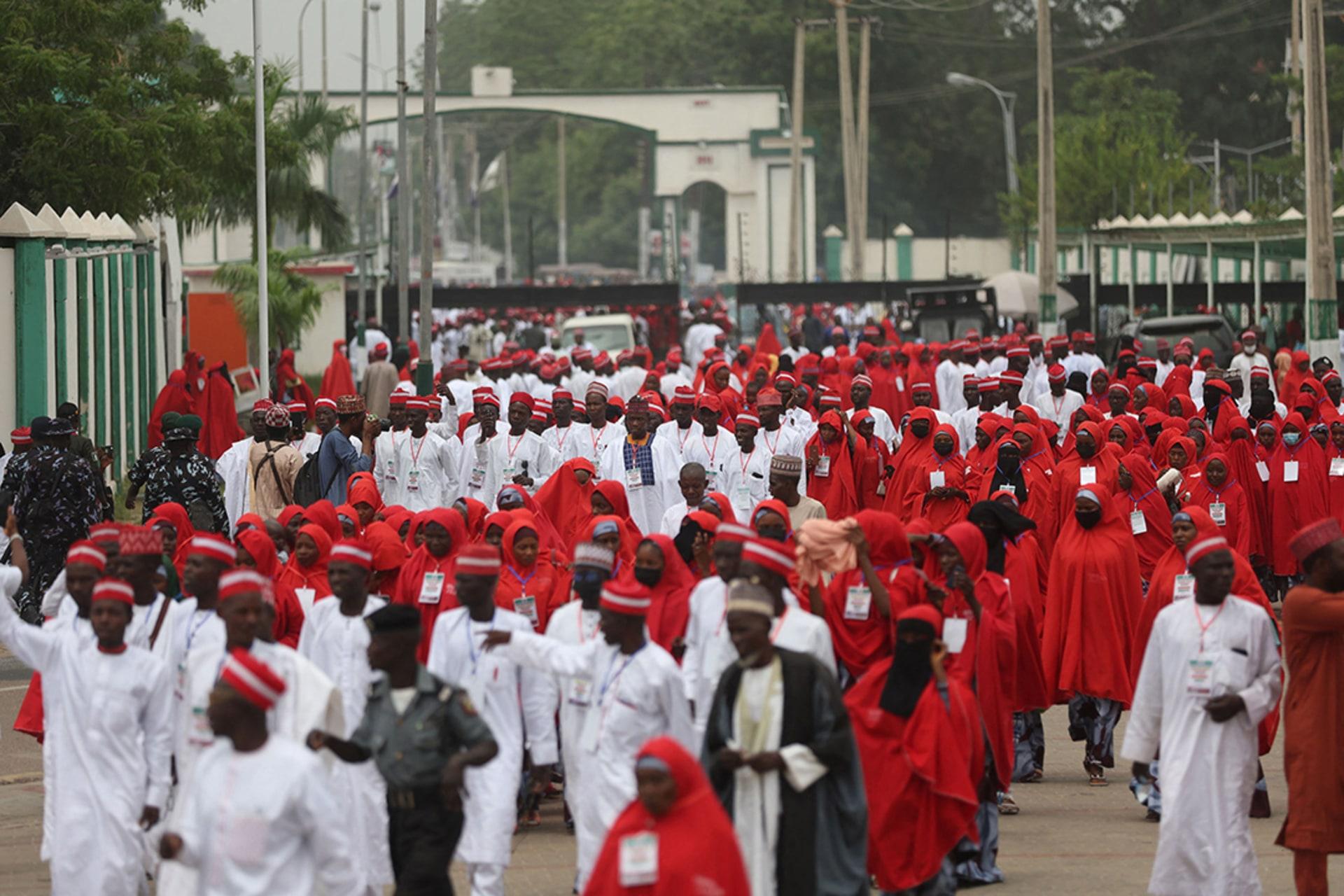
Some 1,500 couples have married in a government-sponsored mass wedding in northern Nigeria, as authorities seek to help low-income residents overcome the rising cost of marriage while screening out applicants attempting to exploit the programme.
The week-long celebrations brought colour and excitement to Kano, with bridal parties and families preparing outfits and attending ceremonies across the city.
On Friday, brides dressed in red hijabs joined grooms wearing matching red caps and white robes at the palace of the Emir of Kano, the city’s traditional Muslim leader, where the main marriage ceremony took place.
The celebrations concluded on Saturday with a wedding breakfast hosted by Kano State Governor Abba Kabir Yusuf.
The state government allocated around 1.5 billion naira, roughly $1 million, to support the mass wedding programme. Assistance includes dowries, household furniture, food supplies and financial support intended to help newly married couples establish their homes.
The initiative is aimed primarily at people unable to meet the financial costs associated with marriage.
Kano’s mass wedding programme began in 2012, when 100 couples, many of them widows and divorcees, were married at the Emir’s palace. The scheme has since expanded significantly, including participants entering polygamous marriages permitted under Islamic law.
Demand this year was particularly high, with around 5,000 couples applying for the 1,500 available places.
The selection process is overseen by the Hisbah, Kano’s Islamic morality police, which is responsible for checking whether applicants are genuinely intending to marry.
Kano has a predominantly Muslim population and operates Islamic Sharia law alongside Nigeria’s secular legal system.
Hisbah deputy commander-general Mujahid Aminudeen said authorities had uncovered several attempts to manipulate the programme.
“Whenever we find out that there’s something dubious or fishy about a couple, we disqualify them,” he told the BBC.
Authorities say roughly one million naira was spent on each participating couple.
Packages provided to newlyweds include beds, mattresses, sheets, pillows, furniture and food. Each bride also receives a dowry of 100,000 naira, while another 100,000 naira is provided as start-up capital to help couples establish small businesses and become financially independent.
Applicants must also undergo medical screening, including tests for HIV, hepatitis, pregnancy and genotype compatibility.
Aminudeen said some applicants were removed from the programme after authorities discovered that medical results had been altered.
In one case, a woman allegedly presented her brother as her prospective husband in an attempt to qualify for the government assistance.
Local journalist Yusuf Ali Abdallah, who has covered Kano’s mass weddings for several years, said Nigeria’s difficult economic conditions had increased pressure on applicants.
“Marriage involves spending money and the country’s economy is not bright at the moment,” he said. “This makes some people desperate to get on this list.”
Officials also discovered at least one couple who were already married but had applied as though they were preparing to wed for the first time.
Separate allegations emerged that intermediaries were asking applicants for money in exchange for securing a place on the wedding list.
One Kano resident who was not selected said he had been asked to pay a bribe, although he later learned that those demanding money were not Hisbah officials.
Aminudeen said authorities were aware of such schemes and stressed that participation in the programme was completely free.
“The whole process is free: from the selection to the medicals and the goods set aside for couples — all are covered by the government,” he said.
For successful applicants, the programme offered an opportunity to marry at a time when the costs might otherwise have been prohibitive.
Clothes trader Rabiu Yusuf, 43, said nobody had asked him for money during the application process.
Yusuf married Aisha Auwal, whom he met after she became a regular customer at his shop. He already has five children with his first wife.
Another bride, 24-year-old Amina Alhassan, married 40-year-old Nura Abdullahi after their families arranged the union in Dambatta village.
Alhassan said the programme had made their marriage possible amid the country’s high cost of living.
“Without it, many couldn’t have afforded to marry,” she said.
Following Saturday’s celebrations, authorities began distributing household goods to the newlyweds as hundreds of couples prepared to begin their new lives together.