
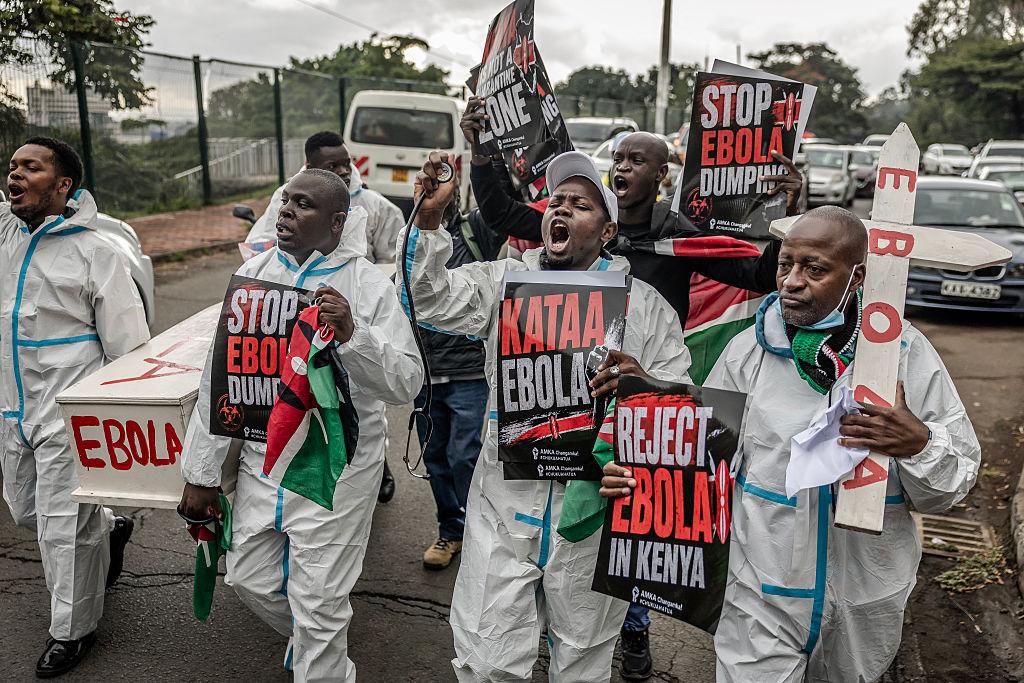
A Kenyan protester was shot dead on Tuesday during renewed demonstrations against a US-linked Ebola quarantine facility in the central town of Nanyuki, witnesses and a protest organiser said, intensifying anger over a project already facing a court challenge and public backlash.
The planned 50-bed unit at Laikipia Air Base, near Nanyuki, is intended to hold Americans who have been exposed to Ebola in eastern Democratic Republic of Congo and Uganda but are not showing symptoms.
Local residents and activists have accused the United States and Kenyan authorities of shifting health risks onto the community, while protesters say the facility threatens the region’s tourism economy and public safety.
Patrick Wahome, one of the protest organisers, said the protester was killed by a gunshot wound to the head. Several eyewitnesses gave similar accounts. Reuters reporters at the scene said they later saw the man’s body lying motionless in the back of a police vehicle with a large head wound, though they did not witness the shooting.
A police spokesperson said he had no information about the incident.
The Kenya Human Rights Commission said in a statement on X that hooded police officers had fired live ammunition and arrested 19 protesters. The rights group also accused officers of attacking demonstrators and journalists. Reuters said it could not independently verify the claims.
Police earlier fired tear gas to disperse hundreds of demonstrators. Some protesters waved Kenyan flags, while one carried a white cross marked with the words “Reject Ebola” in red. Reuters reporters said more than 10 protesters were detained.
The latest death follows earlier protests in Nanyuki last week in which two people were killed, adding to pressure on President William Ruto’s government over its handling of the proposed facility.
Many protesters have framed the site as an attempt to turn Laikipia into a quarantine zone for foreign nationals, despite Kenyan officials saying the centre would also serve Kenyans and other foreign citizens. US officials have not confirmed that claim.
“Laikipia is not a dumping site,” protester Priscilla Imani told Reuters, warning that the area’s association with the facility was already frightening tourists who visit the region to climb Mount Kenya or see wildlife.
The controversy has also moved into the courts. A High Court judge has twice issued orders barring the Kenyan government from taking steps to build or operate the facility. The latest order gave the government one week to disclose all agreements connected to the quarantine centre.
Joshua Malidzo, a lawyer challenging the plan, said the deadline expired on Monday without the government complying.
Despite the court orders, US military aircraft have continued to bring in staff and equipment, according to US and diplomatic sources, flight tracking data and satellite imagery reviewed by Reuters. The satellite images reportedly show a build-up of white tents since late May on an estimated 11-acre section of Laikipia Air Base.
Kenya’s government did not respond to a request for comment.
The United States has said it is aware of the legal challenge and is working with Kenyan authorities to resolve objections.
The dispute comes as eastern Congo and Uganda face an Ebola outbreak that has recorded more than 500 confirmed cases and over 100 confirmed deaths. Several US citizens have been exposed to the virus in the region. Six people, including one confirmed case, were moved to a medical facility in Germany last month, while another was taken to the Czech Republic.
US President Donald Trump’s administration has said it will not allow Ebola cases to enter the United States. The Nanyuki facility is designated for Americans exposed to the virus who remain asymptomatic.
Ruto last week defended the project, saying his government was doing “the right thing” by allowing the centre to be established. But Tuesday’s killing is likely to deepen public anger over a facility critics say has been imposed on the local community without transparency or accountability.