
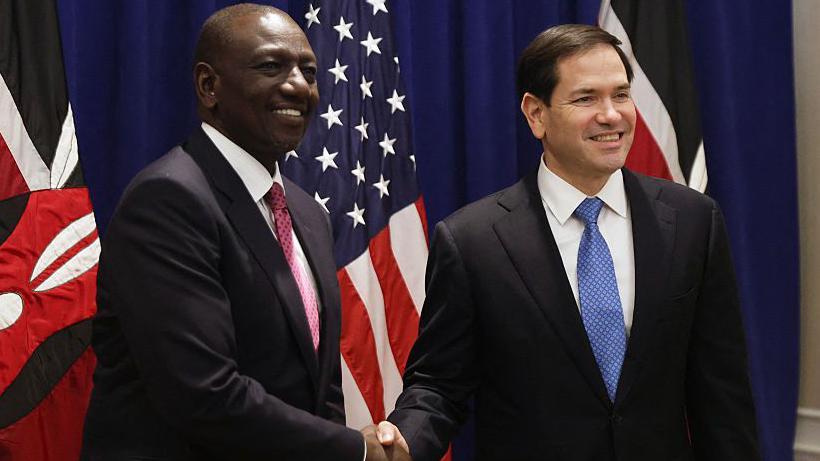
Kenya has signed a five-year, $2.5 billion health partnership with the United States, a flagship agreement under President Donald Trump’s revamped foreign aid strategy that has sparked both praise and concern at home.
The government-to-government deal, billed by US officials as the first in a new wave of agreements with developing countries, is focused on tackling infectious diseases and strengthening Kenya’s health system. Similar pacts are expected with other African states seen as aligned with the Trump administration’s broader foreign policy goals.
Under the agreement, Washington will provide about $1.7 billion, while the Kenyan government will contribute roughly $850 million and gradually assume a larger share of health funding over time.
US Secretary of State Marco Rubio, who signed the deal in Nairobi alongside President William Ruto, hailed the accord as a “landmark agreement” and called Kenya “a longstanding American ally.” He praised Nairobi’s leadership in the UN-backed mission to help counter powerful criminal gangs in Haiti.
“If we had five or ten countries willing to step forward and do just half of what Kenya has done already, it would be an extraordinary achievement,” Rubio said.
The pact aims to support prevention and treatment of HIV/Aids, malaria and tuberculosis, maternal and child health services, polio eradication efforts, and responses to infectious disease outbreaks. It is also intended to increase transparency and accountability by channeling more US funds directly through the Kenyan state rather than via international NGOs and charities.
“We are not going to spend billions of dollars funding the NGO industrial complex while close and important partners like Kenya either have no role to play or have very little influence over how health care money is being spent,” Rubio said.
Ruto said the money would be directed to Kenya’s own priorities, including upgrading hospital equipment and expanding the health workforce.
“I assure you that every shilling and every dollar will be spent efficiently, effectively, and accountably,” the president said.
Data privacy concerns
The agreement, however, has triggered a heated debate over data sovereignty and privacy, with critics warning that it could give the US real-time access to sensitive health information.
The deal is expected to rely heavily on digital systems and data sharing to track disease trends and monitor the use of funds. Some civil society groups, lawyers and whistle-blowers fear this could include granular patient data, such as HIV status, TB treatment history, and detailed vaccination records.
Kenya’s Health Minister Aden Duale sought to ease those concerns, stressing that only anonymised information would be shared.
“Only de-identified, aggregated data will be provided,” Duale said, insisting that Kenya’s health databases remain protected by national laws and regulations.
“Your health data is a national strategic asset,” he added, dismissing allegations that the government had quietly handed over control of the country’s health information.
But calls for transparency are growing. Lawyer Willis Otieno questioned the scope of data-sharing in a post on X, demanding clarity on what exactly is covered by the pact.
“What specific data categories are being shared? Are genomic data, disease patterns, mental health data, insurance claims, hospital records, or biometrics included? If not, why is that not explicitly written?” he wrote.
Prominent whistle-blower Nelson Amenya echoed those concerns, urging the government to publish the full text of the agreement so citizens “can read it for ourselves.”
US officials have not publicly addressed the data-privacy debate, limiting their comments to the deal’s potential public health benefits and its role in reshaping how Washington delivers aid.
Trump’s aid overhaul
The Kenya pact marks a major milestone in Trump’s overhaul of US foreign assistance.
On his first day in office in January, Trump ordered a freeze on foreign aid as part of a sweeping government spending review. His administration later dismantled the US Agency for International Development (USAID) in its previous form and cut billions of dollars in support to low- and middle-income countries, moves that aid groups say led to shortages of key medicines in many places.
In September, the White House unveiled an “America First Global Health Strategy,” tying aid more explicitly to US political and strategic priorities and requiring recipient governments to negotiate new terms that officials say are designed to reduce waste and ensure greater accountability.
Supporters of the new Kenya deal argue that routing funds directly through the government will give Nairobi more ownership over its health programmes and make spending more transparent. Critics worry it could centralise too much power in the executive, sideline independent oversight, and deepen reliance on a single foreign partner.
Despite the controversy, US officials say more countries are lining up to strike similar agreements before the end of the year.
For Kenya, the pact promises a substantial injection of funds into a strained health system still recovering from the disruptions of recent years. But as details of the agreement slowly emerge, the balance between sorely needed financing and the protection of citizens’ data is likely to remain at the centre of a contentious national debate.