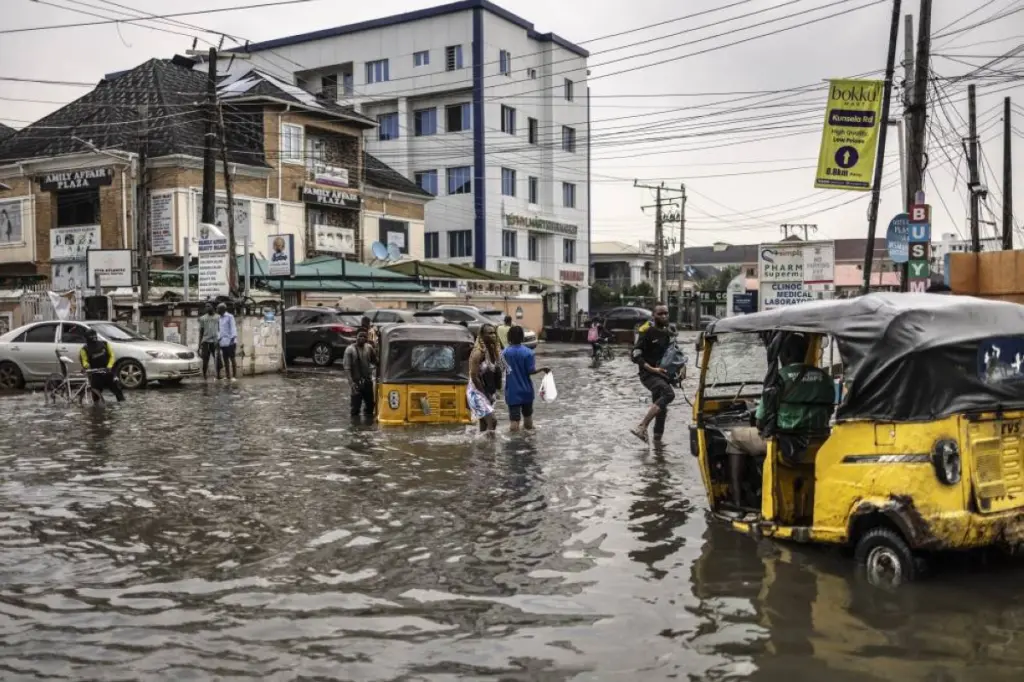
Parts of Lagos and Alexandria are sinking by several millimetres a year, adding to the flood risk that rising seas already pose to millions of people, according to a new study of Africa’s coastal cities.
The research, published in the journal Science Advances, used satellite radar to measure how the ground is moving in 20 coastal cities on the continent, the BBC reported. It found that Lagos is sinking at about 5 mm a year and Egypt’s Alexandria at about 6 mm.
What the study found
Across the 20 cities, an extreme sea-level event could expose more than seven million people, more than one million buildings and assets worth about $180 billion by 2050, the study estimates, according to Premium Times.
Lagos has the highest number of people at risk. The paper puts about 2.59 million Lagos residents in areas exposed to extreme coastal water levels in 2020, rising to 4.07 million by 2100, Premium Times reported.
The picture is not the same everywhere. Luanda in Angola has sunk significantly, while Durban in South Africa has stayed stable or even risen slightly, the BBC reported. Within Lagos, the study says central districts are relatively stable compared with the city’s eastern and western edges.
Why the ground is sinking
The study points to possible human causes, including pumping groundwater, building on reclaimed or loose ground in Lagos, and the Aswan Dam holding back the sediment that once built up the Nile Delta, according to the BBC.
Lead author Oluwaseyi Dasho told the BBC that the effects of sinking land “are often invisible in everyday life, but over decades they can substantially increase flood exposure”.
Senior author Manoochehr Shirzaei, a professor of geosciences at Virginia Tech in the United States, said local causes can be met with local policies. “Whatever we cannot mitigate, we try to adapt to it,” he told the BBC.
What the numbers do not mean
The researchers add some cautions, Premium Times reported. Their estimates do not take account of existing or planned sea defences, and they keep population and building numbers at 2020 levels. The projections do not mean that every area identified will be flooded by those dates.
Why it matters
Lagos is one of Africa’s most populous cities and already floods regularly in the rainy season. Dasho told the BBC he hopes the findings help African governments “prepare adequately for future challenges and more importantly for the future generations”.