
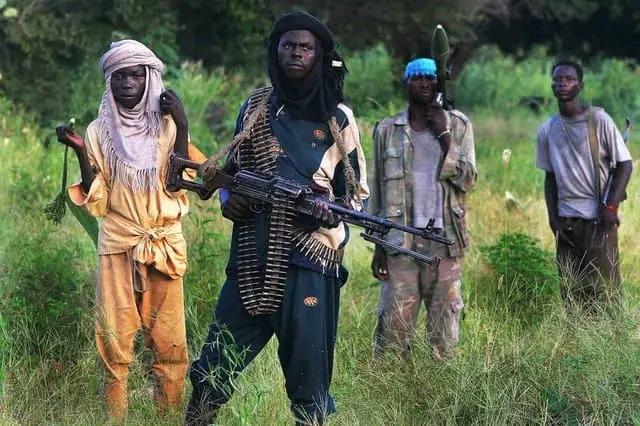
A surge of attacks across northern Nigeria has renewed attention on Lakurawa, a loosely defined jihadist network whose fighters have expanded their presence along the country’s borders with Niger and Benin and are increasingly linked to the Islamic State’s Sahel branch.
The group has emerged as one of the most serious new security threats facing Nigeria’s northwest, benefiting from porous borders, the deterioration of security cooperation between Nigeria and Niger following the 2023 coup in Niamey, and the wider southward expansion of armed groups from the Sahel.
The latest violence came in Niger State’s Borgu area, where gunmen attacked several communities and abducted worshippers from a mosque during Friday prayers.
Police said an unspecified number of people were taken after armed men raided Gidan-Zana and Kpenya villages and entered a mosque at Kpenya. Residents and local officials have estimated that dozens were kidnapped.
Some local reports have blamed fighters associated with Lakurawa and other jihadist factions, although Nigerian authorities have not conclusively identified the perpetrators and no group has publicly claimed responsibility.
The abductions followed another major assault earlier in August in Kebbe, Sokoto State, where more than 300 suspected Lakurawa fighters reportedly arrived on motorcycles and attacked a military position before moving against shops, vehicles and a hospital.
Four Nigerian soldiers were reported killed, although police said at the time that the casualty figure had not been independently confirmed.
Days later, at least 28 people were killed in another attack in Sokoto State attributed by residents to armed militants operating in the area.
From hired fighters to jihadist force
Lakurawa first became widely known in northwest Nigeria around 2017 and 2018, although some accounts trace elements of the network much further back.
Researchers say the name appears to derive from a Hausa adaptation of the French term les recrues, or “the recruits.”
Traditional leaders in parts of Sokoto State initially brought armed fighters from Mali and Niger into their communities to help defend residents against increasingly violent bandit groups operating from neighbouring Zamfara State.
The arrangement initially appeared successful. The fighters were better armed and more organised than many of the bandit groups threatening rural communities.
But the relationship soon deteriorated.
Lakurawa fighters began imposing taxes, policing religious behaviour and enforcing a harsh interpretation of Islamic law. They clashed with some of the same traditional authorities who had invited them into the area.
Research by the US Military Academy’s Combating Terrorism Center says the militants subsequently developed a more permanent presence in the Nigerian borderlands and became increasingly integrated into the wider jihadist ecosystem of the Sahel.
ISIS or al-Qaeda?
Exactly what Lakurawa represents remains disputed.
Rather than a single tightly structured organisation, researchers increasingly describe “Lakurawa” as a local label applied to several groups of Sahelian jihadists operating inside Nigeria.
The strongest evidence suggests that many Lakurawa fighters active in Sokoto and northern Kebbi are linked to the Islamic State Sahel Province, or ISSP, formerly known as Islamic State in the Greater Sahara.
But researchers have also identified links between fighters described locally as Lakurawa and Jama’at Nusrat al-Islam wal-Muslimin, or JNIM, al-Qaeda’s powerful Sahel affiliate.
The Hudson Institute has argued that the name may now function as a broad description for militants arriving from Mali, Niger and Burkina Faso rather than referring to a single unified organisation.
That distinction matters because attacks attributed locally to Lakurawa may in reality involve different organisations, including Islamic State-linked cells, al-Qaeda affiliates or other armed groups.
Expansion after the Niger coup
The July 2023 military coup in Niger created another opportunity for the militants.
Relations between Abuja and Niamey deteriorated sharply after Nigeria, then leading the West African bloc ECOWAS, imposed sanctions and threatened possible military intervention against Niger’s junta.
Cross-border security cooperation weakened, including joint patrols that had previously helped restrict militant movement along the frontier.
That deterioration coincided with a broader push by Islamic State and al-Qaeda-linked groups southward from Mali, Burkina Faso and Niger toward Nigeria, Benin and Togo.
Security researchers have documented growing Islamic State activity across southwestern Niger directly opposite Nigeria’s Sokoto and Kebbi states, providing militants with potential routes into Nigerian territory.
The Africa Center for Strategic Studies says groups identified as Lakurawa now account for a measurable share of militant Islamist violence in the region, although the precise organisational relationships between Lakurawa, Islamic State and JNIM remain fluid.
US enters the fight
Lakurawa attracted international attention on December 25, 2025, when the United States carried out missile strikes against Islamic State-linked militants in northwest Nigeria.
US Africa Command said the operation targeted ISIS militants and was conducted in coordination with the Nigerian government.
The strikes hit suspected militant camps in Sokoto State using Tomahawk missiles.
President Donald Trump described the targets as Islamic State fighters, while analysts said the militants were likely members of the Islamic State Sahel Province or fighters locally identified as Lakurawa.
Nigeria subsequently confirmed that it had approved and cooperated with the operation.
The intervention marked an escalation in Washington’s involvement in Nigeria’s widening jihadist conflict but did not eliminate the network.
Eight months later, suspected Lakurawa fighters are again mounting large-scale attacks.
A wider Sahel threat
The group’s rise reflects a broader transformation underway across West Africa.
Militant organisations that were once concentrated in northern Mali and the central Sahel are increasingly extending recruitment networks, supply routes and operational areas toward coastal West Africa and northern Nigeria.
Nigeria has battled Boko Haram and Islamic State West Africa Province in the northeast for more than 15 years. The emergence of Sahel-linked jihadist networks in the northwest threatens to create a second major insurgent theatre stretching across Sokoto, Kebbi, Niger State and the international borders beyond them.
For Abuja, the danger is therefore no longer simply the rise of another armed faction.
It is the possibility that Nigeria’s vast northwest could become integrated into the wider jihadist battlefield already destabilising much of the Sahel.