
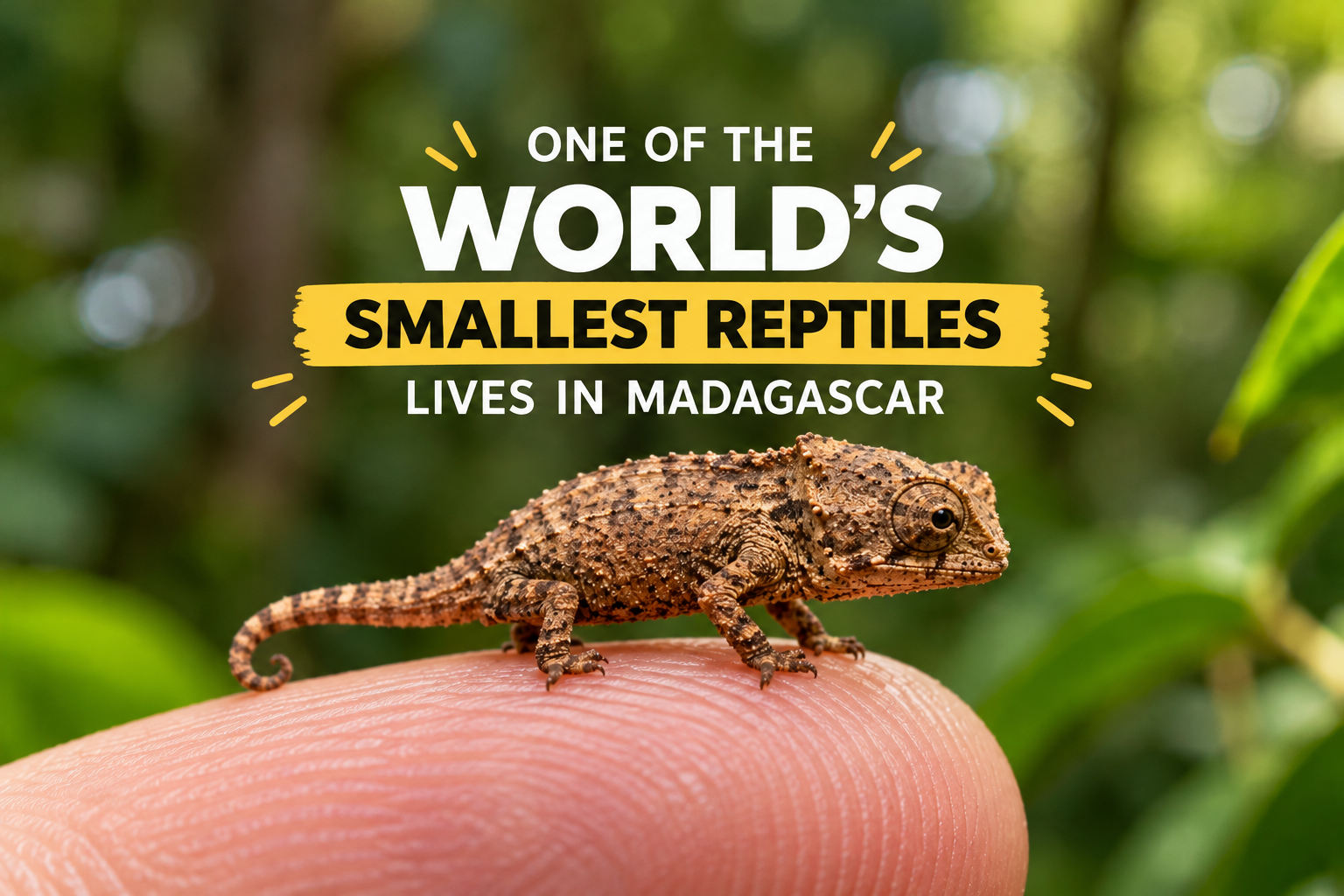
Madagascar’s smallest reptiles include some of the tiniest chameleons ever discovered, with certain species measuring less than three centimetres from nose to tail.
The island nation, located off Africa’s southeastern coast, is famous for its extraordinary wildlife. Many of its animals are found nowhere else on Earth.
Among its most remarkable creatures are miniature chameleons belonging to the genus Brookesia. Despite their tiny size, these reptiles have attracted international scientific attention.
Their discovery highlights Madagascar’s exceptional biodiversity and the importance of protecting its remaining forests.
Madagascar’s smallest reptiles include tiny chameleons
One of the most remarkable examples is Brookesia nana, a miniature chameleon formally described by scientists in 2021.
The species was discovered in the mountainous forests of northern Madagascar.
An adult male measured approximately 21.6 millimetres from its nose to the tip of its tail, making it one of the smallest known male reptiles.
Its body alone measured just 13.5 millimetres.
To put that into perspective, the entire animal is shorter than a typical human thumb.
The female specimen examined by researchers was larger, measuring approximately 28.9 millimetres in total length.
Scientists believe the species represents an extraordinary example of miniaturisation among vertebrates.
However, researchers have studied very few individuals, meaning much remains unknown about its population and behaviour.
Why are Madagascar’s chameleons so small?
Madagascar’s isolation has played an important role in the evolution of its wildlife.
The island separated from other landmasses millions of years ago, allowing many animal populations to evolve independently.
Over time, different environments helped produce an extraordinary variety of species.
Some chameleons evolved large bodies, while others developed extremely small sizes.
The exact evolutionary reasons behind the miniature size of Brookesia nana remain uncertain.
Scientists have explored whether limited habitats, environmental conditions and evolutionary pressures may contribute to miniaturisation.
However, there is no single confirmed explanation for why this particular species became so small.
Tiny reptiles living on the forest floor
Unlike many larger chameleons that spend much of their time in trees, several Brookesia species live close to the forest floor.
Their small bodies and brownish colouring help them blend into leaf litter and surrounding vegetation.
This camouflage can make them extremely difficult to detect.
Some miniature chameleons are more easily located at night when they rest on low vegetation.
Researchers studying these animals must examine forest habitats carefully because their size makes them easy to overlook.
Although chameleons are famous for changing colour, miniature Brookesia species generally have more subdued colouring than some of their larger relatives.
Their appearance reflects the environments in which they live.
Madagascar is a global biodiversity hotspot
Madagascar is one of the world’s most important regions for biodiversity.
Its long geographic isolation has contributed to high levels of endemism, meaning many species occur naturally only on the island.
The country is home to lemurs, unusual geckos, rare frogs and numerous species of chameleons.
Its forests also support plants and insects that have evolved distinctive characteristics.
Scientists continue to describe previously unknown species from Madagascar, demonstrating how much remains to be learned about its ecosystems.
However, the discovery of new species does not necessarily mean they are abundant.
Some may occupy extremely small areas, making them particularly vulnerable to environmental changes.
Forest loss threatens Madagascar’s rare reptiles
Habitat destruction remains a major concern for Madagascar’s wildlife.
Deforestation, agricultural expansion and other land-use changes have reduced natural habitats in several parts of the island.
For reptiles that depend on specific forest environments, losing even a relatively small area can have serious consequences.
Scientists have raised concerns about the conservation of Brookesia nana because of its apparently restricted distribution.
Protecting forest habitats is therefore essential for preserving these unusual reptiles and the wider ecosystems they inhabit.
Conservation efforts can also support local communities by promoting sustainable management of natural resources.
Why Madagascar’s tiny reptiles matter
The discovery of miniature reptiles offers scientists valuable opportunities to study evolution, anatomy and biodiversity.
Understanding how animals function at extremely small sizes may help researchers explore the biological limits of vertebrate development.
These discoveries also demonstrate why continued scientific research is important.
Some species may remain unknown until researchers examine remote or poorly studied habitats.
Madagascar’s miniature chameleons provide a striking example of the natural diversity found across Africa and its islands.
Although they are small enough to fit on a fingertip, their scientific importance is considerable.
Their survival also depends on protecting the forests that make Madagascar one of the world’s most distinctive wildlife destinations.