
Islamist militants have imposed a tightening blockade on Mali’s capital Bamako, stranding civilians and disrupting key supply routes days after the assassination of the country’s defence minister.
Residents and travelers described mounting fear and uncertainty as fighters linked to Jama’at Nusrat al-Islam wal-Muslimin (JNIM) restricted access to the city, warning that no one would be allowed to enter.
“Our army isn’t capable of protecting us—how are we going to get back home?” one stranded mother told the BBC after being blocked from returning to the capital.
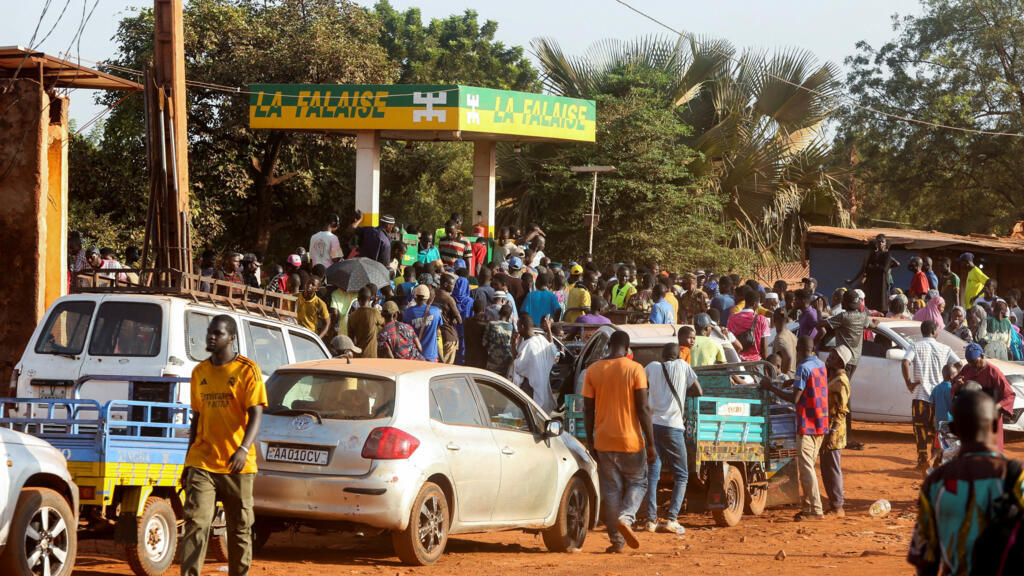
Key highways into Bamako, including the Bamako–Kéniéba route, have been intermittently shut down, leaving families, traders and transport workers stuck for hours or even days. Eyewitnesses say at least three of the city’s six main access roads are periodically closed, with militants moving between checkpoints.
The blockade follows a wave of coordinated attacks last weekend by jihadist groups and Tuareg-led separatists under the Azawad Liberation Front (FLA), who are seeking to topple the military government of Assimi Goïta.
The offensive has already reshaped the battlefield in northern Mali. Fighters forced Russian-backed forces to withdraw from the strategic city of Kidal, now under FLA control. The rebels have since vowed to expand their campaign and called for the full withdrawal of Russian paramilitary forces.
Mali’s army has relied heavily on Russian support, including fighters from the Africa Corps, a successor to the Wagner Group. Moscow signaled it would maintain its presence, with a Kremlin spokesperson pledging continued assistance to combat “extremism and terrorism.”
On the ground, the humanitarian toll is rising. In the town of Ségou, less than 80 kilometers from Bamako, a full blockade has left hundreds of vehicles stranded. Passengers, including families and traders, have been trapped for days with limited access to food and water.
“I’ve never seen something like this,” one lorry driver said. “I’d rather abandon my cargo and save my life.”
Despite the escalating crisis, Goïta has vowed a strong response, claiming that Malian forces have inflicted “heavy losses” on insurgents following an emergency security meeting.
But analysts warn the developments highlight the government’s weakening grip. Alain Antil of the French think tank Ifri said the scale of the attacks underscores the regime’s inability to secure the country.
The situation has prompted multiple foreign governments, including France, Canada and the United Kingdom, to urge their citizens to leave Mali, while the United States has advised those remaining to stay indoors.
Mali has faced a persistent insurgency for over a decade. A similar alliance of jihadists and separatists threatened Bamako in 2013 before being pushed back by a French-led intervention. However, instability has continued, and the latest offensive marks one of the most significant challenges yet to the current military leadership.