
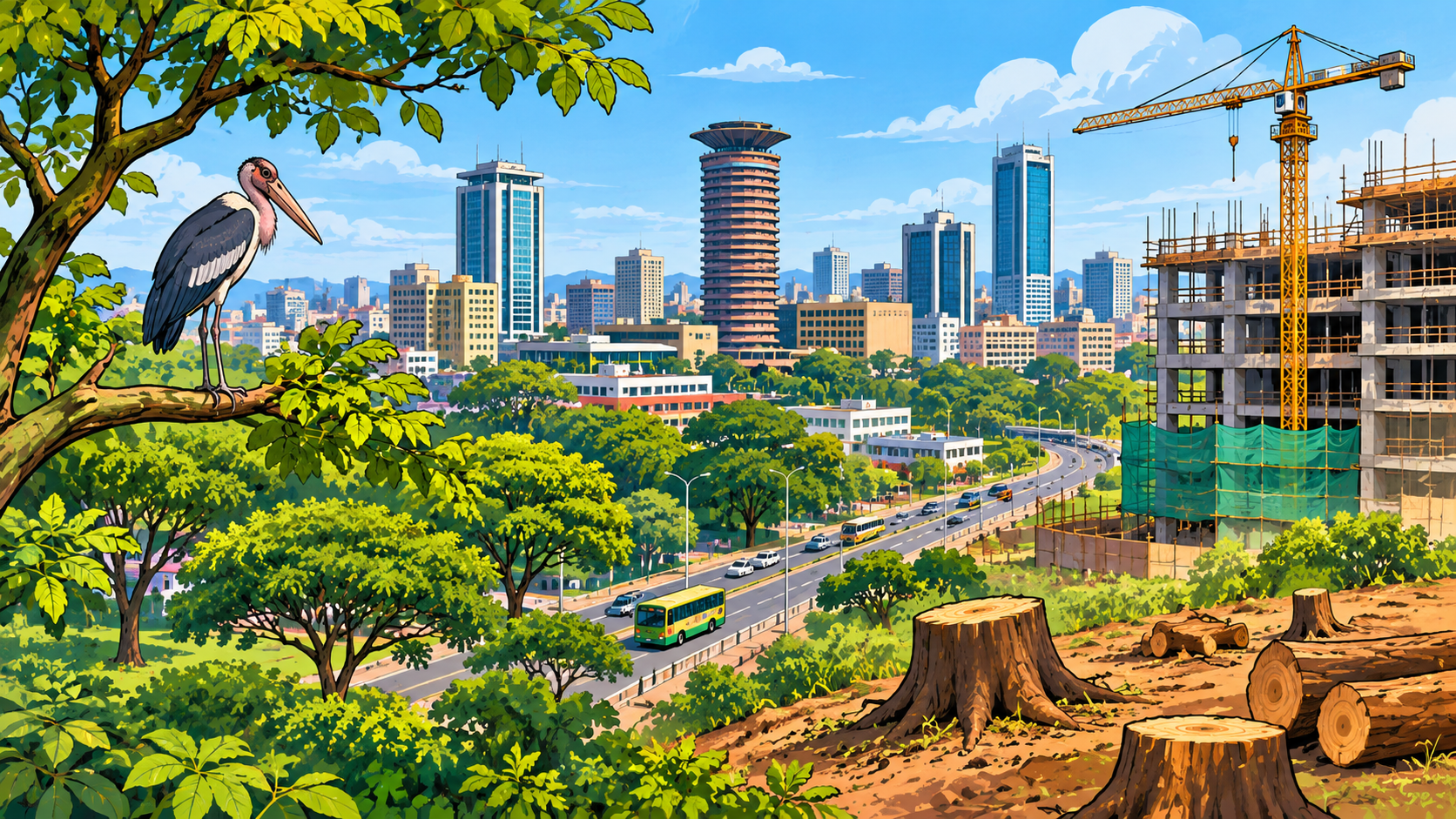
Nairobi’s green spaces are disappearing as rapid construction transforms Kenya’s capital, raising concerns about wildlife and environmental protection.
Trees are being cleared for roads, housing and commercial developments. Meanwhile, environmental advocates warn that the city risks losing its historic green identity.
According to Africanews and the Associated Press (AP), Nairobi’s construction boom has intensified as the population continues to grow.
Nairobi’s construction sector expands rapidly
Kenya’s construction sector grew by 6.8% in 2025, according to government Treasury data.
That represents a sharp increase from the 0.7% growth recorded in 2024.
Meanwhile, Nairobi recorded 25,090 completed private buildings in 2025.
The expansion reflects growing demand for housing, transport infrastructure and commercial space.
However, limited available land has increased pressure on existing green areas.
Nickson Otieno, an architect and sustainability practitioner at Niko Green, says developers must consider environmental protection before starting construction.
He argues that protected conservation areas should remain untouched. In other locations, developers should assess which trees and natural habitats can be preserved.
Urban development changes wildlife habitats
Nairobi’s construction boom is also affecting wildlife.
The marabou stork, a familiar bird in the Kenyan capital, traditionally uses trees for nesting and resting.
However, some birds now occupy billboards and buildings as urban development changes their surroundings.
Ornithologist John Musina says bird populations can help researchers assess the environmental health of cities.
According to Musina, changes in bird numbers and behaviour may reveal wider changes in urban ecosystems.
Therefore, protecting trees is not simply about maintaining Nairobi’s appearance. Green spaces also provide essential habitats for wildlife.
Court halts Nairobi National Park project
Environmental concerns have also prompted legal challenges against development projects.
On October 27, 2026, Nairobi’s Environment and Land Court issued conservatory orders stopping construction of a proposed car park at Nairobi National Park.
The decision followed a lawsuit brought by 4,642 activists opposing the project.
The court intervention highlighted growing public concern about construction near environmentally sensitive areas.
Nevertheless, numerous other developments continue across Nairobi.
Africanews and AP reported that trees are still being removed at several public and private construction sites.
Can Nairobi preserve its green identity?
Nairobi has long been known as the “Green City in the Sun.”
However, environmental advocates fear that rapid development is weakening that reputation.
Environmental law advocate Kelvin Kubai says the city’s green character has deteriorated over the past decade.
He argues that some developers treat trees as obstacles rather than valuable parts of the urban environment.
The debate now centres on balancing economic growth with environmental protection.
As Nairobi expands, urban planners face increasing pressure to provide housing and infrastructure without destroying important natural spaces.
For environmental advocates, preserving existing trees and wildlife habitats is essential to protecting the city’s future.
Nairobi’s challenge is to accommodate a growing population while maintaining the green spaces that have helped define Kenya’s capital for generations.