
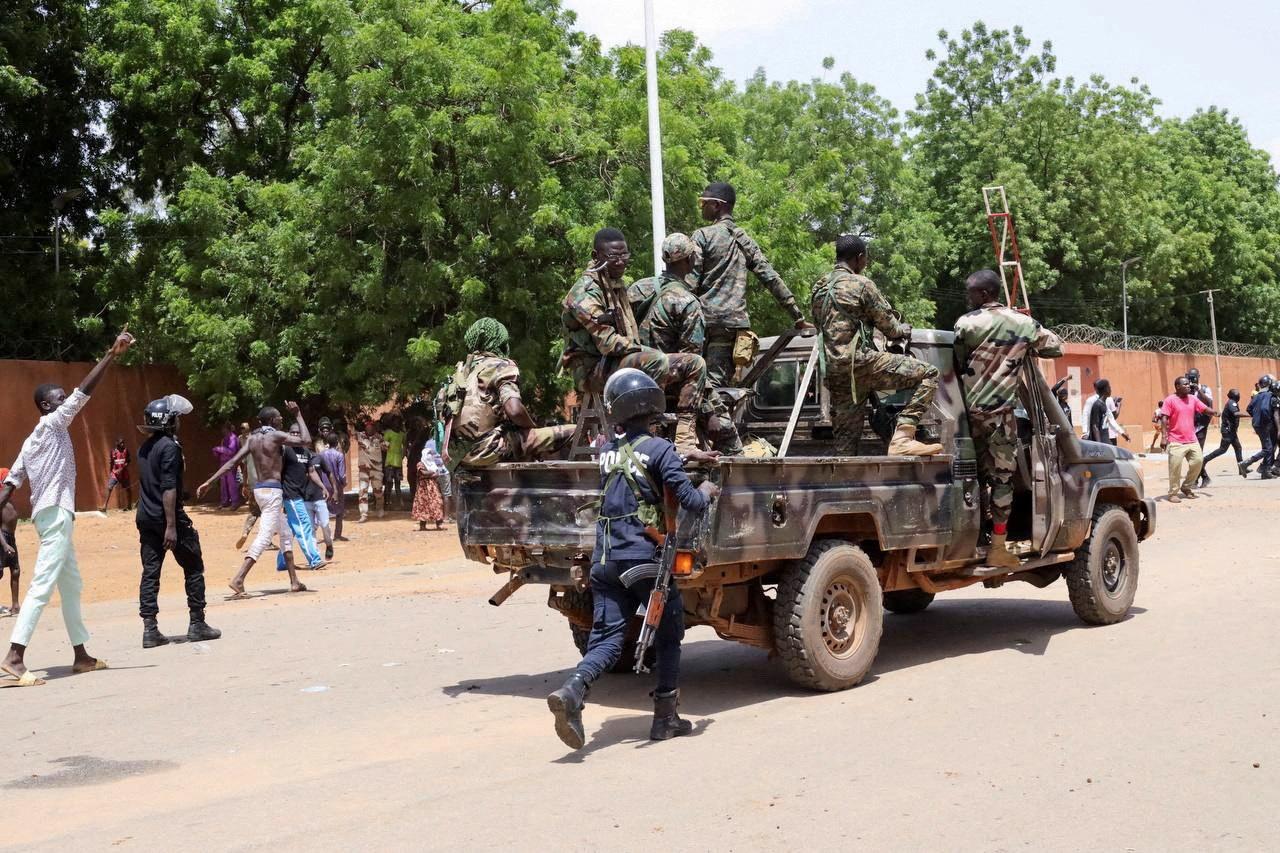
Rival military factions remained locked in a tense standoff in Niger’s capital late Saturday after mutinous soldiers attacked the airport and presidential complex, triggering hours of gunfire and explosions across Niamey.
The overnight assault briefly forced state television and radio off air and posed the latest challenge to military leader Abdourahamane Tiani, who seized power in a July 2023 coup.
Niger’s Defence Ministry said loyalist forces were gradually recapturing positions seized during the attack. However, security sources said mutineers remained at the airport during the afternoon, leaving the overall situation unclear by Saturday night.
After returning to air, state television reported that soldiers from a Niamey military base had opened fire on “sensitive sites” in the capital. It said security forces responded quickly and had contained the disturbance.
Tiani made no public appearance during the day.
A Reuters witness reported sustained gunfire around the airport and adjoining military airbase, where Russian and Italian personnel are stationed, as well as heavy explosions before dawn.
By 09:00 GMT, loyalist troops appeared to have secured the presidential palace, according to two security sources and a diplomat. The airport area, however, remained contested.
The Defence Ministry said the mutineers had attempted to detain fellow soldiers at the military airbase but provided no further details. Two sources said loyalist units had been ordered to retake the airport, either through negotiations or by force.
The Alliance of Sahel States, comprising Niger, Mali and Burkina Faso, expressed support for Niger’s military authorities and claimed the mutiny had been defeated. It remained unclear whether Mali or Burkina Faso provided direct assistance.
Frontline troops reportedly join uprising
The operation reportedly included soldiers arriving from Ouallam, Tera and Dosso in southwestern Niger, according to a Nigerien security source and Yvan Guichaoua, a senior researcher at the Bonn International Centre for Conflict Studies.
Units deployed in these areas have suffered heavy casualties in fighting against militants affiliated with Islamic State. Analysts and security officials say frustration has been growing among frontline troops over the government’s handling of the insurgency.
Around 18 soldiers were killed in an attack on a military position in the southern Dosso region a week before the mutiny, according to Heni Nsaibia, a senior West Africa analyst at the Armed Conflict Location & Event Data project.
Nsaibia warned that repeated attacks causing heavy military losses could deepen resentment and instability within the armed forces.
“The jihadist groups will be the only winners in this situation,” he said, warning that the government may now have to divert resources from counterinsurgency operations to confront internal threats.
It was not immediately clear how many soldiers had joined the mutiny, how many had entered Niamey or where they were positioned.
Security promises under pressure
Niger has been governed by military officers since the 2023 overthrow of elected president Mohamed Bazoum. Tiani justified the takeover partly by promising to improve security, but attacks by groups linked to al-Qaeda and Islamic State have continued.
Militants targeted Niamey’s airport and military airbase earlier in the year, prompting some observers initially to suspect an insurgent assault when Saturday’s fighting began.
Niger, Mali and Burkina Faso have all struggled to contain militant violence despite expelling or distancing themselves from traditional Western security partners and building closer ties with Russia.
The three military-led governments have also withdrawn from the Economic Community of West African States and formed the separate Alliance of Sahel States.
Saturday’s turmoil comes as Niger’s authorities expand state control over the country’s strategically important uranium industry.
The government recently reassigned uranium permits previously held by French nuclear company Orano and Canadian miner GoviEx to state-backed companies. Niger, which also possesses oil and gold reserves, had supplied around 15% of Orano’s uranium when production was operating at full capacity.