
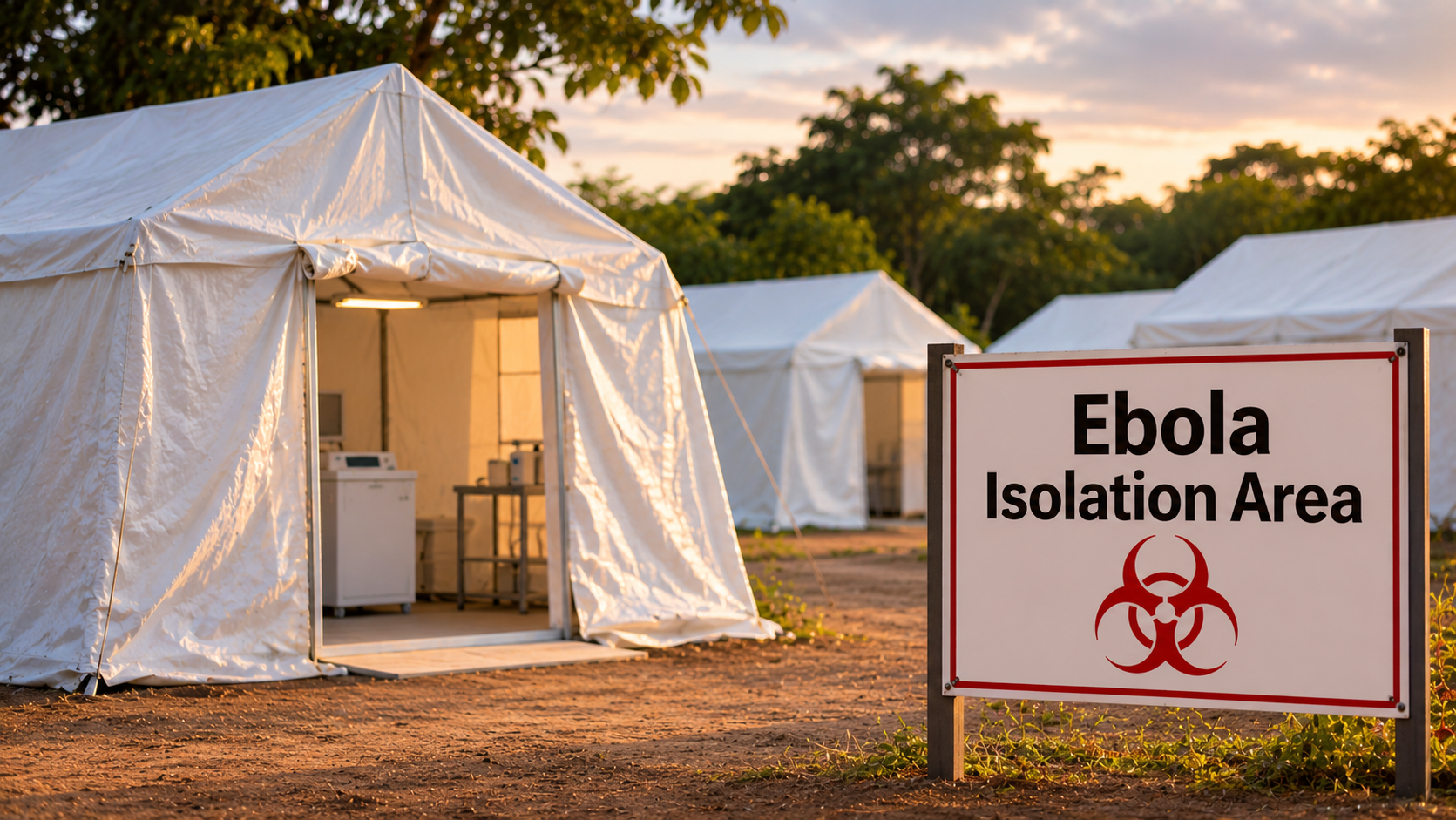
Nigeria is investigating two suspected Ebola cases in its northeastern region as health authorities step up efforts to prevent the virus from spreading.
The Nigeria Centre for Disease Control and Prevention (NCDC) announced on Saturday, October 31, that both individuals had been isolated.
Officials have also begun laboratory testing and contact tracing to determine whether the patients are infected.
According to Al Jazeera, citing Anadolu, the suspected cases come after Nigeria reported an imported Ebola infection earlier in October.
However, authorities stressed that neither of the two new suspected cases has been confirmed.
Nigeria investigates suspected Ebola cases
The NCDC said health officials were taking precautionary measures while awaiting laboratory results.
Both individuals have been isolated to reduce the risk of possible transmission.
Meanwhile, authorities are identifying people who may have come into contact with them.
The agency emphasised that suspected infections should not be confused with confirmed cases.
A final diagnosis will depend on laboratory testing.
Health officials have not disclosed the patients’ identities or provided details about their recent travel histories.
It also remains unclear whether the two suspected infections are connected to Nigeria’s earlier imported case.
Nigeria reported imported Ebola case in October
Nigeria reported its first Ebola case in more than a decade on October 20.
According to the report, a Swiss woman who travelled to Nigeria from Uganda tested positive for the virus.
She and her husband, a Swiss diplomat, were subsequently evacuated to Switzerland.
The case involved the Bundibugyo strain of Ebola, which has been linked to the ongoing outbreak in the Democratic Republic of the Congo.
Nigeria became the fifth country to report an infection associated with the outbreak.
Other countries reporting cases since May include Uganda, France and Kenya.
However, an imported infection does not necessarily mean that sustained transmission is occurring within the country.
Ebola outbreak in DR Congo raises regional concerns
The latest developments come as the Democratic Republic of the Congo faces a major Ebola outbreak.
The outbreak began in May 2026 and has spread across eight of the country’s 26 provinces.
According to figures reported by Al Jazeera, more than 10,300 confirmed infections have been recorded.
The death toll has also exceeded 5,000.
These figures make the outbreak the largest reported in DR Congo’s history.
The outbreak involves the Bundibugyo strain of Ebola.
Unlike some other Ebola virus variants, this strain currently has no approved vaccine or specific treatment, according to the report.
However, vaccine trials are underway.
Health authorities are working to improve detection, treatment and infection prevention as the outbreak continues.
Africa CDC calls for stronger protection
The Africa Centres for Disease Control and Prevention has called for additional measures to protect healthcare workers.
The appeal followed the deaths of two young Congolese doctors who contracted Ebola.
The doctors died in DR Congo’s North Kivu and Ituri provinces earlier in the week.
Their deaths have highlighted the dangers facing frontline medical personnel.
Healthcare workers are particularly vulnerable when treating infected patients without adequate protection or when cases go undetected.
Africa CDC has therefore emphasised the need for stronger infection prevention and control measures.
These include improved protective equipment, surveillance and early identification of suspected cases.
Contact tracing remains a major challenge
Health authorities say weak contact tracing and delayed detection are complicating efforts to contain the outbreak.
In DR Congo, only about 12% of confirmed cases have been identified among previously known contacts, according to the reported figures.
This suggests that many infections are being detected outside established monitoring networks.
Consequently, health teams may struggle to identify potential transmission chains before further infections occur.
Authorities have also reported deaths within communities rather than healthcare facilities.
Such cases can create additional challenges for outbreak monitoring and safe medical response.
Improving surveillance remains a central priority for regional health agencies.
What happens next in Nigeria?
Nigeria’s immediate priority is to determine whether the two suspected cases are positive for Ebola.
Laboratory results will help health officials decide whether additional containment measures are necessary.
Meanwhile, contact tracing is underway as a precaution.
The country has previous experience responding to Ebola, having contained an outbreak in 2014.
However, the ongoing regional outbreak presents renewed challenges for public health authorities.
For now, the two newly identified patients remain suspected cases.
Officials have urged caution while investigations continue, stressing that confirmation depends on laboratory evidence.