
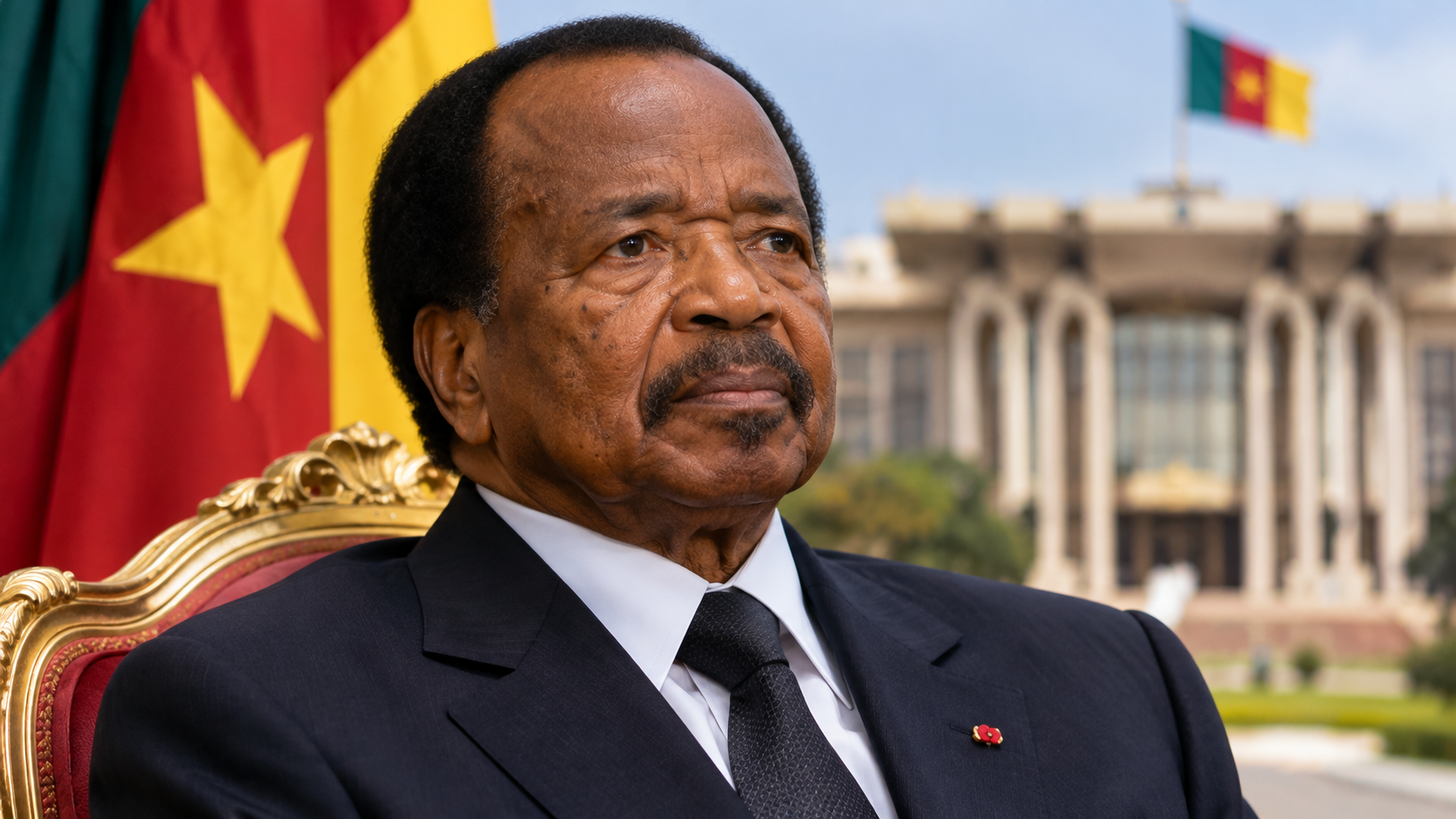
Cameroon’s President Paul Biya has faced renewed questions about who exercises political power during his prolonged absences from the country.
At 93, Biya has governed Cameroon since 1982. However, his extended periods abroad have intensified concerns about decision-making, government accountability and presidential succession.
According to an Al Jazeera investigation published on November 12, uncertainty surrounding the president’s inner circle has raised questions about how Cameroon is governed when Biya is away.
Meanwhile, a recent constitutional amendment has introduced a new succession arrangement, adding another dimension to the debate.
Paul Biya’s prolonged absences raise questions
Biya returned to Cameroon’s capital, Yaounde, on August 20 after spending more than 10 weeks abroad.
His trip began on June 7 and included an extended stay in Europe.
However, his return did not resolve questions about how government decisions were managed during his absence.
Research by the Organised Crime and Corruption Reporting Project (OCCRP) previously found that Biya had spent at least four and a half years abroad on private visits over more than three decades.
The findings raised questions about the concentration of executive authority around the presidency.
In March, a dispute between Housing Minister Celestine Ketcha Courtes and Yaounde Mayor Luc Messi Atangana over roadworks ahead of a papal visit also highlighted tensions between government institutions.
Who exercises power when Biya is absent?
Cameroon’s constitution gives the president extensive executive authority.
Biya determines national policy, appoints senior government officials and serves as commander-in-chief of the armed forces.
The prime minister manages government activities within the president’s policy framework.
However, presidential powers do not automatically transfer to the prime minister when Biya travels abroad.
Under Section 10 of the constitution, the president may delegate certain responsibilities to government officials.
A temporary inability to perform presidential duties requires an express delegation of functions.
According to Al Jazeera, the government has not publicly provided a detailed explanation of whether such arrangements operate during Biya’s extended absences.
Ferdinand Ngoh Ngoh’s role attracts attention
One of the most influential figures within the presidency is Ferdinand Ngoh Ngoh, its secretary-general.
His official responsibilities include coordinating presidential administration and monitoring the implementation of the president’s decisions.
In February 2019, Biya granted Ngoh Ngoh a permanent delegation of signature.
This allows him to sign certain official documents on the president’s behalf.
However, the arrangement does not transfer presidential powers or make him Biya’s constitutional successor.
Meanwhile, analysts have also examined the possible influence of First Lady Chantal Biya and the president’s son, Franck Biya.
Neither holds a constitutional executive office.
Claims about their political influence remain difficult to verify independently.
Cameroon changes presidential succession rules
Questions about Biya’s succession have become more pressing following a constitutional amendment approved on April 14, 2026.
The amendment reintroduced the position of vice president.
Under the revised constitution, the president has the authority to appoint and dismiss the vice president.
If the presidency becomes vacant through death, resignation or legally established permanent incapacity, the vice president would complete the remaining presidential term.
However, if no vice president has been appointed, the constitution provides for an interim presidency under the Senate president.
A presidential election would then take place within 20 to 120 days.
As of November 10, no vice-presidential appointment had been publicly announced.
Therefore, the new succession arrangement has yet to be tested.
Military reshuffles add to political uncertainty
Military appointments made during Biya’s absence have also attracted attention.
According to Reuters, three presidential decrees issued in August reshuffled Cameroon’s senior military leadership.
The changes included replacing commanders in four of the country’s five joint military regions.
They also included senior appointments involving the Presidential Guard and Rapid Intervention Brigade.
Robert Besseling, chief executive of intelligence advisory firm Pangea-Risk, has interpreted the reshuffles partly through concerns about loyalty and presidential security.
However, the decrees did not publicly explain the political reasons behind the appointments.
Consequently, their wider significance remains open to interpretation.
Government defends Biya’s authority
Cameroon’s government has defended the president’s constitutional powers.
In August, government spokesman Rene Emmanuel Sadi told French broadcaster RFI that Biya had the authority to decide when to form a new government.
Meanwhile, opposition figures have criticised the concentration of presidential power.
Social Democratic Front leader Joshua Osih opposed the constitutional amendment, arguing that it weakened democratic legitimacy.
However, some analysts maintain that government institutions continue to function despite the president’s absences.
Yaounde-based political analyst Paul Anchang has argued that state institutions remain operational.
Cameroon faces wider security challenges
The uncertainty comes as Cameroon continues to confront several security challenges.
A separatist conflict remains active in the country’s English-speaking regions.
Meanwhile, armed groups linked to Boko Haram continue to threaten communities in the Far North.
These challenges place additional pressure on the government to maintain effective coordination and decision-making.
Although state institutions continue operating, questions remain about political authority and accountability.
For now, Biya remains Cameroon’s president, and no formal transfer of executive power has been announced.
However, his prolonged absences and the absence of an appointed vice president continue to raise questions about the country’s political future.