
When people think about Africa’s coastlines, countries like South Africa, Egypt and Morocco often come to mind.
But here’s something that might surprise you.
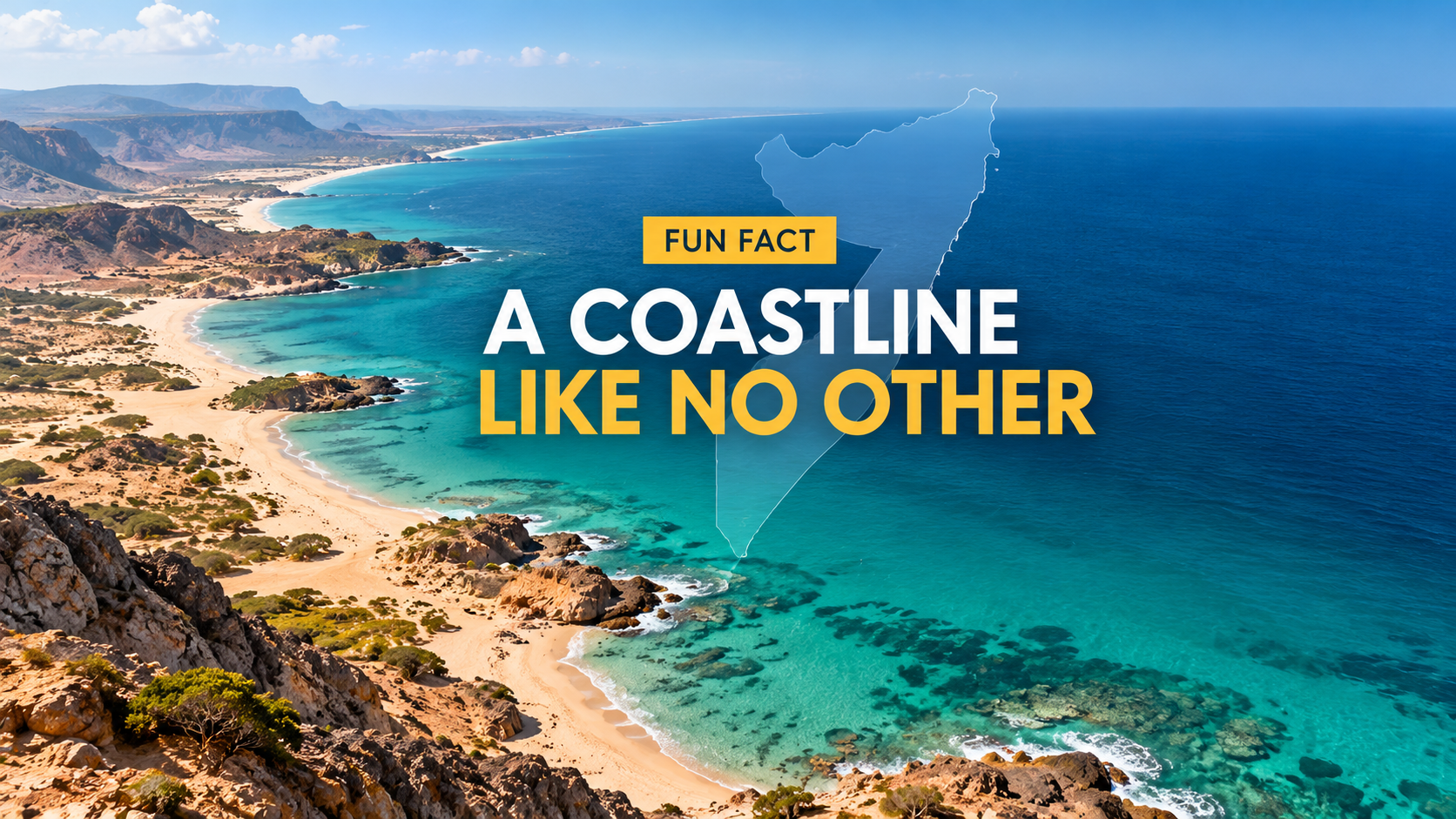
Somalia has the longest coastline of any country on mainland Africa.
Stretching approximately 3,333 kilometres, Somalia’s coastline runs along the Gulf of Aden and the Indian Ocean.
And there’s much more to this remarkable stretch of coastline than beautiful beaches.
Somalia’s coastline stretches over 3,300 kilometres
Located in the Horn of Africa, Somalia occupies one of the continent’s most distinctive geographical positions.
Its northern coastline faces the Gulf of Aden, while its eastern and southern shores meet the Indian Ocean.
This gives Somalia access to maritime routes connecting Africa, the Middle East and Asia.
Its coastline is longer than those of other mainland African countries, including South Africa, Mozambique and Morocco.
However, Somalia does not have the longest coastline among all African countries.
That distinction belongs to Madagascar, the large island nation off Africa’s southeastern coast.
Somalia’s ancient connection to the sea
Somalia’s relationship with the ocean stretches back centuries.
Long before modern shipping routes, Somali coastal towns served as important trading centres.
Merchants exchanged goods with communities across the Arabian Peninsula, Persia, India and other parts of the Indian Ocean region.
Historic port cities such as Mogadishu, Berbera and Zeila played important roles in these commercial networks.
Trade helped connect the Somali coast with different cultures, languages and markets.
These maritime connections remain an important part of Somalia’s history.
A coastline rich in natural resources
Somalia’s extensive coastline offers considerable potential for fishing and maritime trade.
The waters off its shores support a variety of marine species, including tuna and other commercially valuable fish.
Fishing provides livelihoods for coastal communities and contributes to local food supplies.
The country’s geographical position also creates opportunities for ports, shipping and related industries.
However, developing these opportunities requires investment in infrastructure, sustainable fisheries management and maritime security.
Why Somalia’s geography matters
Somalia sits close to the Gulf of Aden, which connects to the Red Sea through the Bab el-Mandeb Strait.
This region forms part of an important international shipping corridor linking the Indian Ocean with the Suez Canal and Mediterranean Sea.
Its location gives Somalia strategic importance in regional and international maritime affairs.
Yet geographical advantages alone do not guarantee economic development.
Infrastructure, stability, investment and effective resource management all influence how countries benefit from their coastal resources.
More than just a geographical record
Somalia’s coastline is more than an impressive statistic.
It reflects centuries of maritime history, rich marine ecosystems and opportunities for future economic development.
From historic trading ports to fishing communities along the Indian Ocean, the sea has helped shape Somali life for generations.
Fun fact: Somalia has the longest coastline on mainland Africa, stretching approximately 3,333 kilometres.
Sometimes, the most remarkable things about a country are found on the map.