
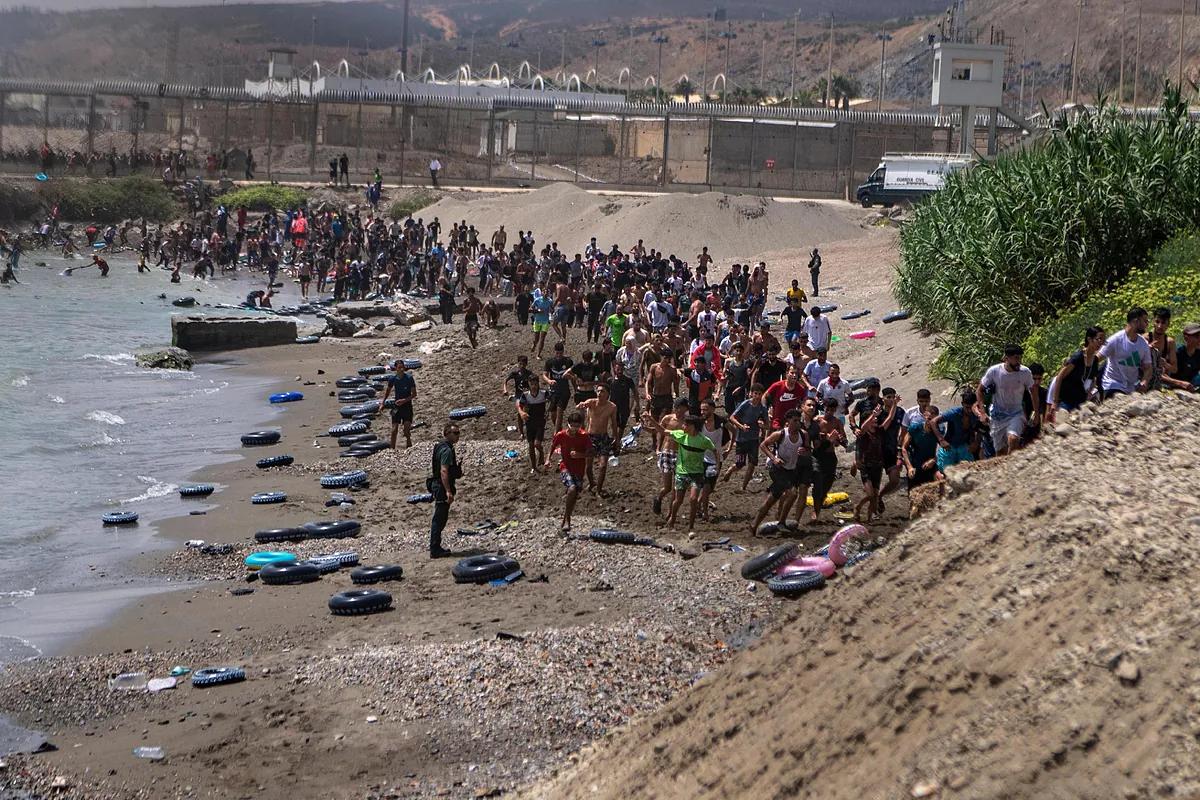
Spanish authorities were repeatedly warned that migrant arrivals to Ceuta were rising in the weeks before more than 70,000 people surged into the North African enclave, but failed to take sufficient action, according to border workers’ unions.
The July 29-30 rush left at least 94 people dead, mostly from drowning, according to figures from Spanish and Moroccan authorities. Rights groups believe the toll could be higher, with others still missing.
The influx followed a June 29 Spanish court ruling that limited when migrants could be immediately returned after entering Ceuta. The decision said summary returns could apply to people crossing a physical border barrier, but not to those reaching the enclave by swimming.
Videos showing migrants successfully reaching Ceuta by sea quickly spread on social media, contributing to a sharp rise in attempted crossings.
Spain’s government has blamed criminal networks for spreading misleading claims about the ruling and helping trigger the mass movement.
However, documents and interviews reviewed by Reuters indicate unions representing police and border personnel had been warning officials for weeks that the situation was becoming increasingly volatile.
Unions warned of an ‘explosive cocktail’
Rachid Sbihi, a spokesperson for the AUGC Civil Guard union in Ceuta, said border workers could not have predicted the extraordinary scale of the eventual rush, but had expected pressure to increase.
He said the combination of the court ruling, smuggling networks and social media created what he described as an “explosive cocktail.”
Reuters reviewed six statements and letters sent by Spanish border unions to national government representatives and police officials in Ceuta following the ruling.
In a July 10 statement, AUGC warned that the decision had created a legal gap that required clear operational procedures.
The union said officers working nightly at the border needed explicit instructions while Spain considered installing a physical barrier at sea.
Three days later, the SUP police union warned that smuggling networks closely monitored changes to immigration law and adjusted their routes whenever deportation procedures became slower or more complicated.
It called for additional personnel and a clearer migration policy.
In another letter dated July 23, SUP warned of persistent sea arrivals that were putting pressure on police infrastructure and requested a temporary migrant reception facility.
Union representatives said the Interior Ministry did not respond and that Ceuta’s government delegate offered a meeting only weeks later.
The Spanish government’s representative in Ceuta rejected suggestions that the earlier rise in migrant arrivals was directly connected to the mass crossing.
Officials said the delegate remained in regular communication with police and Civil Guard units even if requested meetings could not take place.
Spain defends response
Spain’s Interior Ministry said authorities examined several options following the court ruling before deciding to deploy a floating sea barrier on August 1.
The ministry said preparatory work allowed the barrier to be installed within 48 hours of the decision being taken after the July 30 surge.
Police unions said they received no significant new operational instructions before the mass crossing.
Morocco also accused of acting too late
Morocco, which receives European Union funding to help manage migration routes, also faced criticism over its response.
Rabat received €152 million from the EU in 2023 for migration-related cooperation and says it spends roughly €500 million annually securing its northern borders.
Although Spanish and Moroccan border personnel reported increased crossing attempts from mid-July, stricter Moroccan measures, including checks at bus and railway stations, were introduced only shortly before the mass influx.
Significant Moroccan security reinforcements arrived only after migrant numbers reached the tens of thousands on July 29, according to media reports, NGO accounts and Reuters observations.
Riccardo Fabiani, North Africa project director at the International Crisis Group, described the lack of earlier action as a policy failure.
A senior Moroccan official said Rabat had asked Spain after the June court decision whether the ruling would create problems but did not disclose Madrid’s response.
The official argued that dealing with the legal consequences of the ruling was Spain’s responsibility and said deploying more security forces beforehand would not have overcome the powerful incentive encouraging migrants to attempt the crossing.
Questions over Europe’s border policy
The disaster has renewed scrutiny of Europe’s strategy of relying heavily on neighbouring North African countries to curb irregular migration.
Spain and Morocco have nevertheless praised their bilateral cooperation, while the European Commission has said additional financial support could be provided to strengthen border controls.
Both countries are investigating the circumstances surrounding the July events.
Moroccan officials have also called on European governments to do more to discourage irregular migration.
Spain has pursued a comparatively more welcoming migration policy than several European neighbours, including measures allowing some undocumented migrants to regularise their status and join the workforce.
Moroccan Justice Minister Abdellatif Ouahbi questioned that approach this week, arguing that European states should reconsider policies that encourage migrants to risk dangerous sea crossings while simultaneously asking Morocco to stop them.
The Ceuta tragedy has left Spain and Morocco facing growing questions over whether warnings were missed — and whether more decisive action in the weeks before the rush could have prevented one of the deadliest border crises the enclave has experienced.