
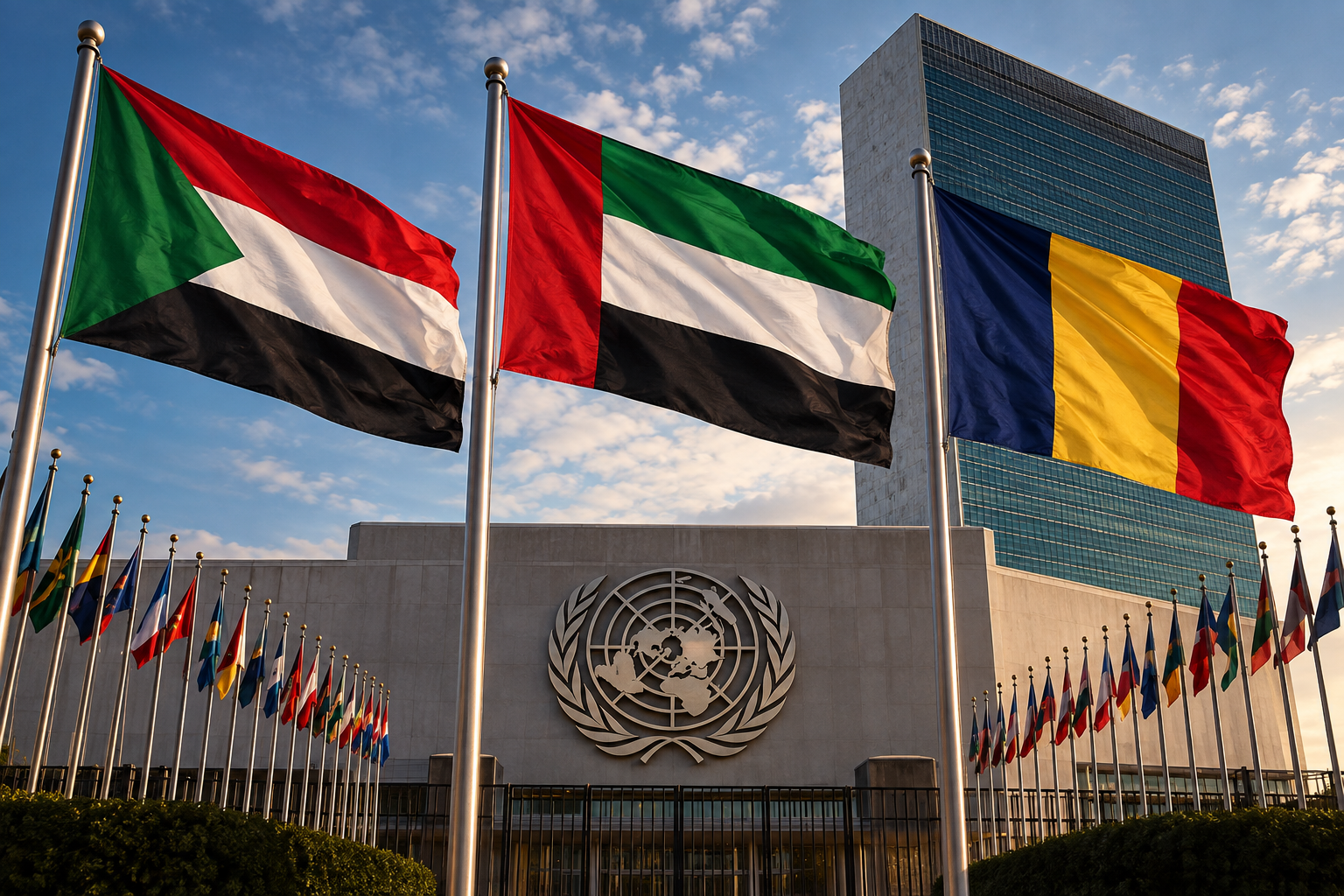
Sudan, the United Arab Emirates and Chad traded accusations at the United Nations as disputes over chemical weapons, foreign military support and responsibility for Sudan’s war spilled into the General Assembly.
The confrontation on Monday exposed deep divisions over the conflict. The UAE challenged the conduct of Sudan’s army-aligned authorities and called for accountability over alleged violations against civilians.
Sudan’s UN ambassador, Al-Harith Idriss, rejected the accusations. He instead renewed allegations that the UAE has provided support to the Rapid Support Forces (RSF).
Chad separately rejected accusations that it has facilitated military activities linked to the RSF.
UAE raises chemical weapons allegations
The UAE representative accused Sudan’s regular armed forces of using internationally prohibited chemical weapons.
The diplomat argued that both warring parties should face scrutiny over alleged violations against civilians. Abu Dhabi also accused the army-aligned authorities of rejecting proposed humanitarian truces.
Sudan has repeatedly denied using chemical weapons.
The allegations have nevertheless attracted international scrutiny.
The United States determined in 2025 that Sudan’s government had used chemical weapons during the conflict and subsequently imposed sanctions.
Further US measures followed in 2026 after Washington said Sudan had failed to meet conditions under American chemical weapons legislation.
Separate investigations have also examined leaked documents, videos and communications concerning an alleged chemical weapons programme linked to Sudan’s military.
Those materials have raised questions about the possible production and deployment of chlorine-based munitions. Sudan’s military has rejected the allegations.
The claims have not been conclusively established by an independent international chemical weapons investigation.
Sudan challenges evidence behind allegations
Idriss rejected the UAE’s accusations and questioned the technical evidence supporting them.
He challenged the Emirati representative to provide forensic evidence, including environmental samples, laboratory findings and medical examinations of alleged victims.
The Sudanese envoy also objected to Abu Dhabi referring to the army-aligned administration as the “Port Sudan authorities”.
Idriss then accused the UAE of supplying weapons, logistical assistance and foreign fighters to the RSF.
He further alleged that Emirati-linked entities had helped train fighters in drone operations, artillery and air defence systems.
The UAE has denied providing military support to the RSF.
Foreign support faces growing scrutiny
Questions over foreign involvement have become increasingly important as Sudan’s war continues.
A UN fact-finding mission reported in September that a transnational network involving individuals and companies operating across several countries, including the UAE and Chad, had supplied the RSF with weapons, logistical assistance, training and foreign personnel.
However, the findings did not establish that every government associated with those networks had directly authorised the activities.
The UAE and Chad have denied providing military support to the RSF.
The UN investigators also identified preliminary evidence of foreign assistance to the drone capabilities of Sudan’s regular armed forces.
The findings have increased scrutiny of external networks accused of helping sustain Sudan’s conflict.
Chad rejects involvement in Sudan war
Chad also entered the diplomatic confrontation at the UN.
Its representative rejected allegations that N’Djamena had facilitated military activities connected to the RSF.
The Chadian diplomat said the country remained neutral. He also said Chad did not allow its territory or infrastructure to be used by either warring party.
Sudan’s army-aligned authorities have accused Chad of facilitating support for the RSF.
Chad has repeatedly denied those accusations.
Pressure grows for Sudan ceasefire
The diplomatic dispute unfolded as international efforts continued to seek a humanitarian ceasefire and a civilian-led political settlement.
The UAE renewed its call for an unconditional cessation of hostilities and a political process independent of Sudan’s armed factions.
The army-aligned authorities, meanwhile, have challenged international proposals they say place Sudan’s regular armed forces and the RSF on equal terms.
Tensions have also emerged between Washington and Sudan’s military leadership over efforts to secure a ceasefire.
The latest diplomatic confrontation has brought renewed attention to allegations against Sudan’s warring parties, foreign networks accused of supporting the conflict and international efforts to protect civilians.