
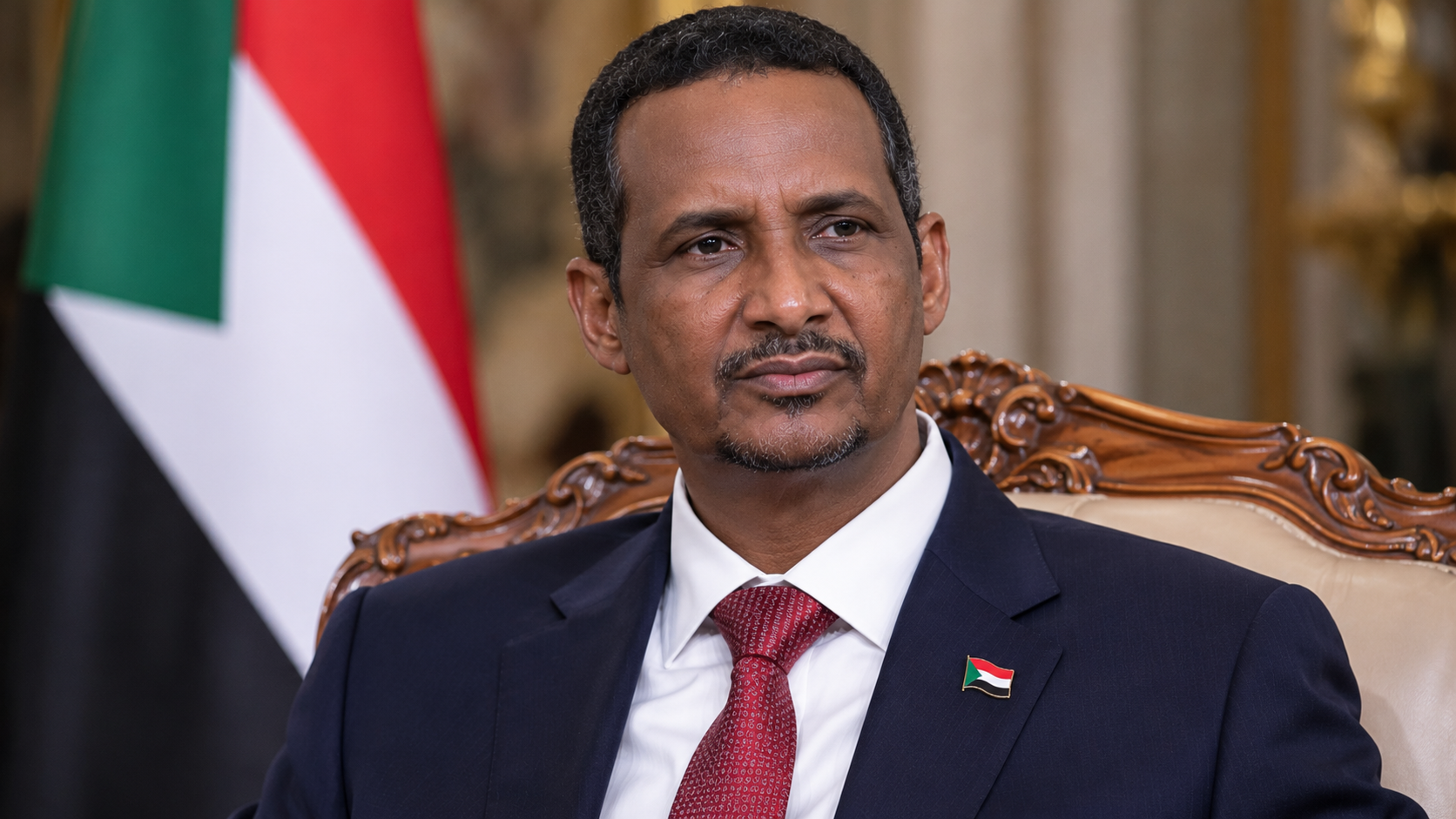
The Sudan Founding Alliance (TASIS) has announced a major restructuring of civilian administration across five states in Darfur and Kordofan, as part of efforts to establish a decentralised system of governance.
Mohamed Hamdan Dagalo, chairman of the TASIS Presidential Council, issued Presidential Decree No. 19 of 2026 on Friday, October 30.
The decree dissolves existing civilian administrations and founding councils in South Darfur, Central Darfur, East Darfur, West Darfur and West Kordofan.
The decision forms part of TASIS’s broader plans to reorganise local government institutions in territories under its control.
Under the alliance’s proposed governance framework, decentralisation and greater regional autonomy are intended to play a central role.
TASIS governance reforms cover five states
The decree abolishes the Civil Administrations Document of 2024, which previously provided the basis for administrative structures in the affected areas.
It also dissolves subordinate administrative bodies, local councils and associated institutions established under that framework.
The order was issued under Article 65 of TASIS’s 2025 Transitional Constitution.
As a result, heads of civilian administrations, founding council chairpersons, advisers and executive officials appointed under the previous arrangements have been relieved of their duties.
Their appointments and administrative mandates have been terminated with immediate effect.
Officials affected by the restructuring must hand over government records, official seals, financial resources, equipment and other public assets to the relevant authorities.
The measures are intended to prepare the affected states for a new administrative framework.
Essential services to continue during transition
The decree includes transitional arrangements designed to maintain essential government services while the restructuring takes place.
Relevant authorities have been instructed to ensure that administrative operations continue during the transition.
Existing competent authorities will temporarily oversee government functions until new legislation is introduced.
The directive also restricts the establishment of replacement councils and permanent appointments without appropriate legal authorisation.
These provisions are intended to prevent administrative gaps as TASIS develops its decentralised governance structures.
However, the decree does not specify when the new system will become fully operational.
The practical effects on public services and administrative personnel will depend on how the transition is implemented.
TASIS advances decentralisation agenda
The restructuring follows the establishment of TASIS’s Government of Peace and Unity in Nyala in 2025.
The alliance subsequently introduced a Presidential Council, transitional ministries and regional administrative structures under its constitutional framework.
Before these arrangements, civilian administrations operated in areas controlled by the Rapid Support Forces (RSF), carrying out local government functions during Sudan’s ongoing conflict.
The latest decree replaces those earlier arrangements as TASIS works towards a revised administrative system.
Decentralisation has been a central element of the alliance’s political programme.
TASIS has proposed a governance model that would give Sudan’s regions greater authority over local affairs.
The alliance presents this approach as an alternative to the country’s historically centralised political structures.
Regional autonomy at centre of proposed reforms
Sudan’s political history has been marked by disputes over the distribution of power and resources between the centre and the regions.
These tensions have contributed to longstanding grievances in Darfur, Kordofan and other parts of the country.
TASIS has placed regional autonomy and decentralised administration at the centre of its proposed political framework.
The latest measures indicate an effort to align existing local institutions with that framework.
However, the decree primarily concerns the dissolution of previous administrative bodies.
Further legislation will be required to establish the replacement structures and define their responsibilities.
Implementation will determine impact
The restructuring represents a significant administrative step for TASIS in the five affected states.
It formally ends the previous civilian administration framework and establishes transitional arrangements ahead of further institutional changes.
The next stage will involve developing the legal and administrative structures needed to implement the proposed decentralised system.
Key questions remain over the appointment of new officials, the division of responsibilities and the continuity of public services.
For residents of the affected states, the practical significance of the reforms will depend on whether the transition improves the delivery of local government services.
The decree marks another stage in TASIS’s efforts to implement its proposed governance model amid Sudan’s continuing conflict.