
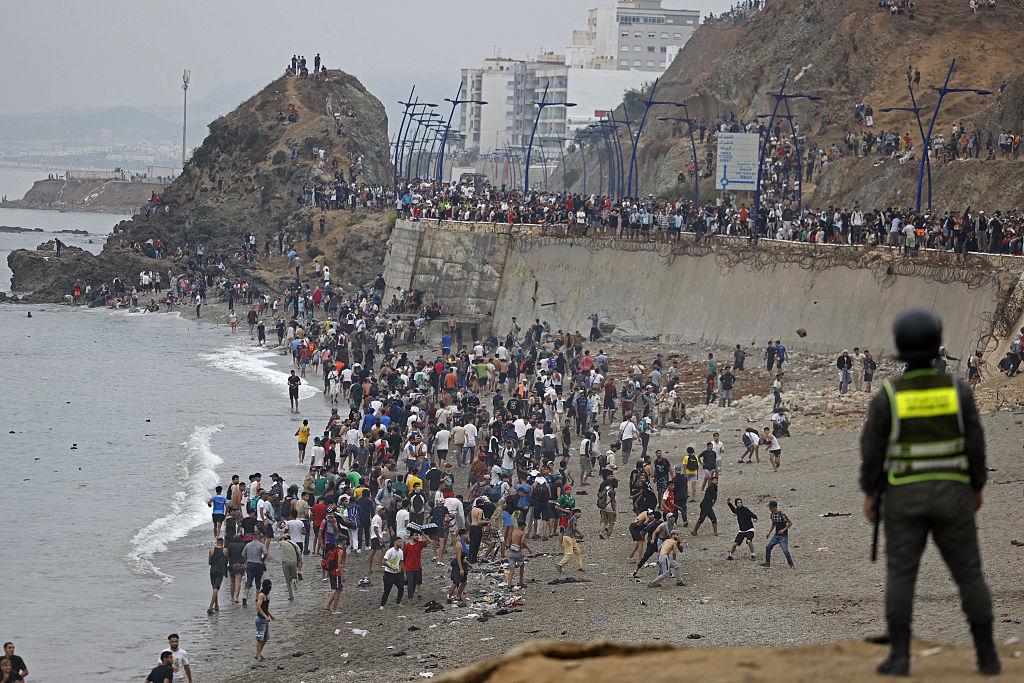
Thousands of migrants remained stranded in Spain’s North African enclave of Ceuta on Monday, leaving reception centres overwhelmed and forcing hundreds to sleep on beaches following last week’s unprecedented mass border crossing.
Local authorities estimate that between 3,000 and 5,000 migrants are still in the small Spanish territory, despite the return of nearly 69,500 people to neighbouring Morocco over the past four days.
The number of returns exceeds Spain’s initial estimate that about 50,000 migrants entered Ceuta on Thursday. At least 72 people died on the Spanish side of the border during the surge, while Moroccan authorities reported 11 deaths.
Many migrants said they decided to return after shops closed, leaving them without access to food, while others described hostility from local residents and little prospect of reaching mainland Spain.
Reuters footage showed scores of migrants, mainly from sub-Saharan Africa, sleeping on the sand at El Trampolin beach. Some wrapped themselves in towels to protect against strong winds as army and police vehicles patrolled nearby roads.
Ceuta’s regional leader, Juan Jesus Vivas, said the enclave’s reception facilities for adults and minors had reached breaking point.
“The centres have collapsed,” Vivas told Spanish broadcaster Telecinco, estimating that between 3,000 and 5,000 migrants remained in the city.
Local official Alberto Gaitan said authorities were processing 862 unaccompanied migrant children, who are protected under Spanish law and cannot be immediately deported.
Ceuta and Melilla, Spain’s two territories on Morocco’s Mediterranean coast, are the European Union’s only land borders with Africa and have repeatedly become focal points for irregular migration.
EU tensions grow
The crisis has intensified political tensions across Europe, fuelling anti-immigration rhetoric and triggering disagreements among European Union governments over responsibility for border control and migrant reception.
EU interior ministers are expected to hold an emergency video conference on Tuesday to discuss the situation.
Spanish Foreign Minister Jose Manuel Albares said Madrid had supported other member states during previous migration emergencies and expected similar solidarity from its European partners.
Albares also accused the Italian government of contributing to the spread of misleading information surrounding the crisis.
He said Morocco had quickly provided police assistance without imposing conditions, allowing Spanish authorities to return most of those who crossed.
However, Vivas openly questioned Rabat’s reliability, saying many Ceuta residents believed Moroccan authorities had either permitted or deliberately facilitated the surge.
“Morocco has shown us that it is not reliable,” Vivas told El Pais. “There is no alternative but to put in place whatever measures are necessary to ensure it cannot do this again.”
Morocco has denied organising the crossing. Its Interior Ministry said the rush was driven by false information circulating on social media, human trafficking networks and confusion over a Spanish court ruling that prohibited the immediate return of migrants intercepted at sea.
Intelligence agencies face questions
Spanish intelligence services have concluded that Morocco did not directly plan the mass crossing but allowed it to take place, according to reports by El Pais and Cadena SER citing officials familiar with the assessments.
The reports said Moroccan border controls were gradually relaxed during July and were effectively removed as large crowds moved toward the Tarajal border crossing during Morocco’s Throne Day holiday.
Morocco’s Interior Ministry did not immediately respond to requests for further comment but said on Sunday that the country remained committed to international cooperation against irregular migration and human trafficking.
The crisis has also raised questions over whether Spain’s intelligence services failed to warn the government about the impending surge.
Interior Minister Fernando Grande-Marlaska said the National Intelligence Centre, known as the CNI, had not alerted him to an imminent mass crossing.
El Pais reported that the lack of warning had created tensions between Spain’s interior and defence ministries, although an Interior Ministry spokesperson played down reports of a dispute.
Defence Minister Margarita Robles declined to say whether the CNI had prior intelligence, saying its operations were classified, while praising the response of Spanish security personnel.