
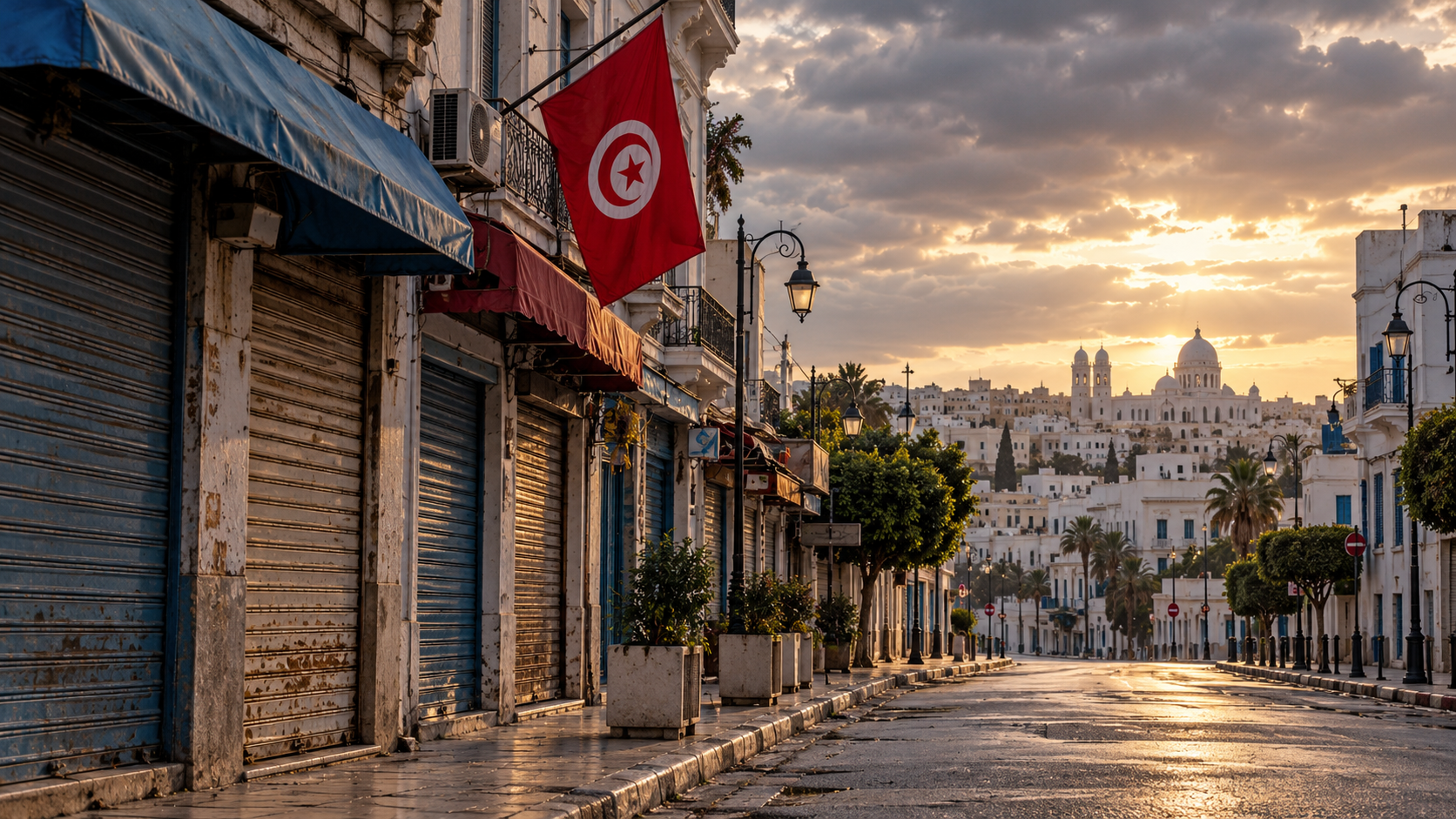
Tunisia’s economic crisis is placing growing pressure on households as high unemployment, rising living costs and unreliable public services fuel frustration across the country.
Thousands of Tunisians took to the streets of the capital, Tunis, on October 17 to protest deteriorating living conditions and President Kais Saied’s government.
The demonstration brought together labour unions, opposition groups and civil society organisations.
According to Al Jazeera, the protests reflect wider concerns over limited job opportunities, economic hardship and the government’s ability to deliver promised reforms.
Tunisia’s economic crisis leaves graduates without jobs
University graduates are among those most affected by Tunisia’s economic difficulties.
Many young people have spent years searching for employment despite completing their education.
Cherine Ghanmi, a graduate from al-Mazzunah in the Sidi Bou Zid region, has been unemployed since graduating in 2012.
Her family made significant sacrifices to support her education, hoping she would eventually secure a job and help improve their living conditions.
However, more than a decade later, she remains financially dependent on her parents.
Her experience reflects the difficulties facing thousands of educated Tunisians who have struggled to enter the workforce.
Unemployed graduates launch Dignity March
On September 27, unemployed university graduates began a 300-kilometre protest march from Menzel Bouzaiane towards Tunis.
Organisers called the demonstration the Dignity March.
Initially, 23 people participated. However, the number reportedly increased to more than 120 as others joined along the route.
The protesters demanded employment opportunities and the implementation of legislation intended to help long-term unemployed graduates enter public-sector jobs.
On October 6, police stopped the group in Borj Cedria, south of Tunis.
Participants said authorities prevented them from continuing as an organised group.
They had hoped to reach Carthage, where Tunisia’s presidential palace is located, to present their demands.
Tunisia unemployment remains high in 2026
Official figures show the scale of Tunisia’s employment challenges.
According to the National Institute of Statistics, the country’s unemployment rate reached 14.9% in the second quarter of 2026.
However, unemployment was considerably higher among university graduates.
The rate stood at 26.6% for graduates overall.
Among female graduates, unemployment reached 35.6%, compared with 14.2% for male graduates.
Meanwhile, unemployment among people aged 15 to 24 reached 35.4%.
These figures highlight the difficulties young Tunisians face when seeking stable employment.
Government employment promises face scrutiny
Tunisia has introduced legislation aimed at addressing long-term graduate unemployment.
A law adopted in December 2025 provides for exceptional public-sector recruitment of eligible graduates.
The legislation establishes a process for registering applicants and prioritising recruitment.
It also provides for hiring in phases over a period of up to three years.
However, unemployed graduates say they need clear implementation procedures and a reliable recruitment timetable.
Cherif Khraifi, spokesperson for the Tunisian Union of Higher Education Graduates, told Al Jazeera that successive governments have failed to prioritise economic development and employment.
He also argued that public-sector recruitment alone cannot resolve the country’s unemployment problem.
Instead, Tunisia needs greater investment and more businesses capable of creating sustainable jobs.
Economic growth fails to ease public hardship
Tunisia’s economy has recorded modest growth, but many households have yet to experience significant improvements.
Official data showed economic growth of 2.7% in 2025.
During the first half of 2026, the economy expanded by 2.4%.
Meanwhile, the World Bank projected annual growth of 2.3% for 2026.
Despite these figures, unemployment remains high.
Economic experts say weak investment, infrastructure problems and limited business opportunities continue to restrict job creation.
Anis Ben Said, a tax adviser and university professor, told Al Jazeera that Tunisia’s challenge is not a shortage of skilled workers.
Rather, he argued, the economy struggles to convert available skills into productive investment and employment.
Water and electricity shortages increase pressure
Tunisia’s economic difficulties extend beyond unemployment.
During the summer, several areas experienced electricity interruptions and water shortages.
These disruptions affected households and businesses.
Small businesses, in particular, have struggled with the additional costs and uncertainty caused by unreliable services.
Some shop owners say repeated interruptions have made it increasingly difficult to maintain their operations.
Meanwhile, young Tunisians facing limited opportunities are considering leaving the country in search of better prospects.
Thousands protest against President Kais Saied
Public dissatisfaction was visible during the October 17 demonstration in Tunis.
Thousands gathered to protest economic hardship, unemployment and restrictions on freedoms.
The protest was organised with the involvement of the Tunisian General Labour Union, opposition groups and civil society organisations.
President Kais Saied has presented his political approach as an effort to confront corruption and address the failures of previous governments.
However, critics argue that his concentration of power since 2021 has weakened political accountability without delivering sufficient economic improvements.
The government continues to face pressure to address employment, public services and household living costs.
Tunisia faces growing pressure for economic reform
Tunisia’s economic crisis continues to affect graduates, workers, families and small businesses.
Although the country has introduced employment initiatives and recorded modest economic growth, many citizens remain concerned about their financial future.
High youth unemployment and persistent public-service disruptions have added to frustration.
For unemployed graduates, the central concern is whether government promises will lead to actual job opportunities.
As demonstrations continue, Tunisia faces mounting pressure to deliver reforms that improve living standards and create sustainable employment.