
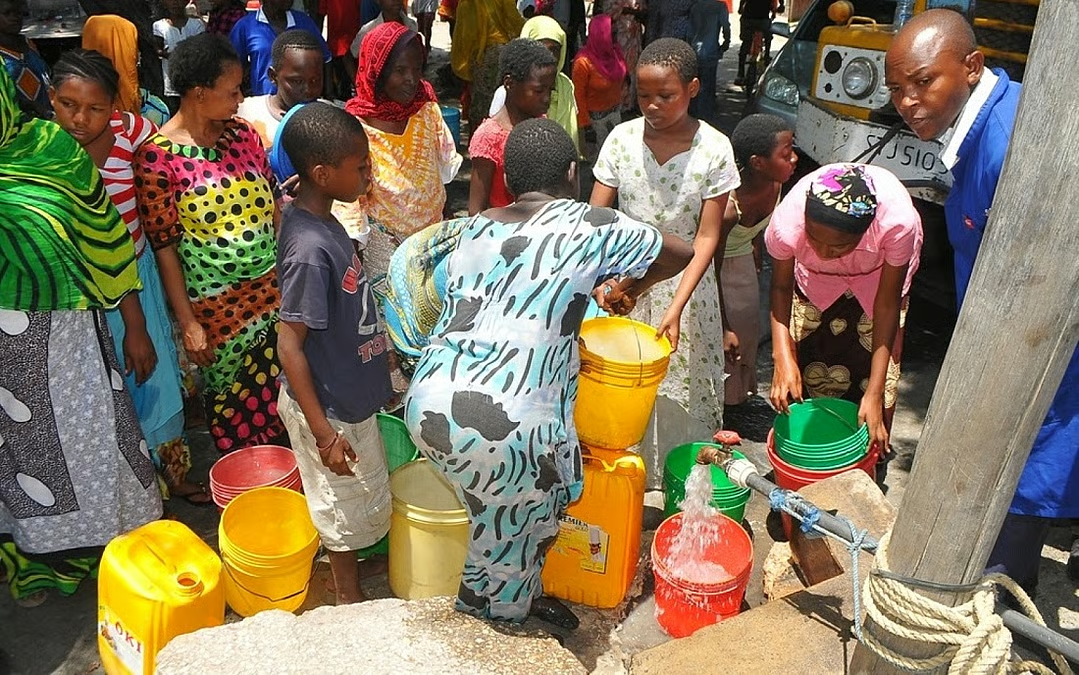
As Christmas approaches, daily life in Dar es Salaam has become a struggle for many of its six million residents, with chronic water shortages draining any sense of festive cheer.
At first light, queues form around water tanks and public taps as families search for supplies. In many neighbourhoods, empty plastic containers are stacked outside homes, ready to be filled whenever word spreads that water has briefly returned to nearby pipes.
Authorities have imposed rationing across the city, with some households receiving running water only once a week, while others wait far longer. The crisis, driven by prolonged drought and rising demand, has persisted for months.
For many residents, private water vendors have become the only option. These suppliers draw water from boreholes and storage tanks, offering temporary relief but at a steep cost that hits low income households hardest.
In Madale, on the city’s north western edge, Cedric Ndosi is preparing to host guests for Christmas lunch, but remains anxious. “There is no water in our taps,” he says. “We now have to buy water for cooking and from trucks for bathing. What used to be money for drinks is now spent on water.”
Elsewhere, prices have surged. Furaha Awadhi, a mother of two in Tegeta, says the cost of 1,000 litres has risen from about four dollars to ten. In Ubungo, Cedric Mushi says he stays awake late into the night to store water whenever taps briefly flow. “It usually comes once a week, and often very late,” he says.
Officials say the shortages are linked to a prolonged dry spell since the end of the rainy season in May, which has sharply reduced river levels and groundwater. Cuts in supply from treatment plants, combined with losses from ageing and leaking pipes, have worsened the situation.
Dar es Salaam, Tanzania’s main economic hub, is one of Africa’s fastest growing cities. Its population has more than doubled in two decades, with new neighbourhoods spreading far beyond the original city limits. Even in normal conditions, water supplies have struggled to keep pace with demand.
Unlike other cities, Dar es Salaam has been particularly affected by the failure of the October to December rains. While the capital Dodoma relies on man made dams, Dar es Salaam lacks a nearby freshwater reservoir, endures high temperatures averaging around 33 degrees Celsius, and has no desalination plant despite its coastal location.
Around 70 percent of the city’s water comes from the Ruvu River, whose flow depends heavily on seasonal rainfall inland. When levels fall, the impact is felt almost immediately, especially in higher lying and newly developed suburbs.
The burden of the crisis is uneven. Some residents wait overnight for water, while others line rooftops and courtyards with containers to capture every possible drop. Small businesses, including food vendors, salons and car washes, have reduced hours or raised prices.
Women are often at the forefront of the daily search for water. “When water is scarce, everything stops,” says Tegemeo Kombe from Kibamba. “Hygiene suffers, stress rises, especially for mothers, and the whole household feels it.”
The government has acknowledged the severity of the problem. Water Minister Juma Aweso said the city’s reliance on rainfall fed rivers has left it especially vulnerable. He said work is under way on a dam to draw water from multiple sources, alongside increased investment in boreholes to meet future demand and reduce climate related risks.
The Dar es Salaam Water and Sanitation Authority has apologised to residents and urged conservation, though critics say communication has been poor and long promised projects too slow to materialise.
Despite the hardship, some residents remain hopeful. “When water disappears, life changes,” says Joyce Fredrick, who plans to leave the city for cooler Arusha during the holidays. “But we believe things will be better next year.”