
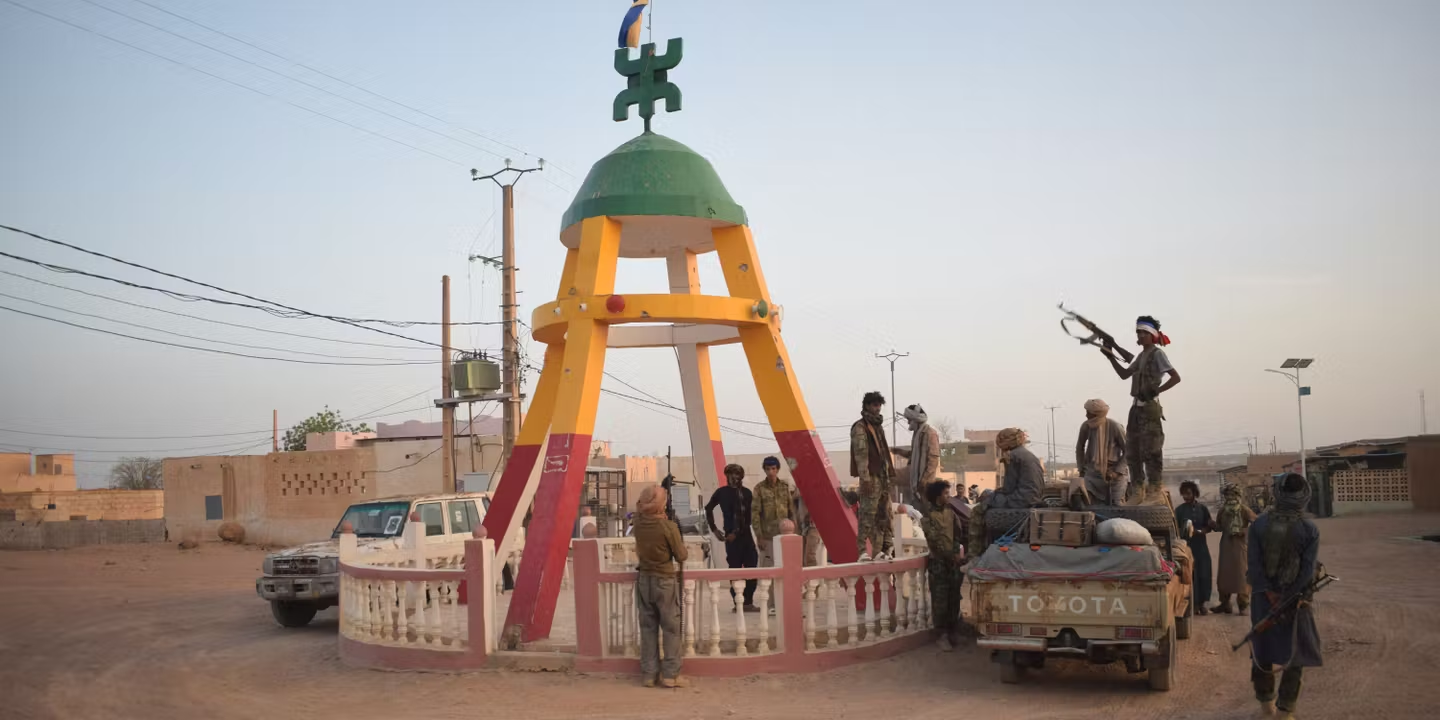
Instability has once again gripped northern Mali as clashes intensify between government forces and a mix of jihadist and Tuareg armed groups, amid the gradual collapse of the 2015 Algiers peace agreement.
After several years of relative calm following the deal, tensions have surged again since 2023, with the situation deteriorating further after Mali’s military authorities effectively abandoned key commitments to the agreement in 2024. This shift has pushed the Tuareg-led National Movement for the Liberation of Azawad (MNLA) and other armed factions back into the spotlight.
Renewed fighting in the north
Violence escalated recently when fighters from the Azawad movement, alongside other local armed groups and elements linked to jihadist organisations, seized control of the northern city of Kidal after pushing out Malian government forces supported by Russian fighters.
According to regional reporting, Russian mercenaries requested a safe corridor to withdraw from Kidal and surrounding areas, which was granted. All Moscow-backed fighters are reported to have left the area, now under Tuareg control.
Origins of the Azawad movement
The National Movement for the Liberation of Azawad was founded in October 2011 through the merger of two Tuareg groups. It aimed to unify Tuareg political demands across the vast region of Azawad in northern Mali.
Azawad spans roughly one million square kilometres, bordering Algeria, Mauritania, Niger, and Burkina Faso. The Tuareg people, a nomadic Amazigh group, are spread across several countries in the Sahel and Sahara, sharing a common language and cultural identity.
What does the group want?
The movement seeks either full independence for northern Mali or broad autonomy over the region, including major cities such as Timbuktu, Gao, and Kidal.
These ambitions escalated into armed conflict in 2012, when the group briefly took control of large parts of northern Mali before losing ground to rival armed factions and jihadist groups.
The 2015 Algiers agreement, signed between the Malian government and northern armed groups, aimed to end hostilities by promoting decentralisation, political inclusion, and security reforms. However, its implementation has been fragile and inconsistent.
Collapse of the peace process
In early 2024, Mali’s military-led government announced it would suspend or revise its commitments under the Algiers agreement, citing external interference and security concerns.
With the political framework weakened, violence has resurged, and Tuareg armed groups have resumed military operations in several مناطق across the north, further destabilising the region.
Ideology and allegations
The Azawad movement describes itself as secular and committed to building a democratic political entity. It has consistently distanced itself from extremist groups.
However, Malian authorities and some regional governments have accused it of cooperating at times with jihadist organisations such as al-Qaeda-linked groups and other militant factions.
The movement strongly denies these allegations, insisting it has no organisational ties to extremist groups and highlighting the traditionally moderate, Sufi-influenced religious practices of Tuareg.
Algeria’s role
Algeria has played a central mediating role in Mali’s conflicts, particularly in brokering the 2015 peace deal.
While some observers accuse Algeria of backing the Azawad movement, Algerian officials have repeatedly denied this, stating their goal is to stabilise the region and promote a political solution rather than support any armed faction.
A long history of rebellion
Tuareg uprisings in Mali date back to the country’s independence in 1960, driven by grievances over political marginalisation and underdevelopment in the north.
Major rebellions erupted in 1963, 1990, and 2012, each followed by fragile peace agreements that failed to fully resolve the conflict.
The current resurgence of violence reflects the collapse of previous peace efforts and the growing complexity of the Sahel’s security landscape, where state forces, separatists, and jihadist groups continue to compete for control.