
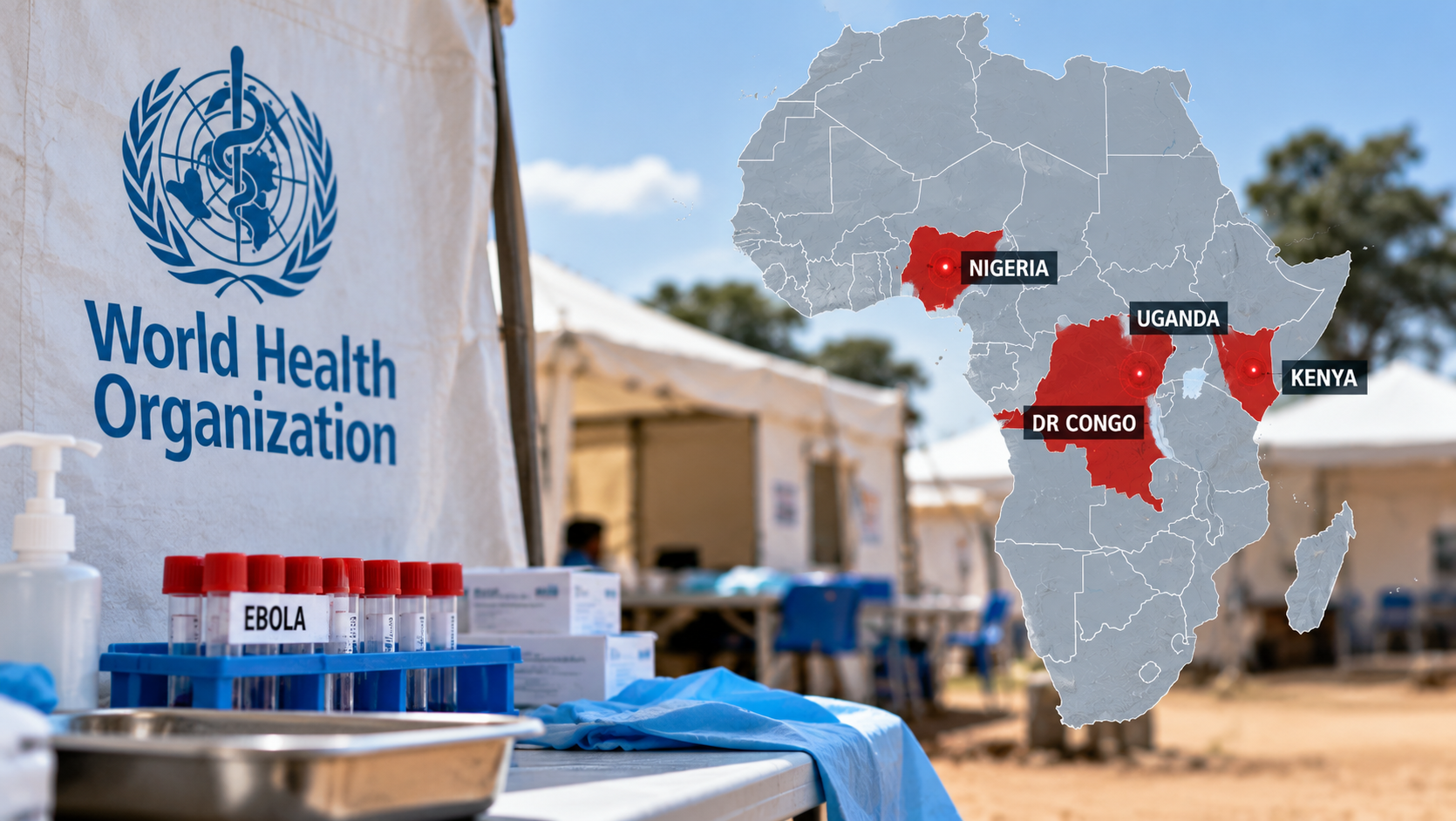
The World Health Organization (WHO) has warned that Africa is facing an increasingly complex Ebola outbreak after Nigeria confirmed its first case in more than a decade.
The imported infection marks a significant development in an outbreak that has spread beyond Central and East Africa.
WHO officials say the growing geographical reach of the virus is creating new challenges for health authorities.
Nigeria, Africa’s most populous country, confirmed the case on Tuesday, raising concerns about the possibility of further transmission in West Africa.
WHO warns of growing outbreak
WHO Regional Director for Africa Mohamed Janabi said the continent was facing a more complicated public health situation.
Speaking during an online briefing on Thursday, Janabi confirmed that Nigeria had recorded an imported Ebola case.
The infection involves the Bundibugyo strain, which is responsible for a major outbreak in the Democratic Republic of Congo (DRC).
According to health authorities, the patient is a female diplomat with a history of travel to Uganda.
Nigeria’s confirmation makes it the fourth African country affected by the outbreak.
The virus has also reached Kenya, where authorities have reported nine cases since October 6.
The emergence of infections across different regions has increased pressure on national health systems to strengthen surveillance and respond quickly to suspected cases.
Nigeria confirms first case in over a decade
Nigeria’s latest Ebola case is the country’s first since the 2014 outbreak.
That earlier epidemic affected several West African nations and became one of the deadliest infectious disease emergencies in the region’s history.
More than 11,000 people died across West Africa during the epidemic, which lasted from late 2013 until 2016.
Nigeria successfully contained its outbreak in 2014 through contact tracing, isolation measures and coordinated public health action.
The country’s previous experience has raised expectations that health authorities can respond effectively to the latest imported infection.
However, officials face the challenge of preventing further transmission while monitoring people who may have come into contact with the patient.
DR Congo records thousands of deaths
The Democratic Republic of Congo remains the centre of the current Ebola emergency.
According to figures reported by health authorities, more than 9,000 confirmed cases have been recorded since mid-May.
At least 4,381 people have died, making it the deadliest Ebola outbreak in the country’s history.
The scale of the epidemic has placed considerable pressure on healthcare workers and medical facilities.
Ebola spreads through direct contact with the blood or other bodily fluids of infected people who are symptomatic, as well as contaminated materials.
Early identification, isolation, contact tracing and appropriate medical care are essential to controlling transmission.
The geographical expansion of the outbreak has increased concerns about cross-border spread.
Vaccine trial underway in Congo
Researchers are investigating whether an existing Ebola vaccine can offer protection against the Bundibugyo strain.
The Ervebo vaccine is approved for Ebola disease caused by the Zaire strain of the virus.
However, its effectiveness against Bundibugyo has not been established.
A clinical trial is underway in eastern Congo to assess whether the vaccine can provide protection against the strain driving the current outbreak.
In August, the WHO said 70,000 doses of Ervebo had been approved for use in the DRC.
Around 50,000 doses were intended for frontline personnel and healthcare workers.
The remaining 20,000 doses were allocated to a clinical trial examining the vaccine’s potential effectiveness against Bundibugyo.
There is currently no licensed vaccine or specific approved treatment for the Bundibugyo strain.
African countries strengthen surveillance
The appearance of Ebola cases in Nigeria and Kenya highlights the importance of coordinated regional disease surveillance.
Health authorities must identify infections quickly, trace contacts and prevent further transmission.
The WHO’s warning reflects the challenges of managing outbreaks across countries with different healthcare capacities and public health resources.
Nigeria’s successful response in 2014 offers a precedent for containing imported cases.
However, the continuing outbreak in the DRC and the emergence of cases elsewhere demonstrate that the threat remains serious.
The WHO and national health authorities are continuing efforts to contain infections and limit the spread of the virus across the continent.