
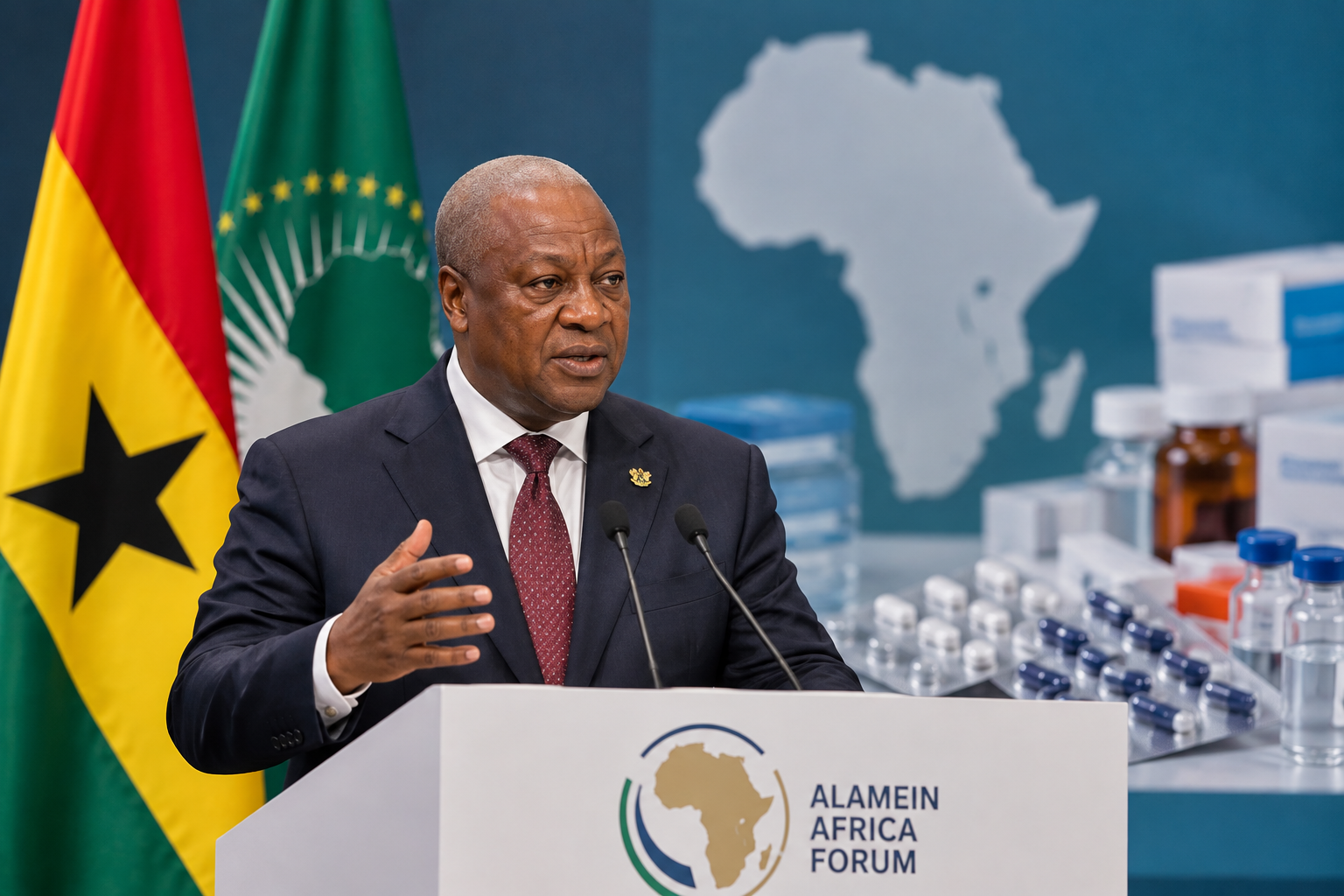
Africa imports over 70% of its medicines and approximately 99% of its vaccines, according to Ghanaian President John Dramani Mahama, who is calling for greater investment in pharmaceutical manufacturing across the continent.
Speaking at the Alamein Africa Forum in Egypt, Mahama said Africa’s dependence on imported medical products presents both a healthcare challenge and a major economic opportunity.
He urged African governments and private investors to expand local production, strengthen supply chains and develop pharmaceutical industries capable of serving regional markets.
According to Business Insider Africa, Mahama argued that healthcare should be viewed not only as a public service but also as an industry capable of creating jobs, attracting investment and supporting economic growth.
Africa’s medicine imports highlight manufacturing gap
Africa relies heavily on international suppliers for medicines, vaccines and other essential healthcare products.
Mahama said the continent imports more than 70% of its medicines and around 99% of its vaccines.
These figures, cited by the Ghanaian president, highlight the limited scale of local pharmaceutical manufacturing compared with the continent’s healthcare needs.
Heavy reliance on imports can expose countries to international supply disruptions, currency fluctuations and changes in global market conditions.
When medicines must be purchased from overseas, healthcare providers may also face additional costs related to transportation, distribution and foreign exchange.
Mahama argued that expanding African production could help address these challenges while creating new economic opportunities.
Ghana’s president calls for pharmaceutical investment
Mahama encouraged African investors to consider pharmaceutical manufacturing as a major area for long-term investment.
He said the continent already spends substantial amounts on medical products manufactured abroad.
Developing local industries could allow more of that spending to support African businesses, workers and research institutions.
The opportunities extend beyond medicine production itself.
Pharmaceutical manufacturing requires supporting industries, including packaging, transportation, laboratory services, cold storage and medical technology.
Expanding these activities could generate skilled employment and encourage investment in scientific research.
However, Mahama acknowledged that governments cannot finance such development alone.
He called for greater participation from commercial banks, development finance institutions, sovereign wealth funds and private investors.
African countries urged to produce medicine ingredients
A central part of Mahama’s proposal involves moving beyond the final stages of pharmaceutical manufacturing.
Some existing African pharmaceutical operations focus on packaging, formulation and finishing medicines.
However, producing the active pharmaceutical ingredients used in medicines requires more advanced industrial capabilities.
These ingredients are responsible for the intended therapeutic effects of pharmaceutical products.
Mahama argued that African countries should invest in developing this capacity rather than remaining heavily dependent on imported ingredients.
Such investments would require specialised equipment, technical expertise, reliable infrastructure and substantial financing.
Stronger cooperation between governments, universities, manufacturers and investors could also support the development of these industries.
Regional trade could support medicine production
Mahama also highlighted the importance of regional integration in expanding pharmaceutical manufacturing.
Producing medicines for a single national market may not always provide sufficient demand to justify the cost of a large manufacturing facility.
However, companies that can supply several African countries may benefit from larger markets and more predictable demand.
Regional cooperation could therefore make pharmaceutical investments more commercially attractive.
Efforts to improve cross-border trade and align regulatory requirements could help manufacturers distribute products more efficiently.
The African Continental Free Trade Area provides a broader framework for increasing trade between African countries.
Nevertheless, pharmaceutical products must still meet appropriate safety, quality and regulatory standards.
Developing local production will require investment in both manufacturing capacity and effective oversight.
Local manufacturing could strengthen Africa’s healthcare systems
Increasing pharmaceutical production in Africa could provide benefits beyond industrial development.
A stronger local manufacturing base may help countries respond to medical emergencies and reduce some risks associated with international supply disruptions.
It could also support faster distribution of essential medicines where regional supply networks are well developed.
However, building factories alone would not guarantee affordable medicines or improved healthcare access.
Competitive pricing, quality standards, reliable distribution and public health investment would remain important.
For Mahama, the larger objective is to turn Africa’s existing demand for imported medicines into an opportunity for industrial development.
His remarks reflect growing interest in connecting healthcare investment with economic diversification and regional trade.
Although Africa’s reliance on imported medicines is unlikely to change quickly, greater investment in pharmaceutical production could help the continent retain more economic value while strengthening its healthcare supply chains.