
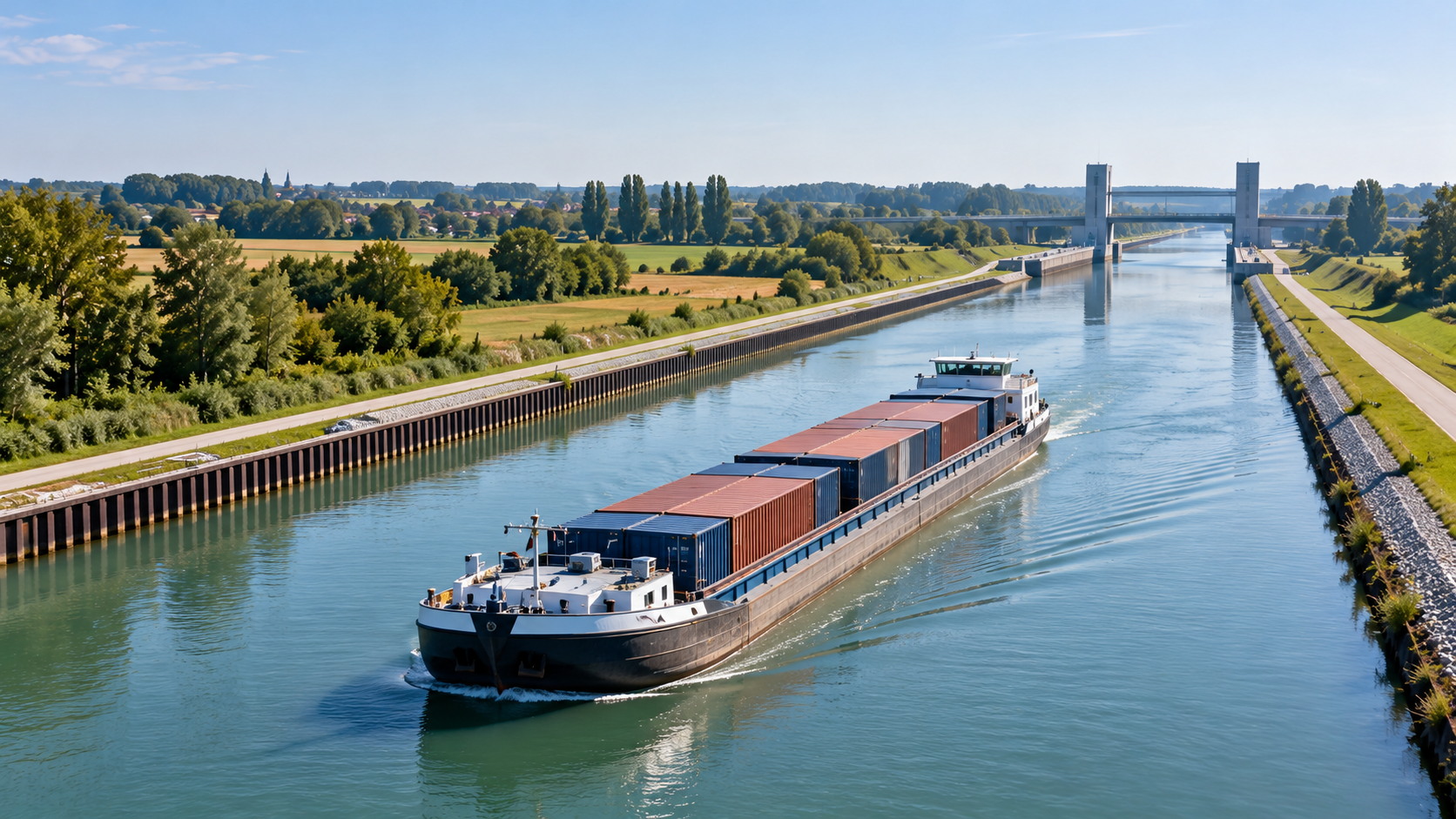
France is developing an $8.5 billion canal to strengthen European trade, drawing comparisons with Egypt’s Suez Canal and its revenue-generating shipping model.
The 107-kilometre Seine-Nord Europe Canal will connect northern France with major waterways serving Belgium and the Netherlands.
The project aims to move more goods by water, reduce road congestion and improve access to European ports.
However, unlike Egypt’s Suez Canal, the new French waterway will primarily serve regional cargo transport.
France invests $8.5 billion in new canal
The Seine-Nord Europe Canal is one of France’s major transport infrastructure projects.
It will stretch across the Hauts-de-France region and form part of the wider Seine-Scheldt waterway network.
This network connects France with Belgium and the Netherlands, including major commercial ports such as Rotterdam and Antwerp.
According to Business Insider Africa, the project’s estimated cost has risen from €5.1 billion to €7.3 billion, equivalent to approximately $8.5 billion.
The revised budget was announced in January 2026 by Société du Canal Seine-Nord Europe, the public body overseeing construction.
Officials attributed the increase to inflation, delays and additional environmental requirements.
Construction is underway, with completion now expected in 2032.
That is two years later than the previously reported 2030 target.
New waterway could replace one million truck journeys
The canal is designed to accommodate much larger cargo vessels than existing inland routes.
It will measure approximately 54 metres wide and 4.5 metres deep.
Barges using the waterway will be able to carry up to 4,400 tonnes of cargo.
By comparison, vessels travelling through the existing Canal du Nord are limited to around 650 tonnes.
The increased capacity could significantly improve freight transport across northern Europe.
Project officials estimate that the canal could replace up to one million heavy truck journeys on French roads each year.
This could reduce traffic congestion and make cargo transport more efficient.
The project will also include seven locks, three canal bridges and several road and rail crossings.
Funding comes from the European Union, the French government and regional authorities.
How does France’s canal compare with Egypt’s Suez Canal?
The French project has attracted comparisons with Egypt’s Suez Canal, one of the world’s most important shipping routes.
Both waterways use navigation charges as part of their operating models.
However, their purposes and capacities are very different.
Egypt’s Suez Canal stretches approximately 193 kilometres between the Mediterranean Sea and the Red Sea.
It allows large commercial ships to travel between Europe and Asia without sailing around Africa.
The canal is also a major source of foreign currency for Egypt.
In 2023, the Suez Canal Authority reported record annual revenue of $10.25 billion.
France’s new canal will operate on a much smaller scale.
Rather than serving ocean-going ships, it will accommodate inland cargo barges transporting goods between European markets.
Its economic benefits are expected to come mainly from improved freight capacity and lower transport costs.
Will France introduce Suez-style canal tolls?
France already charges commercial vessels for using its inland waterways.
The system is managed by Voies Navigables de France, the country’s waterways authority.
Under its 2026 tariff schedule, fixed charges for commercial operators range from €24.90 to €93.30 per journey.
Additional fees depend on factors such as cargo weight and distance travelled.
The Seine-Nord Europe Canal is expected to operate within this existing framework.
However, authorities have not announced specific toll rates or projected annual revenue for the new waterway.
This means comparisons with the Suez Canal remain limited.
Egypt’s canal serves international maritime trade, while the French project focuses on European inland transport.
Environmental concerns surround canal project
Despite its expected economic benefits, the project has faced criticism.
Environmental groups have questioned whether reduced truck traffic will compensate for the ecological effects of construction.
Building the canal requires major changes to land and waterways.
Project authorities have included environmental restoration measures in their plans.
However, rising costs have also raised questions about the project’s long-term economic value.
Supporters argue that moving more freight by water could reduce pressure on European roads.
Critics say the environmental and financial costs require careful assessment.
Egypt’s Suez Canal remains a global trade route
The French project highlights the continuing importance of canals in international and regional trade.
In 2015, Egypt invested approximately $8.2 billion in expanding the Suez Canal.
The expansion included a parallel shipping channel and improvements designed to increase capacity.
France is now making a similarly large investment in waterway infrastructure.
However, the two projects serve different markets.
The Suez Canal remains a strategic maritime passage connecting major global economies.
France’s Seine-Nord Europe Canal, meanwhile, aims to strengthen trade within Europe.
Its success will depend on whether increased cargo capacity and reduced road transport deliver the expected economic and environmental benefits.