
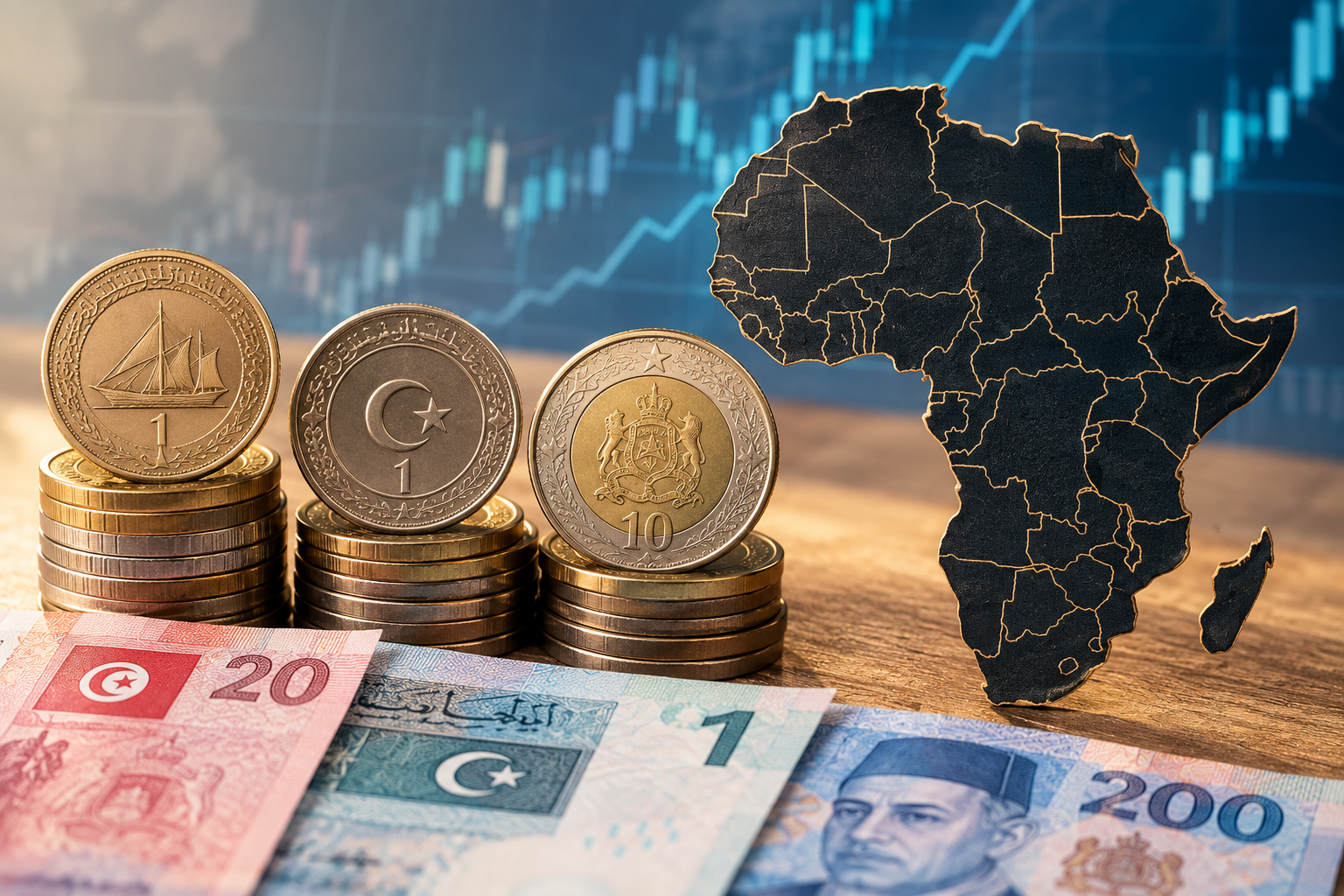
Tunisia has Africa’s highest-valued currency against the US dollar in September 2026, followed by Libya and Morocco.
The ranking is based on the number of local currency units required to equal one US dollar. A lower figure therefore represents a higher nominal value for a single unit of that currency.
However, this does not mean the countries with the highest-valued currencies necessarily have Africa’s strongest economies.
Tunisia leads Africa’s strongest currencies
Business Insider Africa, using exchange-rate data from the Forbes currency calculator, listed the Tunisian dinar as Africa’s highest-valued currency in September. Business Insider Africa
The Tunisian dinar ranks first, at 2.96 dinars to one US dollar.
The Libyan dinar ranks second, at 6.39 dinars per dollar, while the Moroccan dirham is third, at 9.63 dirhams per dollar.
The Ghanaian cedi ranks fourth, with 11.63 cedis equal to one dollar.
Botswana completes the top five. The Botswana pula ranks fifth, at 13.67 pula per dollar.
The Seychellois rupee is sixth, at 13.82 rupees per dollar, followed by the Eritrean nakfa in seventh place, at 15 nakfa per dollar.
Southern African currencies occupy the final three positions.
The South African rand ranks eighth, at 16.41 rand per dollar. The Swazi lilangeni ranks ninth, at 16.42 per dollar, while the Namibian dollar completes the top 10, at 16.43 per US dollar.
Why currency stability matters
A stable or strengthening currency can benefit economies that rely heavily on imported fuel, machinery, food and raw materials.
When fewer units of local currency are required to buy a dollar, dollar-priced imports can become less expensive in local terms.
This can help limit imported inflation and make costs more predictable for businesses. It can also reduce the local-currency burden of foreign-denominated debt.
However, exchange-rate strength can have disadvantages. Exporters may face pressure if their products become more expensive for overseas customers.
For this reason, currency stability and lower volatility can be more important than simply having a high nominal exchange value.
South African rand shows resilience
South Africa’s rand was among the currencies highlighted in the report after showing periods of strength during September.
Business Insider Africa reported that the rand gained about 0.2% on September 10, trading at around 16.0250 per dollar. It remained broadly stable later in the month as investors awaited inflation data and a central bank interest-rate decision. Business Insider Africa
Kenya’s shilling does not appear among the top 10 by nominal unit value. However, the report said it had remained relatively stable against the dollar in recent weeks.
The Central Bank of Kenya quoted the shilling at 129.48 per dollar on September 24. Reuters, as cited by Business Insider Africa, attributed some of that stability to foreign-currency inflows. Business Insider Africa
Currency value does not measure economic strength
The ranking should not be interpreted as a list of Africa’s strongest economies.
It compares the nominal value of individual currency units against the US dollar. The face value of a currency can be influenced by how the currency is denominated and by a country’s exchange-rate system, among other factors.
Therefore, Tunisia ranking first does not by itself show that its economy is stronger than those of South Africa, Morocco or other African countries.
The figures instead provide a snapshot of how much of each listed currency was required to buy one US dollar in September 2026.