
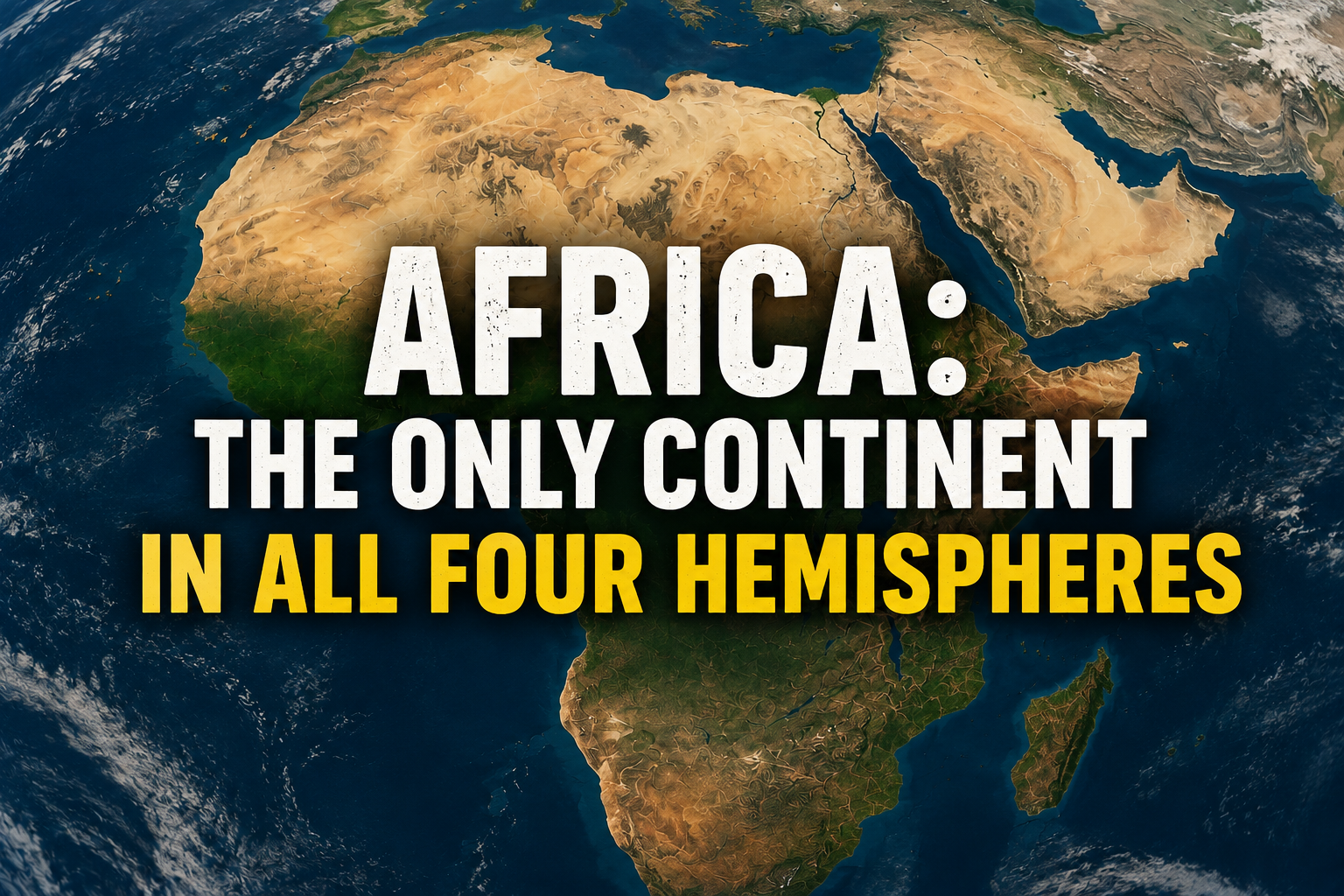
Africa holds a unique geographical distinction as the only continent spanning all four hemispheres.
Africa holds a geographical distinction that no other continent can claim: it lies in all four hemispheres of the Earth.
The continent stretches across the Northern, Southern, Eastern and Western hemispheres, thanks to two imaginary lines that cross Africa: the Equator and the Prime Meridian.
It sounds like a small geographical detail, but it helps explain just how enormous and diverse Africa really is.
How can Africa be in four hemispheres?
The Equator divides Earth into the Northern and Southern hemispheres.
It passes directly through Africa, crossing countries including Gabon, the Republic of Congo, the Democratic Republic of Congo, Uganda, Kenya and Somalia.
That means part of Africa lies north of the Equator while another part lies south of it.
The Prime Meridian, meanwhile, separates the Eastern and Western hemispheres.
It also crosses Africa, passing through countries including Algeria, Mali, Burkina Faso and Ghana.
Put the two together and Africa occupies all four hemispheres.
Ghana sits remarkably close to the centre
One of the most interesting places to see this geography is Ghana.
The Prime Meridian passes through the country and crosses the Equator just offshore in the Gulf of Guinea.
The Ghanaian city of Tema sits very close to longitude zero, while the Equator lies several hundred kilometres to the south.
Visitors can even find monuments in Ghana marking the Prime Meridian.
Africa stretches far beyond the Equator
Africa’s position across the Equator contributes to its extraordinary range of landscapes and climates.
The continent contains the vast Sahara Desert in the north, tropical rainforests around Central Africa, high mountains in the east and Mediterranean environments along parts of its northern coastline.
Travel farther south and the continent extends deep into the Southern Hemisphere, ending at South Africa’s Cape Agulhas.
Africa’s enormous north-to-south reach also means seasons do not occur at the same time everywhere.
When countries in North Africa experience summer, southern African countries experience winter.
One continent, four parts of the globe
Maps can sometimes make Africa appear smaller than it really is.
In reality, Africa covers roughly 30 million square kilometres, making it the world’s second-largest continent after Asia.
Its position across both the Equator and Prime Meridian provides another striking way of understanding that scale.
So the next time somebody asks which continent lies in all four hemispheres, there is only one answer:
Africa.