
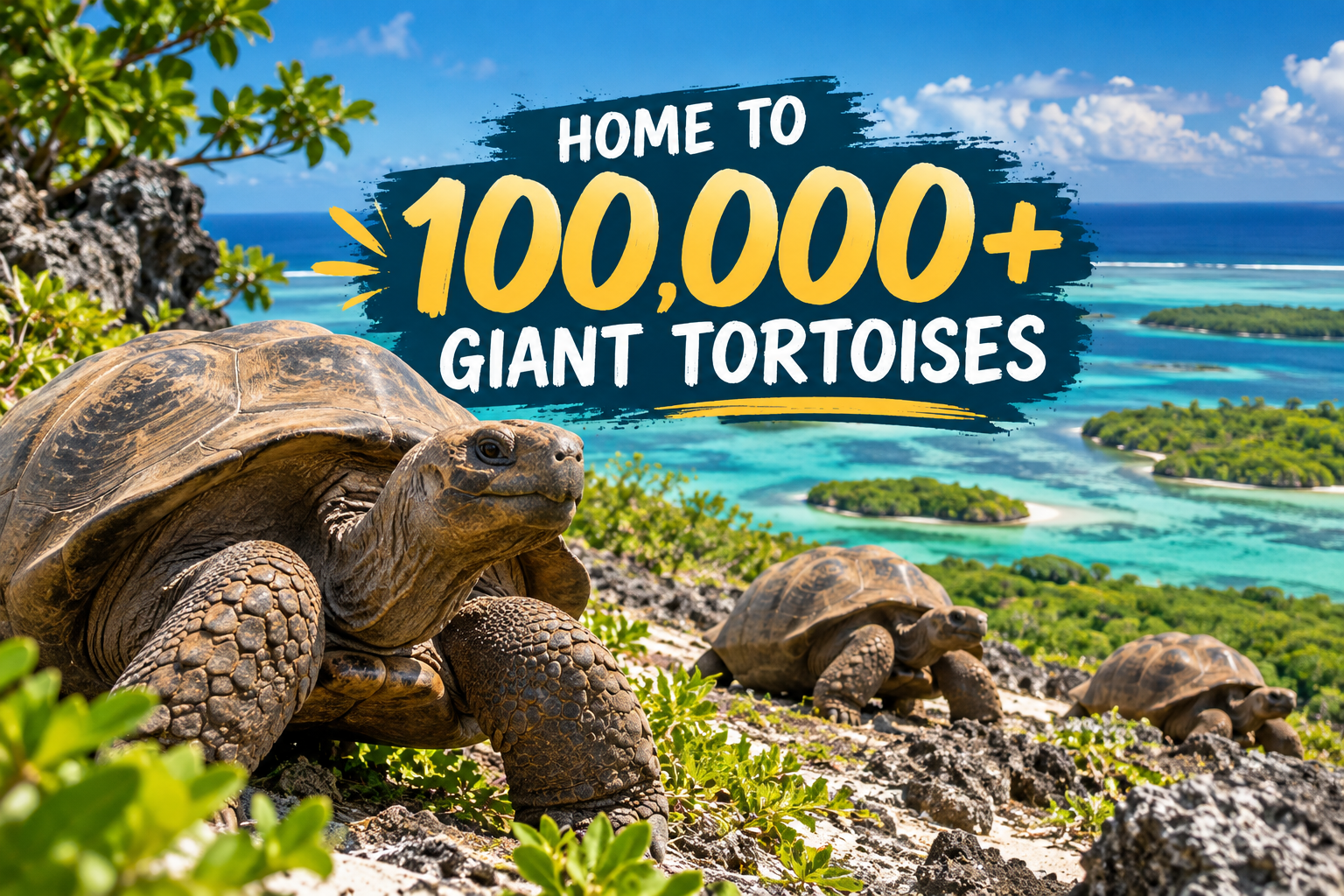
On a remote island group in the Indian Ocean, giant tortoises roam freely across beaches, grasslands and forests. Their numbers are extraordinary, while the islands have no permanent human population.
Welcome to Aldabra Atoll, part of Seychelles and one of Africa’s most remarkable natural wonders.
The atoll is home to more than 100,000 giant tortoises. These enormous reptiles are among the main reasons Aldabra is internationally recognised for its wildlife.
An African island ruled by giant tortoises
Aldabra lies in the western Indian Ocean, far from Seychelles’ main populated islands.
The atoll consists of several islands surrounding a large lagoon. Its remote location has helped protect its wildlife from many pressures associated with human settlement.
Unlike most inhabited islands, Aldabra has no permanent residential population.
Researchers, conservation staff and occasional visitors are among the few people who spend time there.
The giant tortoises, however, are found throughout the atoll.
They wander through coastal vegetation, rest in the shade and graze on grasses and other plants.
How many giant tortoises live on Aldabra?
The Aldabra giant tortoises number more than 100,000, although population estimates vary.
The Aldabra giant tortoise is one of the largest living tortoise species in the world.
Adult males can weigh well over 100 kilograms. Their enormous shells and thick legs make them easy to recognise.
Despite their size, these animals mainly eat plants.
They feed on grasses, leaves, fruits and other vegetation found across the atoll.
Their large population makes Aldabra one of the world’s most important habitats for giant tortoises.
Giant tortoises can live for over 100 years
One of the most fascinating facts about Aldabra giant tortoises is their long lifespan.
These reptiles can live for more than 100 years, although their exact lifespan varies.
They grow slowly and can take many years to reach maturity.
Their long lives make them an important part of Aldabra’s ecosystem.
As they move across the islands, the tortoises graze on vegetation and help disperse seeds.
Their feeding habits also influence the surrounding plant communities.
Why is Aldabra so special?
Aldabra became a UNESCO World Heritage Site in 1982.
It is one of the world’s largest raised coral atolls. Its four main islands surround a shallow lagoon.
The atoll also provides a home for rare birds, marine turtles and other wildlife.
Some species found there live nowhere else in the world.
The Aldabra giant tortoises play a particularly important role in this environment.
Their grazing helps shape the vegetation, while their movements contribute to seed dispersal.
Conservation efforts have also helped protect the tortoises after earlier periods of hunting and exploitation.
Can tourists visit Aldabra?
Visiting Aldabra is not like taking a normal beach holiday.
The atoll is remote, access is carefully controlled, and there are no conventional tourist resorts.
Conservation and scientific research remain the main priorities.
Despite its isolation, Aldabra faces environmental threats. These include climate change, rising sea levels, invasive species and plastic pollution.
For now, this remarkable corner of Africa remains a place where giant tortoises vastly outnumber humans.