
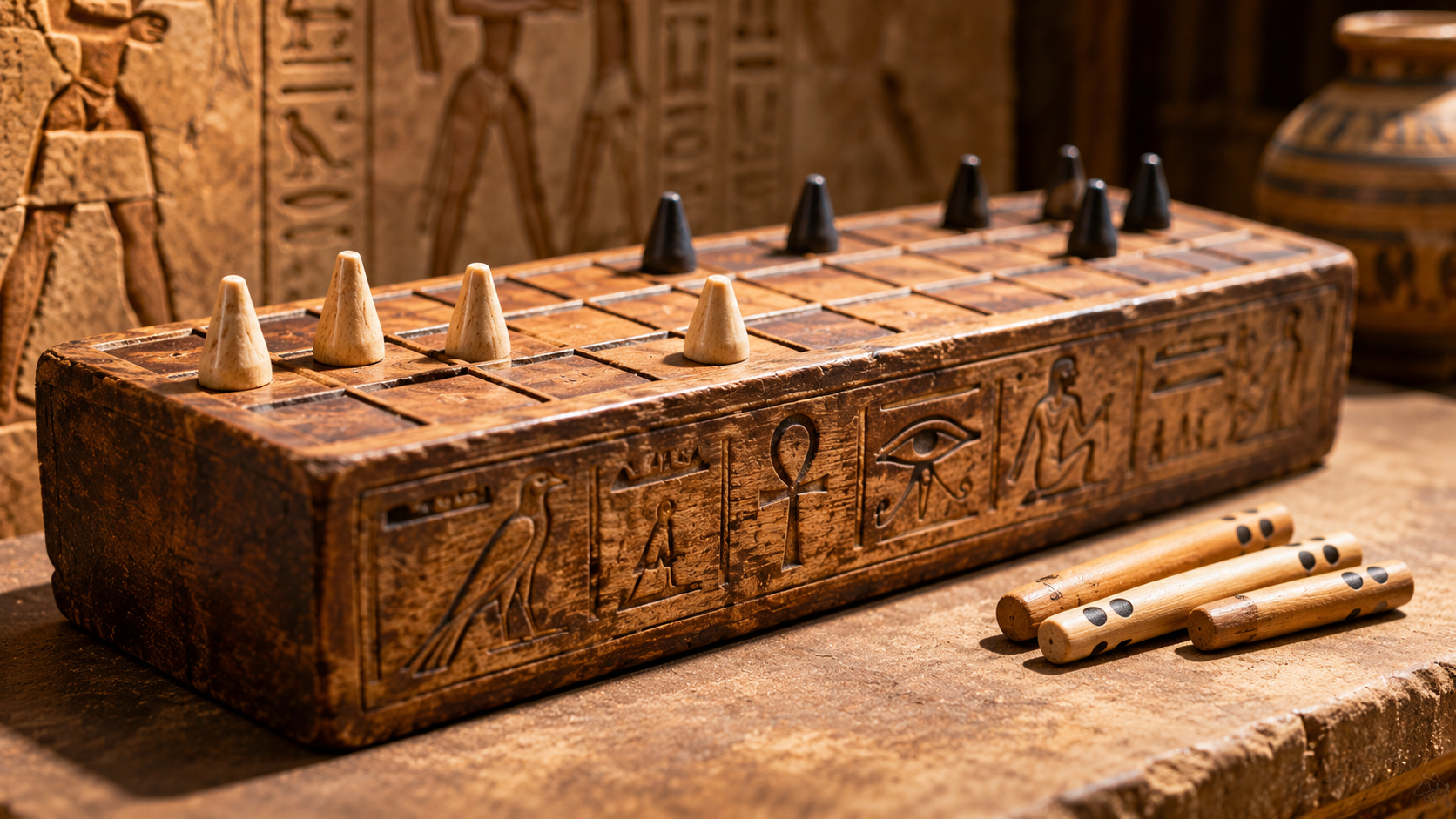
Fun Fact: Ancient Egyptians played board games over 5,000 years ago
Long before modern board games became popular, ancient Egyptians were already gathering around boards, moving pieces and competing in games of strategy.
One of their most fascinating inventions was Senet, a board game with a history stretching back approximately 5,000 years.
It is among the oldest known board games in the world.
Archaeologists have discovered ancient Senet boards, playing pieces and illustrations showing how important the game was in Egyptian society.
But perhaps the most interesting detail is that nobody knows its complete original rules.
What was the ancient Egyptian game Senet?
Senet was a board game typically played by two people.
The board contained 30 squares arranged in three rows of ten.
Players moved pieces across the board using throwing sticks or small bones to determine their moves.
The aim was to advance pieces along a winding route while competing against an opponent.
According to New York’s Metropolitan Museum of Art, players could block their opponents or force opposing pieces backwards.
However, because no complete ancient rulebook survives, modern versions are based on historical reconstructions.
A game played by Egyptian royalty
Senet was not simply an ordinary pastime.
Archaeological discoveries show that the game was also associated with ancient Egyptian royalty.
One famous example comes from the tomb of Queen Nefertari, where artwork depicts her playing Senet.
Even more remarkably, several game boxes were discovered in the tomb of Pharaoh Tutankhamun.
According to the Metropolitan Museum of Art, Tutankhamun was buried with at least five game boxes.
These discoveries demonstrate the cultural importance of board games in ancient Egyptian society.
More than just entertainment
Over time, Senet developed meanings beyond recreation.
During ancient Egypt’s New Kingdom period, the game became associated with beliefs about the journey after death.
Some squares represented obstacles, while others symbolised progress.
This religious interpretation formed part of ancient Egyptian culture.
Today, historians study these beliefs to understand how Egyptians viewed life, death and the world around them.
However, the game’s historical religious symbolism is separate from its value as an archaeological example of early board gaming.
Can people still play Senet today?
Yes, although modern players use reconstructed rules.
Museums and historians have studied surviving boards, artwork and ancient texts to develop playable versions.
These reconstructions allow people to experience something resembling the game enjoyed thousands of years ago.
However, researchers cannot confirm that modern versions reproduce every original rule.
The British Museum has also highlighted Senet as an important example of ancient Egyptian leisure and gaming traditions.
Africa’s long history of board games
Senet is just one example of Africa’s rich gaming heritage.
Across the continent, traditional board games have entertained generations while encouraging planning, observation and strategic thinking.
Games such as Oware in West Africa, Bao along the Swahili coast and Fanorona in Madagascar reflect this diversity.
Many remain part of local cultural traditions today.
These games demonstrate that Africa’s contributions to global culture extend beyond architecture, literature and art.
They also include centuries-old traditions of recreation and strategic competition.
Fun Fact: Thousands of years before modern board games, ancient Egyptians were already moving pieces across a 30-square board. And despite centuries of research, the complete rules of Senet remain a mystery.