
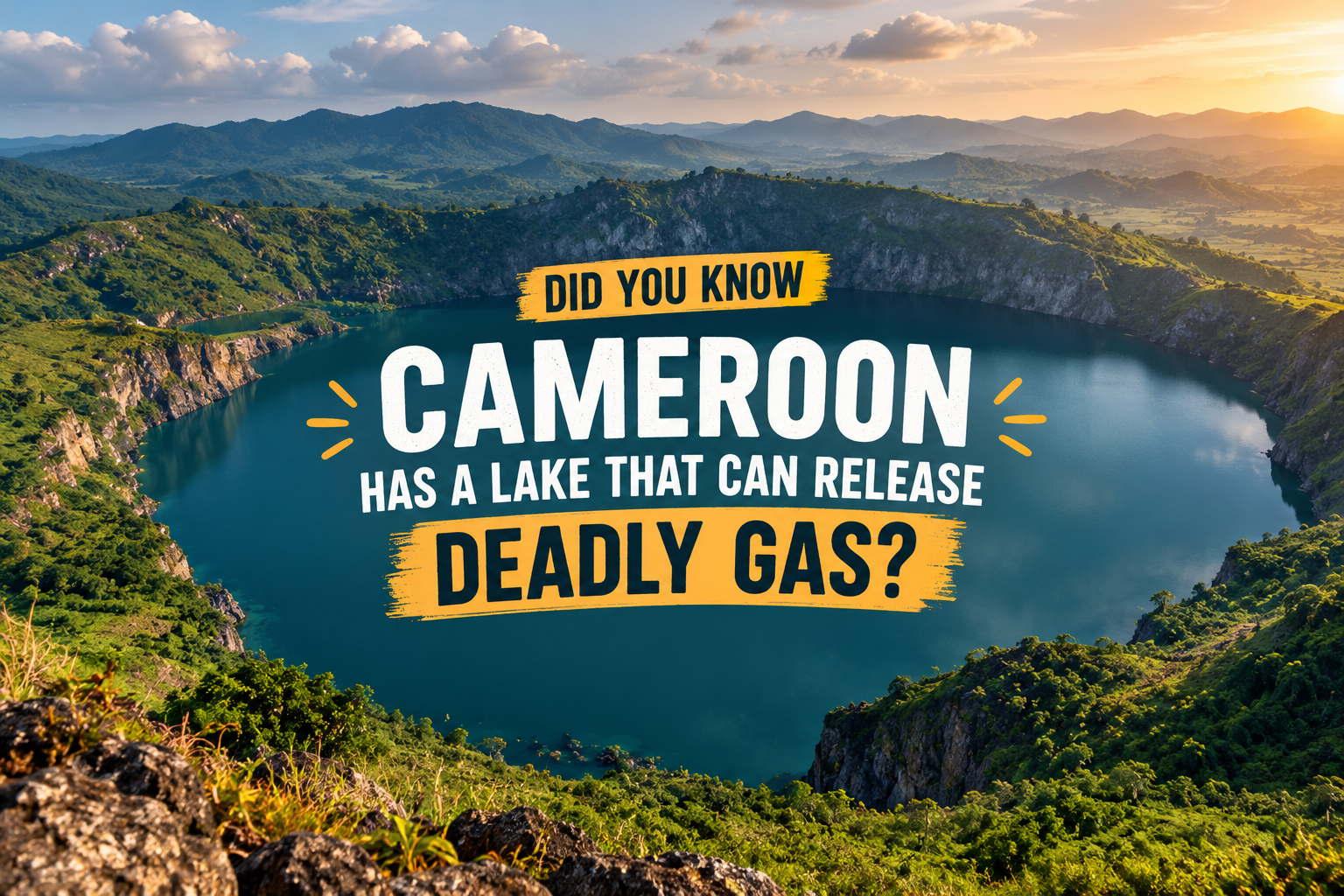
Hidden among the green hills of northwestern Cameroon lies Lake Nyos, a beautiful volcanic crater lake with an extraordinary natural feature: its deep waters can accumulate enormous amounts of carbon dioxide.
Unlike most lakes, Lake Nyos can store gas beneath its surface for years. Under certain conditions, that gas can escape suddenly in an event known as a limnic eruption.
The phenomenon is extremely rare and has made Lake Nyos one of Africa’s most closely studied lakes.
How can a lake store gas?
Lake Nyos sits in a volcanic region of Cameroon.
Carbon dioxide originating from underground volcanic activity gradually enters the lake through groundwater.
Because the lake is deep and its water layers do not mix easily, much of the gas remains dissolved near the bottom.
The process is similar to how carbon dioxide stays dissolved inside a sealed bottle of sparkling water under pressure.
If gas-rich deep water rises towards the surface, the lower pressure can cause carbon dioxide to escape rapidly.
Scientists call this unusual process a limnic eruption.
What happened at Lake Nyos in 1986?
On August 21, 1986, Lake Nyos experienced a sudden and devastating release of carbon dioxide.
The invisible gas spread through surrounding valleys, displacing breathable air and suffocating people and animals.
According to the United States Geological Survey, approximately 1,700 people and 3,500 livestock died in the disaster.
The tragedy drew international attention to the unusual geological conditions beneath the lake.
Scientists subsequently investigated how such a large quantity of gas could accumulate underwater and escape so rapidly.
How did scientists make the lake safer?
Following the disaster, engineers developed a system to remove carbon dioxide from the lake in a controlled manner.
Special pipes were installed to bring gas-rich water from the lake’s depths towards the surface.
As the water rises, the dissolved carbon dioxide escapes gradually rather than accumulating until a potentially dangerous release.
Controlled degassing began at Lake Nyos in 2001. Additional pipes were installed in later years.
Research has shown that these efforts substantially reduced the amount of dissolved gas and the risk of another major release.
Are there other lakes like Lake Nyos?
Lake Nyos is not the only lake known to accumulate large quantities of carbon dioxide.
Nearby Lake Monoun, also in Cameroon, experienced a deadly gas release in 1984.
Lake Kivu, located between Rwanda and the Democratic Republic of the Congo, also contains significant quantities of dissolved gases in its deep waters.
However, the conditions needed for this phenomenon are unusual, making such lakes exceptionally rare.
A remarkable example of nature and science
Today, Lake Nyos remains an important site for scientific research.
Its history has helped researchers better understand volcanic gases, lake chemistry and ways to reduce natural hazards.
The lake also demonstrates how scientific knowledge and engineering can help protect communities from dangers that are otherwise difficult to detect.
Beneath its peaceful surface lies one of Africa’s most remarkable geological stories.