
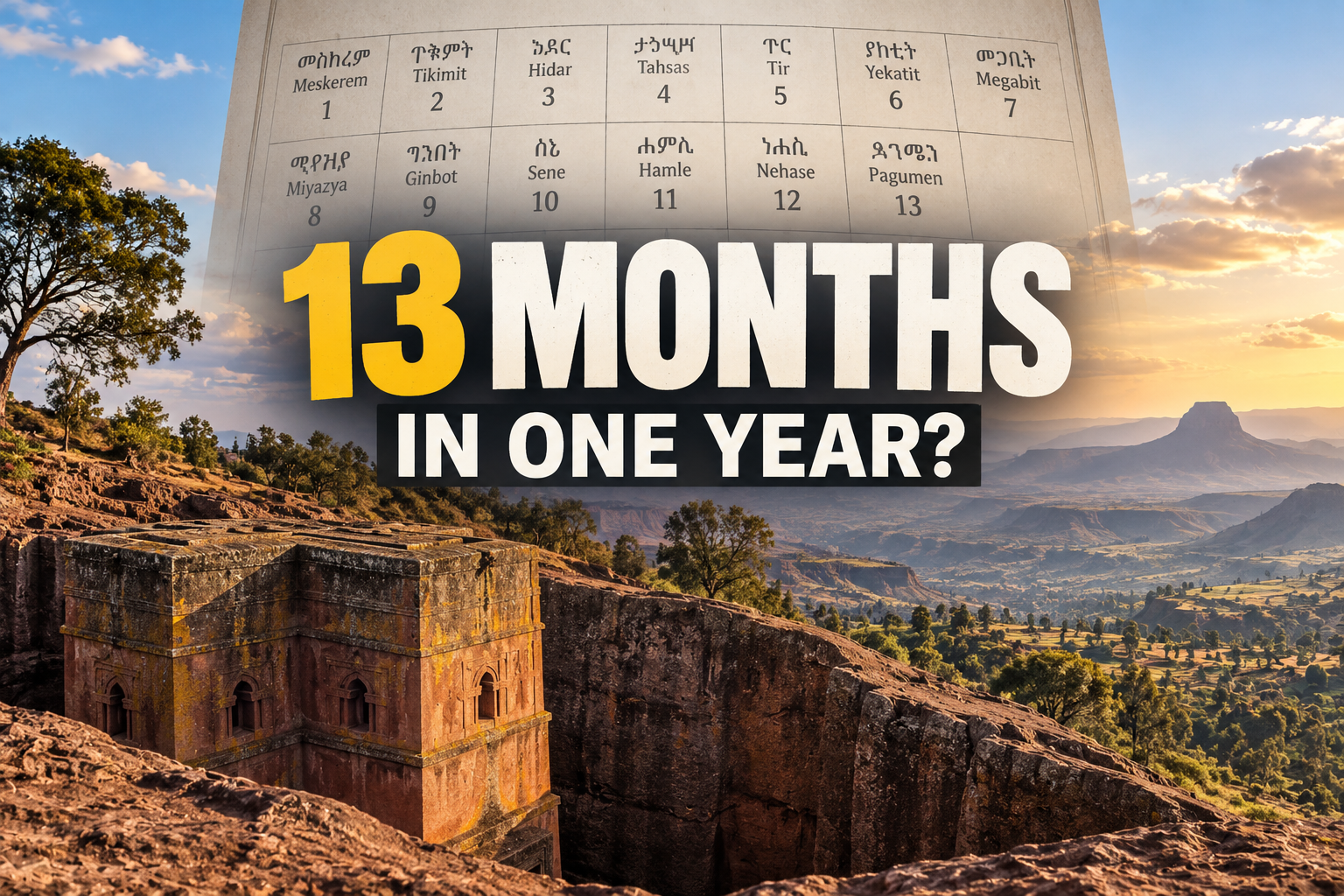
Most of the world divides the year into 12 months. Ethiopia’s calendar has 13.
The Ethiopian calendar has 12 months containing 30 days each. Then comes a short 13th month called Pagumen.
Pagumen usually lasts five days. During a leap year, it has six.
It is one of the most distinctive calendar systems still widely used today. But why is Ethiopia different?
Why does Ethiopia have 13 months?
Ethiopia follows its own traditional calendar, which developed from an ancient calendar tradition closely related to the Coptic calendar.
Instead of dividing the year into months of different lengths, the Ethiopian system keeps things relatively simple.
The first 12 months each contain exactly 30 days.
That accounts for 360 days.
The remaining five days — or six in a leap year — form Pagumen, the 13th and final month.
So Ethiopia does not have a longer year. It simply divides roughly the same solar year differently.
Ethiopia is also several years behind
There is another surprising difference.
The year displayed on the Ethiopian calendar is usually around seven to eight years behind the Gregorian calendar used internationally.
This difference comes from different historical calculations used to determine the date of the birth of Jesus Christ.
As a result, the Ethiopian New Year also does not fall on January 1.
It is generally celebrated on September 11 in the Gregorian calendar, or September 12 in the year before a Gregorian leap year.
Does Ethiopia really use this calendar?
Yes.
The Ethiopian calendar remains widely used for everyday life, public holidays and official purposes inside the country.
However, Ethiopians are also familiar with the Gregorian calendar, particularly when dealing with international travel, business and communication.
This means dates sometimes need to be converted between the two systems.
A calendar unlike most of the world
Ethiopia is well known for preserving cultural traditions that developed differently from those in many other parts of the world.
Its calendar is one striking example.
Twelve months have 30 days each. A tiny 13th month completes the year. And New Year’s Day arrives in September.
So when someone tells you Ethiopia has 13 months in a year, they really are right.