
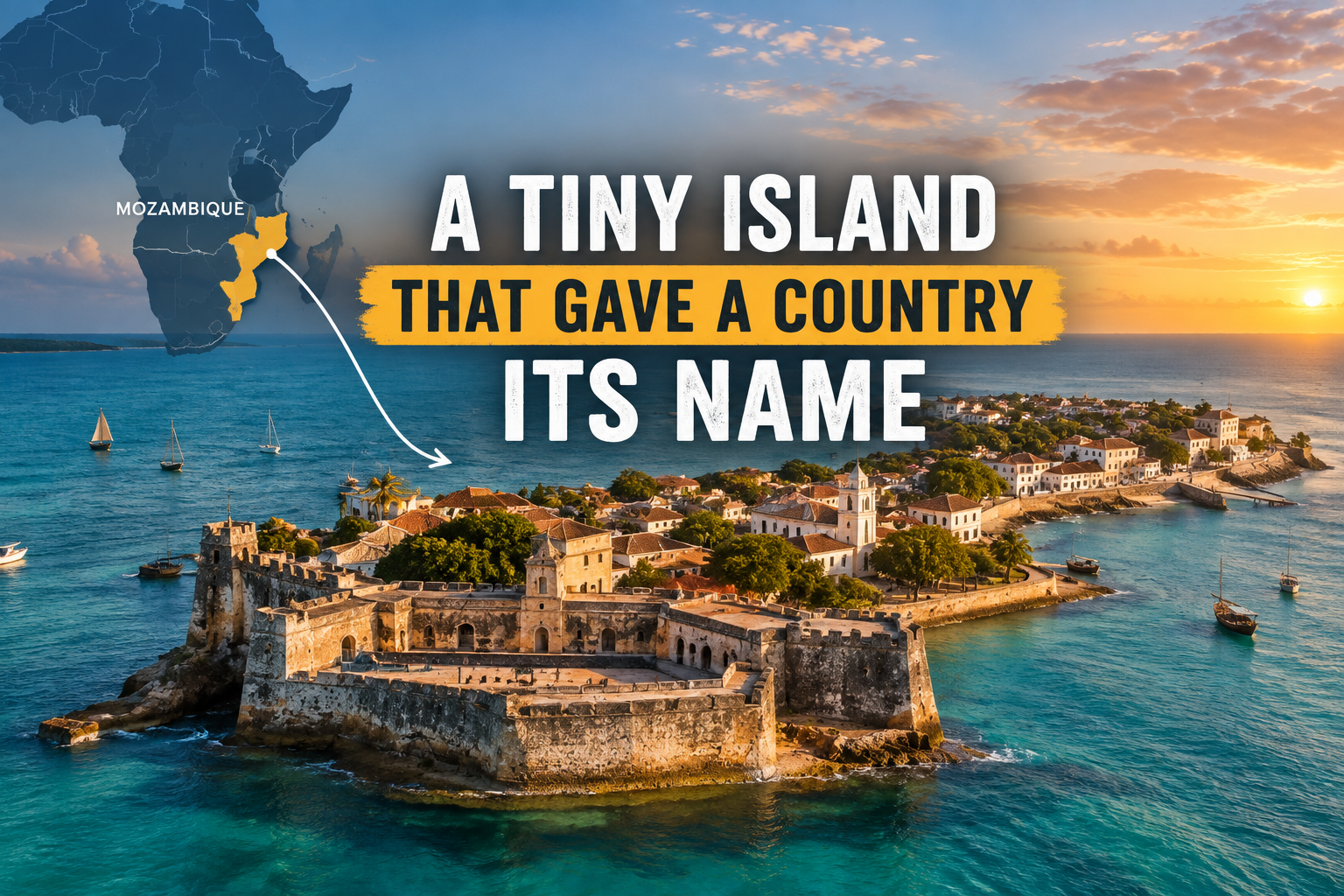
Mozambique is one of Africa’s largest coastal countries, stretching for thousands of kilometres along the Indian Ocean. Yet its name can be traced to a small island just a few kilometres from the mainland.
The Island of Mozambique, known in Portuguese as Ilha de Moçambique, gave its name to the modern country. Mozambique’s own tourism authorities identify the island as the place from which the country’s name originated.
Today, the historic island in northern Mozambique is a UNESCO World Heritage Site with a remarkable history stretching back centuries.
How did Mozambique get its name?
The exact origin of the word Mozambique is not completely certain.
A widely cited explanation connects the name to a local ruler or trader known by variations such as Mussa Bin Bique, Musa Al Big or Mussa Ben Mbiki.
Portuguese sailors adopted a version of the name for the island, and it eventually came to be used for the much larger territory on the African mainland.
So, rather unusually, the sequence was essentially:
Person → island → country.
The precise identity and spelling of the person behind the original name remain uncertain, so it is safer not to present one particular version as definitively proven.
A tiny island with a huge history
The Island of Mozambique sits about four kilometres off the mainland in northern Mozambique’s Nampula Province.
It lies on a coral reef at the entrance to Mossuril Bay and is connected to the mainland by a bridge.
Its location made the island important to Indian Ocean trade.
UNESCO says communities on the island were connected to intercontinental trading networks from around the 10th century. Over time, African, Swahili, Arab, Persian, Indian and European influences helped shape its culture and architecture.
Portuguese turned the island into a major trading post
When Portuguese navigators reached the region at the end of the 15th century, the island became strategically important on the maritime route linking Europe with India.
Vasco da Gama reached the Island of Mozambique in March 1498, according to historical documentation held by UNESCO.
The Portuguese later established a trading post and naval base there.
For centuries, the island served as an important administrative and commercial centre. UNESCO says it was the first seat of Portuguese colonial government in the territory before the administrative capital eventually moved south.
Why the Island of Mozambique is protected today
The island’s long history remains visible in its buildings.
Its northern area contains stone-and-lime architecture shaped by Swahili, Arab and European influences. Traditional African architecture is particularly visible in the southern part of the settlement.
Among its historic structures is the Fortress of São Sebastião, constructed between the 16th and 17th centuries.
UNESCO added the Island of Mozambique to the World Heritage List in 1991 because of its architectural and historical significance.
Today, the island is a reminder that the name of an entire African nation can have surprisingly small geographical beginnings.