
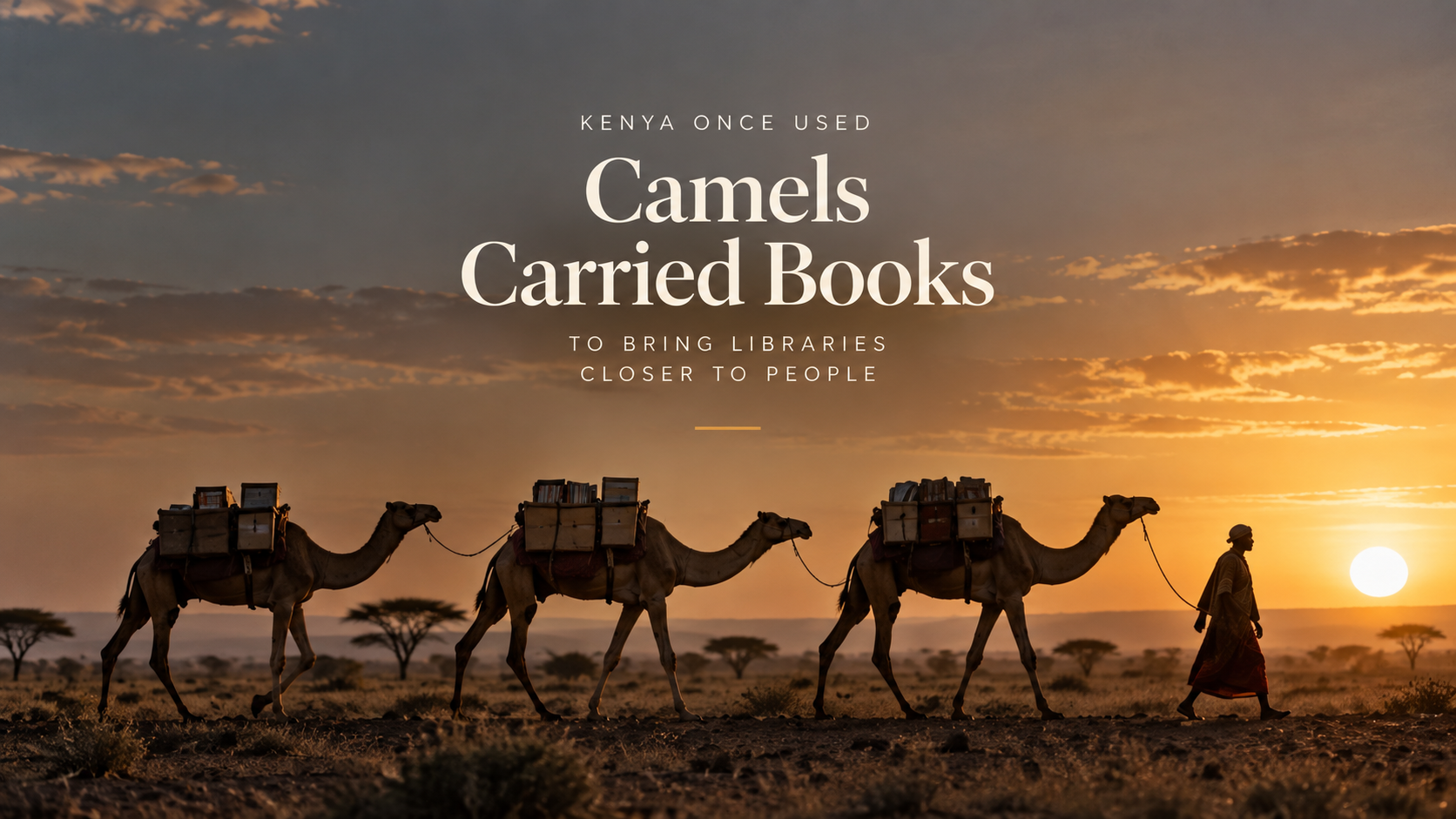
In northern Kenya, camels once carried something unusual across the dry landscape: library books.
The Kenya National Library Service (KNLS) created a camel library to bring books and reading services to communities that were far from conventional libraries.
The programme began in Garissa in 1996. After its success there, a similar service was launched in Wajir in 1999.
Why did Kenya use camels?
The camel was well suited to northern Kenya.
According to KNLS, camels were already a familiar and valued form of transport among nomadic communities.
They could also travel through the region’s difficult terrain.
As a result, they offered a practical way to bring books to communities that were difficult to reach by conventional library vehicles.
A library carried across the landscape
The service operated with camel caravans.
One camel could carry two boxes containing 200 books each.
Another camel carried equipment including a tent, reading mat, chairs and a table. A third camel travelled as a backup.
Library staff and a camel handler accompanied each caravan.
When they reached a village or another designated stop, the team unloaded the equipment.
They then pitched the tent and displayed the books on mats.
For a short time, the site became a temporary outdoor library.
Children, adult learners and other residents could use the books and library services.
At the end of the visit, everything was packed onto the camels again.
Then, the caravan returned to prepare for another journey.
What happened to Kenya’s camel libraries?
The unusual service did not continue forever.
KNLS says caring for the camels was costly. Travelling for long periods in high temperatures was also demanding for staff.
Meanwhile, roads in the region improved.
Eventually, KNLS discontinued the camel library and replaced it with motorbike services.
More residents could also travel directly to the Garissa library, while schools gained greater access to books through institutional memberships.
Still, Kenya’s camel library remains a remarkable example of how libraries adapted to geography to bring books closer to readers.