
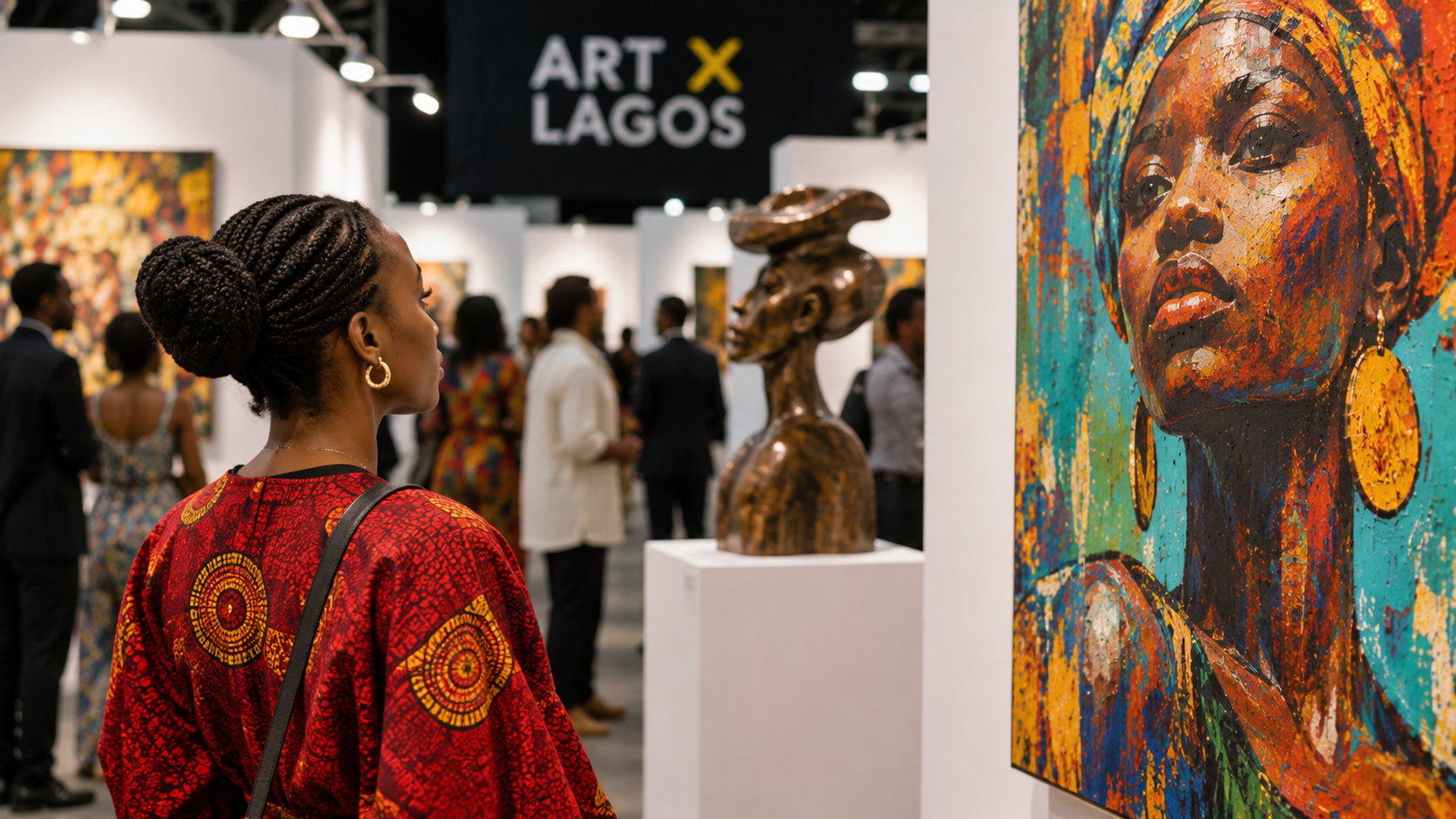
Lagos Art Week has brought together artists, collectors and visitors to explore African heritage, identity and cultural memory through contemporary art.
At the centre of the celebrations was ART X Lagos, one of West Africa’s leading art fairs. The event took place from November 5 to 8 at the Federal Palace Hotel on Victoria Island.
Now in its 11th edition, the fair featured paintings, sculptures, installations, films and discussions. This year’s theme, “A New Chapter, A New Decade,” highlighted the relationship between Africa’s artistic past and its creative future.
According to Al Jazeera’s Pelumi Salako, the exhibitions explored migration, cultural preservation and belonging while showcasing Lagos as a growing centre for African creativity.
African artists explore history and migration
Nigerian artist Ndidi Dike presented Residues of Past Encounters II, an installation examining slavery, colonialism and migration.
Her artwork featured a suspended wooden canoe, sand and traditional Adire-inspired fabric. Meanwhile, recorded ocean waves evoked Badagry, a Nigerian coastal town historically linked to the transatlantic slave trade.
The installation connected the experiences of people forcibly displaced centuries ago with the challenges facing contemporary African migrants.
Dike also highlighted the difficult journeys many young Africans undertake in search of opportunities abroad.
Through her work, she encouraged visitors to reflect on how historical experiences continue to shape modern African societies.
Celebrating Nigeria’s artistic pioneers
Another exhibition celebrated the legacy of Ladi Kwali, the renowned Nigerian potter whose work gained international recognition.
Titled Beyond the Vessel, the exhibition displayed Kwali’s handcrafted ceramics alongside photographs documenting her artistic achievements.
Her pottery featured intricate designs inspired by nature, including butterflies, lizards and scorpions.
Curator Jareh Das emphasised the importance of preserving African artistic traditions and introducing younger generations to influential cultural figures.
Meanwhile, ART X Lagos founder Tokini Peterside described African history as an important source of inspiration for contemporary creativity.
Art connects with younger generations
Beyond its exhibitions, Lagos Art Week also focused on education and public engagement.
More than 750 schoolchildren participated in the fair’s educational programme, gaining exposure to contemporary African art.
The initiative aimed to make artistic expression more accessible and encourage young people to explore their creative abilities.
Elsewhere, artist Adeniyi Adewole presented Breath Beneath the Waters, a sculpture reflecting his personal experiences with depression and recovery.
His work explored the transition from emotional difficulty towards peace and reflection.
Additional exhibitions across Lagos examined memory, domestic spaces and cultural identity.
Documentary revisits Chibok kidnapping
The programme also included Mothers of Chibok, a documentary directed by Joel Benson.
The film follows families affected by the 2014 Boko Haram kidnapping of 276 schoolgirls in northeastern Nigeria.
It explores the experiences of parents and survivors while highlighting the lasting consequences of insecurity.
According to Amnesty International figures cited in the original report, 82 of the abducted girls remained in captivity as of April 2024.
The documentary encouraged conversations about remembrance, justice and the protection of girls.
Lagos strengthens its cultural influence
The exhibitions demonstrated how contemporary African artists are using creativity to examine difficult histories while celebrating cultural achievements.
From traditional pottery to modern installations, Lagos Art Week offered visitors opportunities to engage with African stories through different artistic forms.
The event also reinforced Lagos’s growing importance as a destination for contemporary African art.
As the fair concluded, its central message remained clear: Africa’s cultural heritage continues to influence how artists understand the present and imagine the future.