
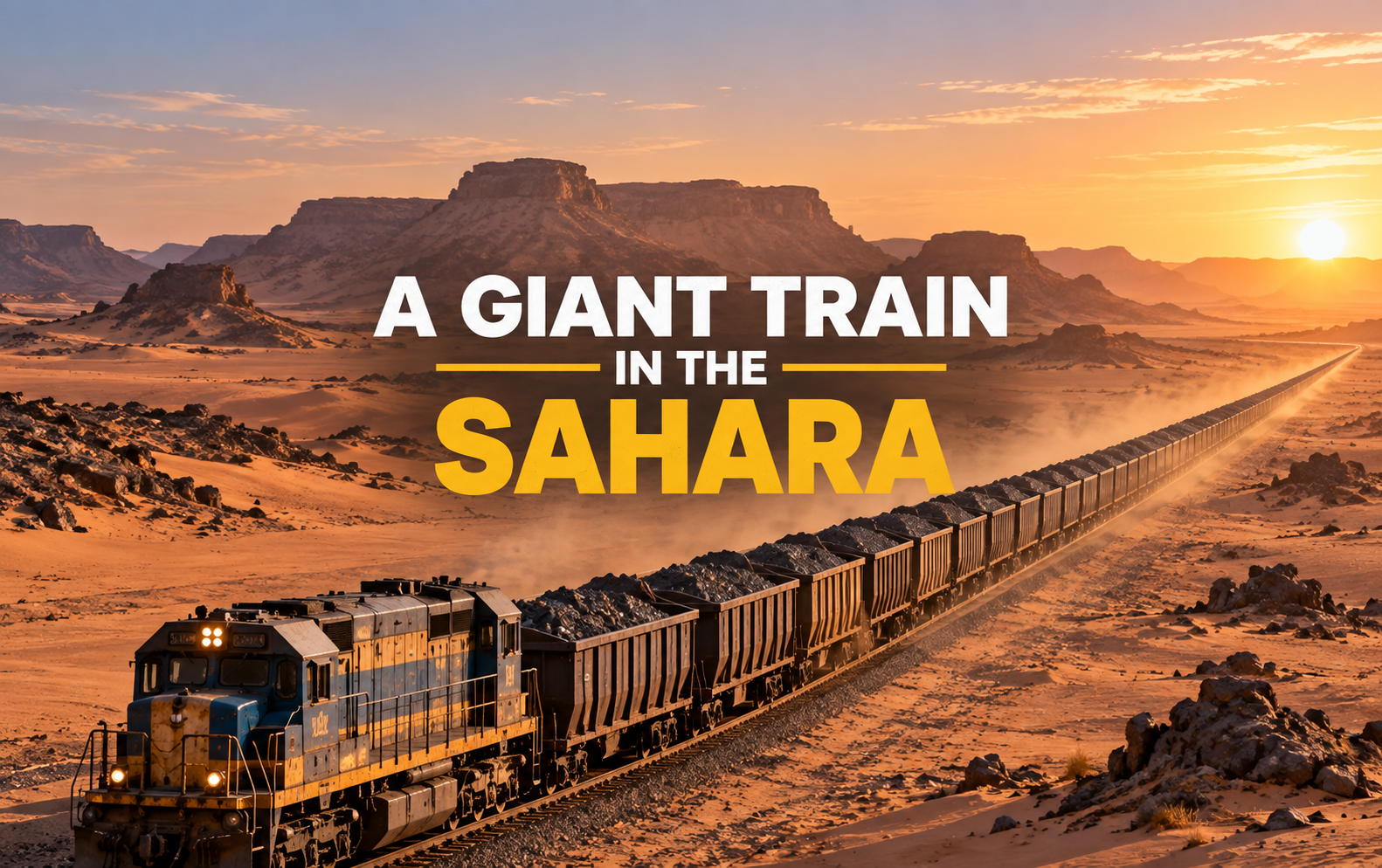
Across the Sahara, a huge train carries iron ore through hundreds of kilometres of desert in Mauritania.
The railway connects the mining region around Zouerate with the Atlantic port of Nouadhibou. Mauritania’s state mining company SNIM says the railway stretches for more than 700km.
The enormous ore trains travelling along this route have become one of Mauritania’s most recognisable sights.
But why does the country need such a remarkable railway?
From Mauritania’s mines to the Atlantic
The answer lies beneath the desert.
Northern Mauritania contains major deposits of iron ore. SNIM operates mines and processing facilities around Zouerate in the Tiris Zemmour region.
However, the mines are hundreds of kilometres from the coast.
Therefore, Mauritania needs a reliable way to move huge quantities of ore across the Sahara.
The railway provides that connection.
It links the mining sites around Zouerate with Nouadhibou on the Atlantic coast. There, the iron ore is transferred onto ships for export.
Why are the trains so long?
Iron ore is extremely heavy. Moving it efficiently requires large numbers of freight wagons.
As a result, Mauritania’s ore trains can form extraordinarily long convoys across the desert.
SNIM describes the railway as one of the world’s longest and most heavily used lines dedicated to transporting ore.
The company normally operates several ore trains each day between the mining region and the port.
So the railway is not simply an unusual attraction. It is a major part of Mauritania’s mining industry.
Iron ore is important to Mauritania
Mining plays a major role in Mauritania’s economy.
SNIM says it sells more than 14 million tonnes of iron ore annually. The company also says it accounts for about 27% of the country’s exports.
In 2024 alone, SNIM transported a record 14.3 million tonnes of iron ore on its railway.
Once the trains reach Nouadhibou, the ore can be loaded onto large ships.
The port has also been expanded to handle growing mining operations.
A railway across the Sahara
The Mauritanian railway has operated as part of the country’s mining industry for decades.
SNIM says its iron ore products have been sold internationally since 1963. Today, the company controls the process from mining and processing to rail transport and loading ships.
The railway also serves communities along the remote desert corridor. SNIM says it provides transport for people and goods along the route, alongside its main role carrying iron ore.
That makes Mauritania’s famous train more than an extraordinary sight in the Sahara.
It is the backbone of a system connecting remote desert mines with the Atlantic Ocean and international markets.