
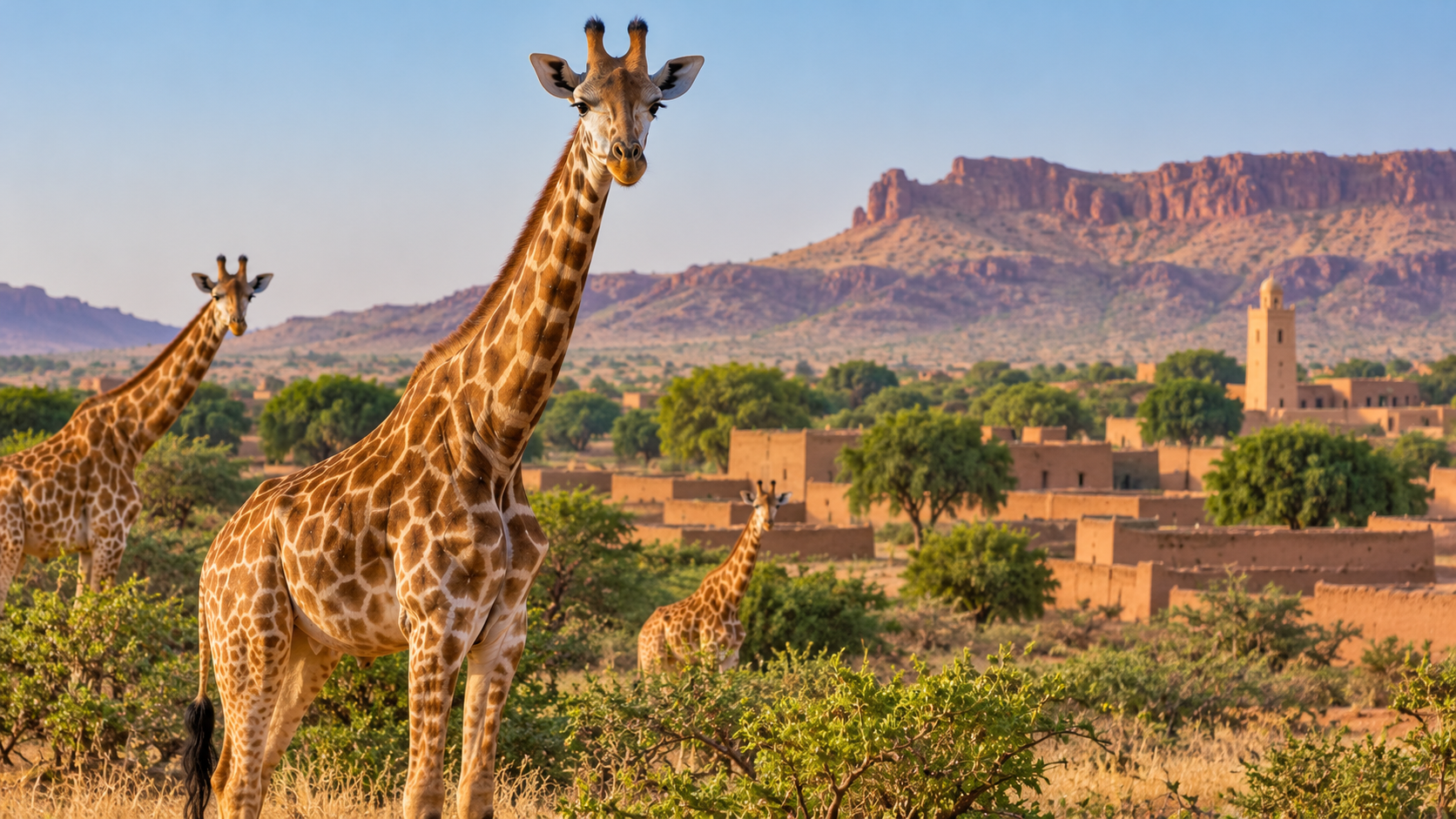
When people think of giraffes, they often imagine the famous wildlife parks of Kenya, Tanzania or South Africa.
However, one of Africa’s most remarkable giraffe populations lives in Niger, a country better known for its vast desert landscapes.
Near the village of Kouré, southeast of the capital, Niamey, West African giraffes roam through open countryside, farmland and areas surrounding rural communities.
Unlike giraffes living inside fenced wildlife reserves, these animals have long shared their habitat with local residents.
Even more surprisingly, their population has recovered from the brink of extinction.
Niger’s giraffes nearly disappeared
During the 1990s, the future of Niger’s West African giraffes looked uncertain.
Habitat loss, hunting and growing pressure from human activities had reduced their numbers dramatically.
By 1996, fewer than 50 individuals remained in the country’s surviving population.
The animals faced a serious risk of disappearing from the wild.
However, conservation organisations, local communities and government authorities began working together to protect them.
Their efforts helped transform the population’s future.
Over the following decades, giraffe numbers increased substantially, making Niger an important example of successful wildlife conservation.
Giraffes live alongside local communities
One of the most unusual features of Niger’s giraffes is their relationship with nearby villages.
Around Kouré, the animals move through landscapes where people grow crops and raise livestock.
Unlike many wildlife populations, these giraffes are not confined to a traditional national park.
Instead, they share much of their environment with farming communities.
This arrangement creates challenges, particularly when giraffes feed on crops or move through cultivated areas.
Nevertheless, local participation has played an important role in conservation.
Community awareness programmes, habitat protection and efforts to reduce conflicts have helped people and wildlife coexist.
The giraffes have also attracted visitors interested in seeing these animals in their natural surroundings.
What makes West African giraffes special?
West African giraffes belong to a distinctive giraffe population associated with the region.
They have relatively pale coats with brown patches separated by lighter lines.
Like other giraffes, they use their long necks to reach leaves high in trees.
Their height allows them to feed on vegetation that many other grazing animals cannot easily reach.
Giraffes also have remarkably long tongues, which help them grasp leaves from branches.
Despite their impressive size, they are generally quiet animals.
They spend much of their time feeding, moving between trees and resting.
Conservation efforts bring new hope
Niger’s giraffe recovery shows how conservation can succeed when communities participate.
Protection measures have helped the population grow from its extremely low numbers in the 1990s.
Conservationists have also worked to establish additional populations in suitable habitats.
For example, some giraffes have been relocated from the Kouré area to the Gadabedji Biosphere Reserve.
The aim is to reduce the risks of keeping the entire population in one area.
Establishing more than one population can help protect the animals against local threats.
However, habitat pressures and human-wildlife conflicts remain important challenges.
Continued protection is therefore essential.
A surprising wildlife story from Niger
Niger is often associated with the Sahara Desert, ancient trade routes and spectacular landscapes.
Yet its giraffes reveal another side of the country.
Their recovery demonstrates the importance of protecting wildlife beyond traditional national parks.
It also highlights the role that local communities can play in preserving threatened animals.
Fun fact: Niger’s West African giraffes recovered from fewer than 50 individuals in the 1990s, becoming one of Africa’s notable wildlife conservation success stories.