
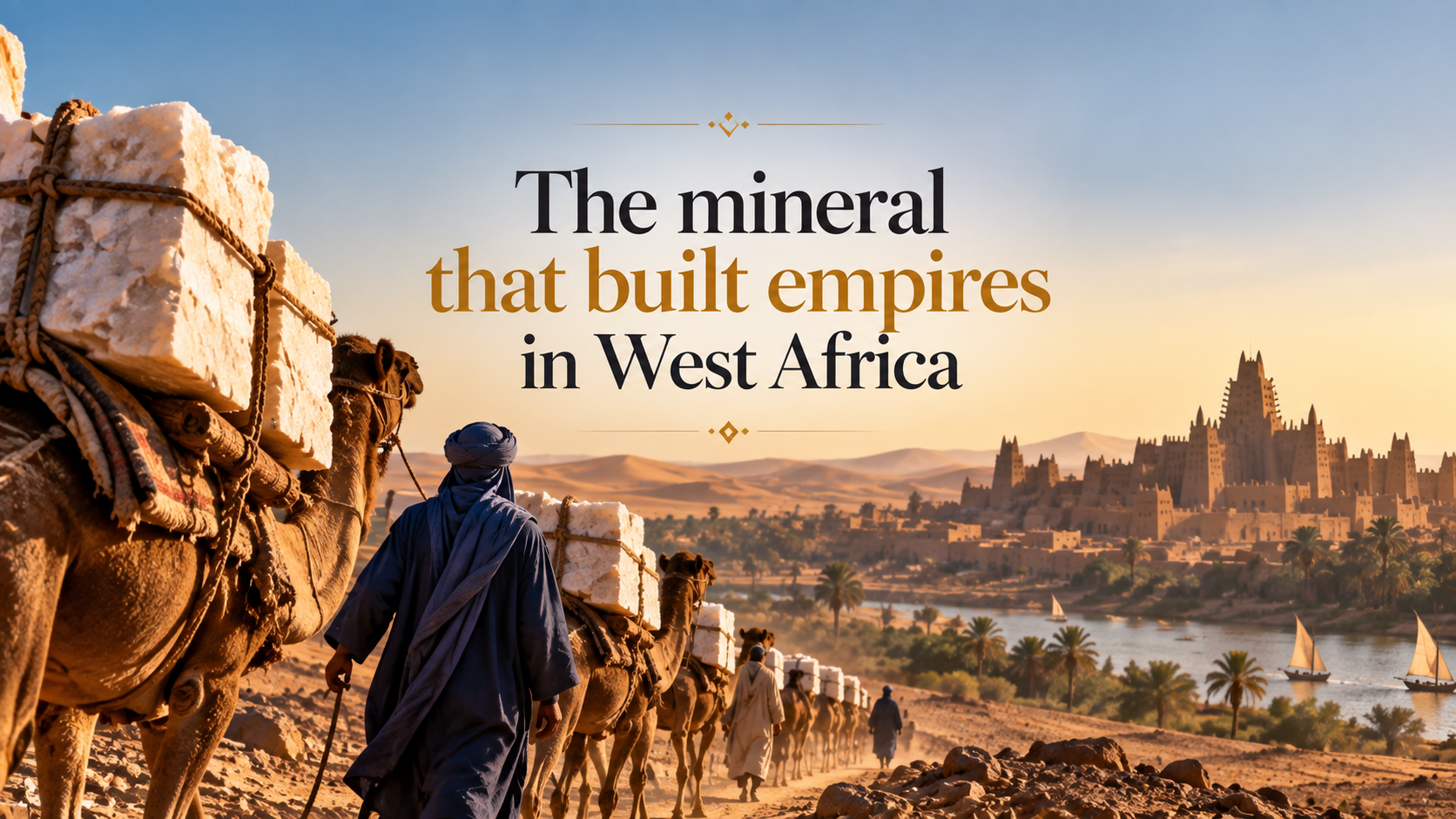
Why salt was once one of West Africa’s most valuable goods
Today, salt is an inexpensive everyday ingredient. But centuries ago, it was one of the most important goods moving across West Africa.
In some areas, salt could even be exchanged for gold.
The reason was simple. Large deposits of rock salt existed in the Sahara, while many communities farther south had much more limited access to high-quality salt. At the same time, West Africa contained major gold-producing regions.
That difference helped create one of Africa’s great historic trading networks.
Why was salt so valuable in West Africa?
Salt was important for everyday life.
People needed it in their diets. It was also useful for preserving food, particularly before modern refrigeration.
However, good sources of salt were unevenly distributed.
Major deposits could be found in the Sahara. Salt was extracted from desert locations such as Taghaza and transported south in large slabs.
Moving such a heavy product across the desert was difficult. That added to its value by the time it reached communities farther south.
Camels carried salt across the Sahara
Camel caravans transformed long-distance trade across the region.
Merchants loaded slabs of salt onto camels and travelled along routes connecting the Sahara with West African trading centres.
Cities including Timbuktu became important links in these networks. From there, salt could travel farther south, including along the Niger River.
The journey could involve hundreds of kilometres of desert.
Meanwhile, merchants travelling north carried valuable goods from West Africa, particularly gold.
Salt and gold moved in opposite directions
This created a powerful exchange.
Salt generally moved south from the Sahara. Gold from regions farther south moved north towards North Africa and eventually Mediterranean markets.
Historical accounts suggest that salt became extremely valuable after travelling far from its source.
In some remote areas, it could reportedly be exchanged for gold dust at comparable weights.
However, this did not mean salt was always worth the same as gold everywhere in West Africa. Its value changed depending on location, supply and transportation costs.
Trade helped powerful empires grow
The gold-and-salt trade also helped shape West African history.
The Ghana, Mali and Songhai empires benefited from controlling important trade routes and commercial centres.
Rulers could collect taxes on goods moving through their territories. Their location between Saharan salt deposits and gold-producing regions farther south gave them major economic advantages.
Timbuktu later became one of the best-known centres connected to this trade.
The city linked trans-Saharan caravans with commercial routes running deeper into West Africa.
A mineral that helped connect a region
Salt may appear ordinary today, but its history tells a much bigger story.
The demand for it helped merchants cross the Sahara, connected distant communities and supported trading cities and powerful states.
It also shows why the value of something can depend on where it is found.
In the Sahara, salt could be abundant. Hundreds of kilometres farther south, the same mineral could become an extremely valuable commodity.