
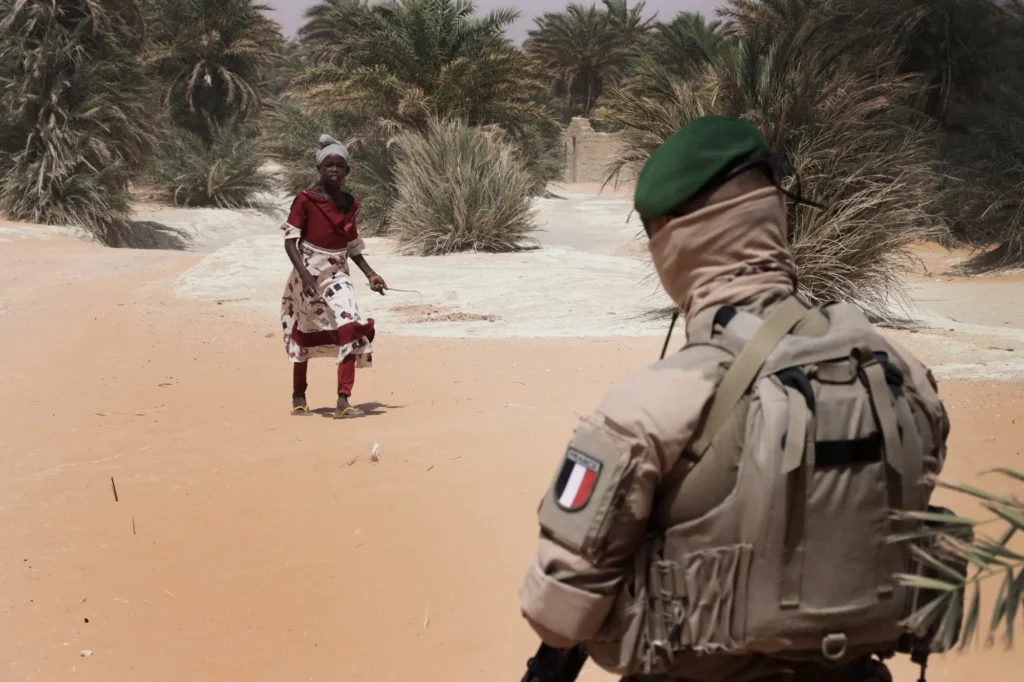
Chad ends military pact with France, seeks independence
Chad has terminated its military pact with France, citing its outdated nature and the need for greater autonomy.
Chad ends military pact with France, seeks independence Read More »
Chad has terminated its military pact with France, citing its outdated nature and the need for greater autonomy.
Chad ends military pact with France, seeks independence Read More »

The incident highlights the dangers of football hooliganism and the need for improved security measures at sporting events.
Around 100 killed in violent clashes during football match in Guinea Read More »

Rewriting the Thiaroye Massacre and the Shifting Historical Narrative The massacre at Thiaroye, which took place on December 1, 1944, remains one of the darkest chapters in the history of French colonialism in West Africa. The victims were soldiers of the “Tirailleurs Sénégalais,” a corps of colonial infantry drawn from West Africa to fight in both World Wars. Tensions had been building among the soldiers over unpaid wages in the days leading up to the massacre, and on that fateful day, French troops turned their guns on unarmed African soldiers, killing many. For years, French authorities downplayed the incident, labeling it as a “mutiny.” Early French military reports suggested that only 35 soldiers were killed, while later reports increased the death toll to 70. But recent research, including estimates based on the number of soldiers stationed at the camp, suggests the true toll could have been in the hundreds, with some historians estimating up to 400 deaths. On Thursday, French President Emmanuel Macron officially acknowledged the event as a massacre for the first time, in a letter to Senegal’s President Diomaye Faye, which was seen by The Associated Press. “France must recognize that on that day, the confrontation between soldiers and riflemen who demanded their full legitimate wages be paid, triggered a chain of events that resulted in a massacre,” Macron wrote. However, many historians reject the notion of a “confrontation” between the French soldiers and the African riflemen. Martin Mourre, a French historian and author of Thiaroye 1944: History and Memory of a Colonial Massacre, argues that the events were nothing less than the execution of unarmed soldiers. He points to the absence of any mention of weapons in the trial of the accused African soldiers and the lack of injuries among the French troops as evidence that there was no violent uprising, but rather a cold-blooded massacre. While Macron’s letter recognizes the event as a massacre, it avoids specifying the exact number of casualties, which remains a source of contention. The lack of transparency in the historical record has compounded the controversy. In 2014, French President François Hollande handed over archives on Thiaroye to Senegal’s then-president, Macky Sall. However, key documents—such as those detailing the location of mass graves and the precise number of soldiers present—remain elusive. It is unclear whether these documents still exist or if they have been lost or withheld. Senegalese efforts to uncover the truth have also been hampered. Under President Sall, historical investigations into the massacre were often delayed or obstructed, with some historians blaming diplomatic sensitivities toward France. “The archives remained inaccessible until this year for obscure reasons,” says Mourre. Mamadou Diouf, a Senegalese historian, notes that Sall’s reluctance to confront the painful history was likely aimed at avoiding tensions with the French government. However, Senegal’s newly elected President Bassirou Diomaye Faye has vowed to take control of the country’s historical narrative, with a focus on Thiaroye. Since his election in March, Faye has emphasized the importance of recognizing the massacre as a crucial part of Senegal’s national story. The government has organized extensive commemorations from December 1 to April 2025 to raise awareness and educate the public about the massacre. These efforts are part of a broader attempt to address the colonial past and reclaim Senegal’s historical voice. “The authorities’ goal behind these major commemorations is to integrate Thiaroye into Senegal’s national identity,” says Babacar Ndiaye, a political analyst at the Wathi think tank. “This is not just about remembering the massacre but ensuring the younger generation, many of whom may not know the full story, are exposed to it through television, media, and social media.” The 80th anniversary of the Thiaroye massacre occurs amid a shift in France’s influence in West Africa, where former colonies are increasingly distancing themselves from Paris. In recent years, countries like Mali, Burkina Faso, and Niger have expelled French forces, while Chad has ended its military cooperation agreement with France. Senegal remains one of the few countries where French troops are still present, although they play a more limited, supportive role. President Faye has made clear that he does not view the continued French military presence favorably. “Historically, France enslaved, colonized, and stayed here,” he remarked. “It would be difficult to imagine another country, like China or Russia, having a military base in France.” At a ceremony on Sunday at the Thiaroye military cemetery, Faye announced several initiatives to honor the victims. These include the construction of a memorial, the creation of a research center to house the massacre’s archives, and the addition of history lessons on the event to the national school curriculum. December 1 will now be officially recognized as “National Day of the Tirailleur.” “We are doing this to fulfill our duty of remembrance, to reveal the truth, and to discharge a moral debt to the riflemen and their families,” Faye said, addressing an audience that included France’s Foreign Minister Jean-Noël Barrot, as well as heads of state from neighboring countries. Macron did not attend the ceremony. The official narratives continue to differ. While the French foreign minister referred to the events as a “cry of anger” from the riflemen, which France “repressed in a bloodshed,” President Faye characterized the killings as “a premeditated act”—a clear sign of the ongoing tension between the two countries over how to reckon with this painful chapter of history.
France acknowledges Thiaroye massacre amid ongoing disputes Read More »

The country will also work to amplify the voices of the Global South and address pressing global challenges such as climate change and pandemic preparedness.
Africa’s first G20 presidency: South Africa takes charge Read More »

East African leaders gathered in Arusha, Tanzania, to discuss regional peace and security, particularly the ongoing conflict in eastern Congo.
Regional summit seeks peace in DR Congo, despite absence Read More »

The students were staying in a house near their school when the storm hit.
Four students killed in lightning strike in Malawi Read More »

This training is part of a broader effort by Turkey to strengthen Somalia’s military capabilities.
Somali elite soldiers graduate from Turkish training program Read More »

Armed men abducted women and children from a sinking migrant boat off the Libyan coast.
Migrant boat sinks off Libya, women, children abducted Read More »

Rescue operations are ongoing in eastern Uganda following devastating landslides that have buried homes in over six villages. Irene Muloni, a former Energy Minister and current Woman MP for Bulambuli District, urged authorities on Thursday (Nov. 28) to relocate residents from the disaster-stricken area. So far, 45 houses have been completely buried. At least 15 people, including 7 children, have been confirmed dead, and 113 others are still missing. “The government is working to acquire more land, but as you can see, the situation is dire. The rains are continuing, and the water is everywhere—on the hills, flowing down in waterfalls. It’s just too dangerous. People need to be moved immediately. My appeal is for the people to leave this area and stay with relatives. Let’s leave this place,” Muloni said. The landslides occurred after heavy rainfall on Wednesday night in the mountainous Bulambuli District, located about 280 kilometers east of Uganda’s capital, Kampala. This is not the first time the district has been impacted by torrential rains; last year, similar flooding caused significant loss of life. Uganda Police have ramped up rescue efforts, working alongside other security agencies and local communities. However, rescue teams are facing challenges due to impassable roads. During a rescue operation on the Nile River, two boats capsized on Wednesday while attempting to reach the submerged Pakwach Bridge.
Rescue efforts continue in Eastern Uganda after deadly landslides Read More »

Tanzanians have been voting in local government elections, seen as a key test for the country’s democratic institutions ahead of the 2025 presidential election. Around 31 million eligible voters are choosing from over 80,000 candidates for village and street leadership positions, which hold significant influence across the country. President Samia Suluhu Hassan’s ruling Chama Cha Mapinduzi (CCM), a dominant force for decades, is facing growing opposition, particularly from parties that boycotted the 2019 elections. While Hassan promised a free and fair vote, there have been allegations of irregularities and repression leading up to the polls. The main opposition party, Chadema, accused the authorities of electoral fraud, citing the disqualification of thousands of its candidates and alleged ballot box stuffing. Chadema also reported that three of its members were killed on the eve of the election, and party leader Freeman Mbowe was briefly arrested during a rally over the weekend. Hassan, who assumed office in 2021 after the sudden death of her authoritarian predecessor, John Magufuli, was initially praised for easing restrictions on the opposition and media. However, rights groups and Western governments have since criticized what they view as a resurgence of repression ahead of these elections.
Tanzania holds local elections amid allegations of irregularities and repressi... Read More »