
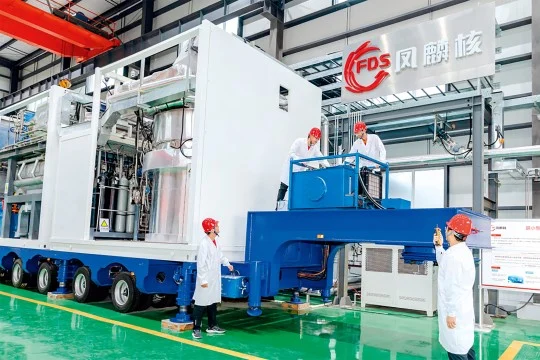
China has tested a prototype nuclear reactor small enough to be mounted on a truck, in what researchers say could mark a breakthrough in mobile energy systems designed for remote and high-demand environments.
The experimental unit, developed by scientists at the Institute of Nuclear Energy Safety Technology, is a compact microreactor capable of generating around 10 megawatts of power — enough to supply electricity to industrial sites, data centres or isolated communities.
State-linked researchers described the system as a mobile “power bank”, designed to be transported by road and deployed rapidly in areas where traditional grid infrastructure is unavailable or has been disrupted.
Microreactors are a new class of nuclear technology significantly smaller than conventional plants, with the ability to operate for years without refuelling. China’s prototype is among the first designed specifically for vehicle-based deployment, highlighting Beijing’s push to develop flexible nuclear solutions.
The potential applications are wide-ranging, from disaster response and mining operations to military logistics and energy-intensive technologies such as artificial intelligence computing hubs.
The project forms part of China’s broader effort to expand its leadership in advanced nuclear systems, including small modular reactors and next-generation designs aimed at improving efficiency and reducing waste.
However, the concept raises significant concerns among analysts, particularly around safety and security. Transporting a nuclear reactor introduces new risks, including potential accidents, targeting in conflict zones, and the absence of clear international regulatory frameworks governing mobile nuclear technology.
Experts say the key challenge will be proving that such systems can be safely transported, deployed and operated under real-world conditions before they can move beyond the prototype stage.
If successful, the development could signal a shift away from large, fixed nuclear plants toward portable reactors capable of delivering reliable power wherever it is needed.