
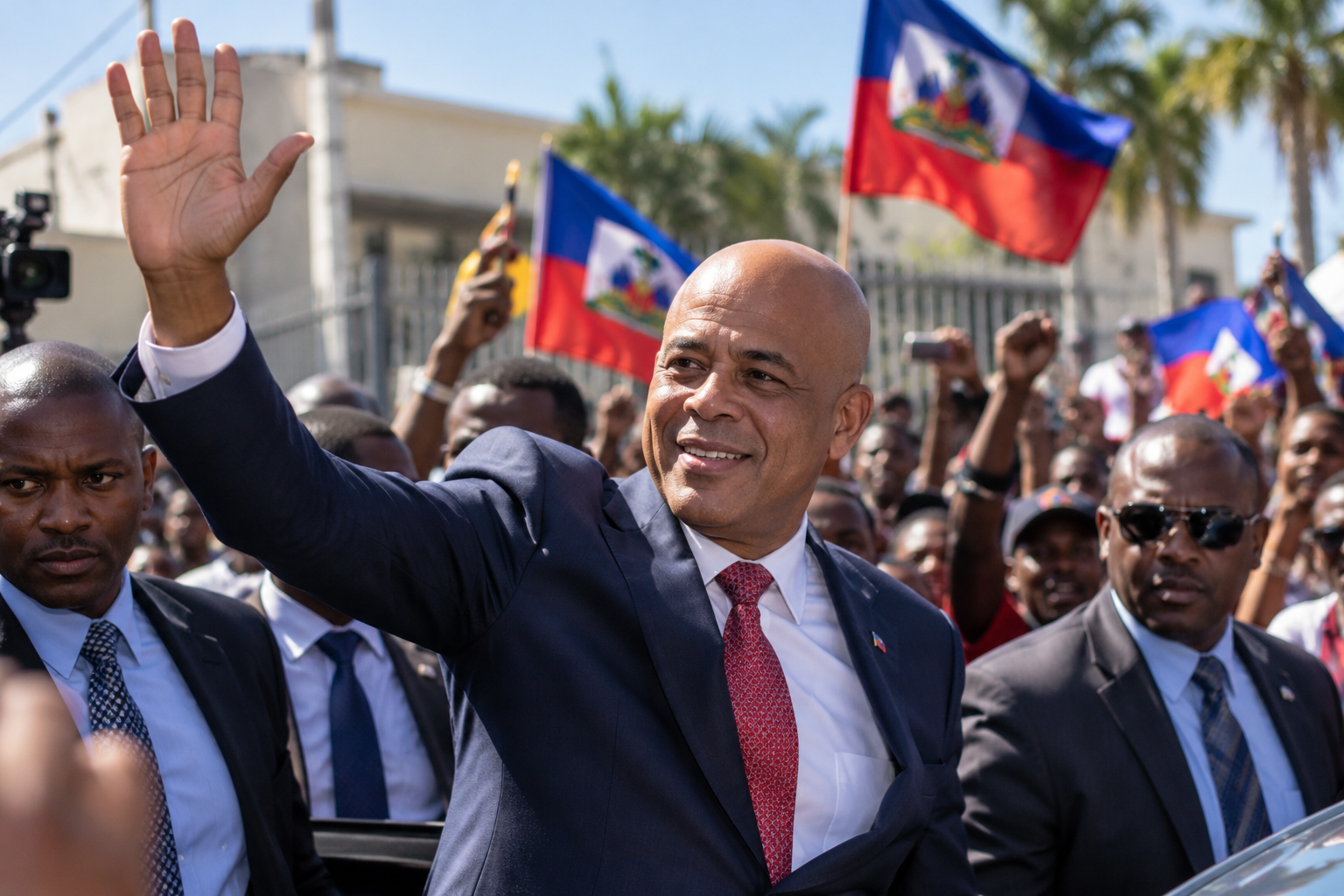
Haiti’s former President Michel Martelly has entered the country’s presidential election race as gang violence continues to threaten the voting process.
Martelly officially registered his candidacy on Friday, October 23. Haiti plans to hold its general elections on December 13, 2026.
The vote would be the country’s first general elections in more than a decade.
However, widespread gang violence has raised serious concerns about whether the elections can take place safely.
According to the Associated Press, Martelly arrived at the electoral council’s offices in Port-au-Prince with three lawyers. Hundreds of supporters also gathered to welcome him.
Martelly joins Haiti presidential election race
Martelly served as Haiti’s president from 2011 to 2016.
Before entering politics, he was a popular musician known as Sweet Micky.
Now, he hopes to return to power through the Debloke political coalition. The alliance includes former members of PHTK, the party he previously led.
However, his candidacy comes amid controversy over international sanctions.
The United States and Canada previously sanctioned Martelly. Both countries accused him of facilitating drug trafficking and supporting criminal gangs.
Earlier this month, Haiti’s electoral council removed a rule that affected candidates facing foreign sanctions.
The decision, announced on October 9, removed a potential obstacle to Martelly’s candidacy.
Gang violence threatens Haiti presidential election
Meanwhile, Haiti continues to struggle with widespread gang violence.
More than 1.4 million people have fled their homes because of insecurity, according to the Associated Press.
Armed gangs also control an estimated 70 percent of Port-au-Prince.
In addition, they control major roads connecting the capital to the Central and Artibonite regions.
These three areas are home to more than half of Haiti’s voters.
As a result, many residents may struggle to register or reach polling stations.
Security concerns could also prevent election officials from organising voting in some communities.
UN report warns of rising violence
A recent report submitted to the United Nations Security Council highlighted the influence of criminal gangs in Haiti.
The report described links between armed groups and powerful political and economic figures.
It also warned that violence could increase ahead of the December elections.
Meanwhile, attacks against security personnel have added to the country’s challenges.
In a recent incident, armed men abducted four Salvadoran officers serving with an international security force.
The officers were aviation technicians working to support efforts against criminal gangs.
Following the attack, El Salvador’s President Nayib Bukele ordered a special forces operation to rescue them.
The incident highlighted the dangers facing security personnel in Haiti.
Election officials extend registration deadline
Despite these challenges, preparations for Haiti’s presidential election continue.
The Provisional Electoral Council has extended the candidate registration deadline to October 31.
By October 24, 16 presidential candidates had registered, according to the Associated Press.
However, election officials still face major security and logistical challenges.
Millions of Haitians live in areas affected by gang violence. Therefore, ensuring safe access to polling stations remains a major concern.
The country must also address the needs of displaced voters.
Haiti faces uncertain political future
The upcoming elections could mark an important step towards restoring democratic institutions.
However, holding a successful vote will require improved security and public confidence.
Political stability also depends on ensuring that citizens can participate without fear.
For now, Haiti’s presidential election remains a major test for a country struggling with violence and political uncertainty.
The coming weeks will be crucial as election officials prepare for the December vote.