
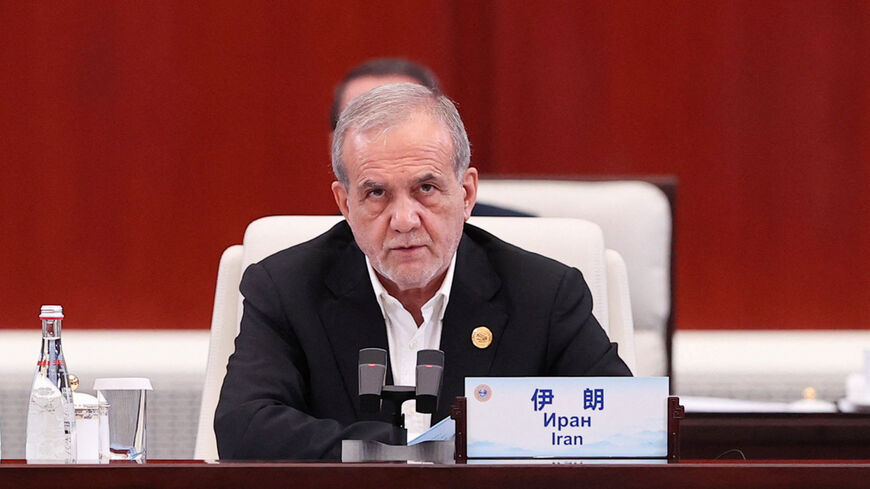
Iranian President Masoud Pezeshkian was reportedly taken to a secret location in Tehran for a meeting with Supreme Leader Mojtaba Khamenei — but was never allowed to see him and could only hear his voice.
The extraordinary encounter, reported by Iran International citing informed sources, has deepened questions over Khamenei’s health, whereabouts and even whether the president spoke to the supreme leader at all.
According to the report, Pezeshkian was escorted by security personnel to an undisclosed location after repeatedly requesting a meeting and threatening to resign.
Instead of being taken to Khamenei’s residence, the president was placed in the rear seat of a commercial vehicle with heavily tinted windows. He was reportedly denied a handshake and spoke for only a few minutes to a person he could not see.
Pezeshkian was then ordered to leave.
The Iranian president reportedly considered the treatment humiliating and later raised an extraordinary question inside the presidential office: Was the person whose voice he heard really Mojtaba Khamenei?
The sources said it remained unclear whether the question reflected genuine doubts over the speaker’s identity or anger at the way Pezeshkian had been treated.
Pezeshkian later requested another meeting at Khamenei’s residence, but the request has reportedly been rejected.
The account could not be independently verified, and Iranian authorities have not publicly confirmed the details.
Still, the report has drawn attention because no verified video or audio recording of Mojtaba Khamenei has been released since he was selected as Iran’s supreme leader around five months ago.
The prolonged absence has fuelled speculation about his health and location, particularly after reports that he may have been seriously injured or killed.
A video published by the Iranian newspaper Hamshahri on August 2 claimed foreign intelligence agencies could locate Khamenei by analysing audio recordings, background noise and fluctuations in electricity networks.
The video also claimed intelligence agencies could assess his injuries or emotional condition through changes in his voice — an explanation that only intensified questions over why Iran’s leader has remained unseen and unheard in public.
US President Donald Trump said three weeks earlier that there was a 90% chance Khamenei had been killed, although Israel’s prime minister later said he remained alive.
Iranian Foreign Minister Abbas Araghchi said in a July 9 interview that he had not seen Khamenei and that only a very limited number of people had met him.
Pezeshkian said a day later that meetings with the supreme leader had increased, but he did not provide details or say whether he had actually seen him in person.
The dispute comes amid reports of deep tensions between the presidency and Khamenei’s office.
Mohammad Bagher Kharrazi, a relative of the Khamenei family, claimed in a video published on August 3 that Pezeshkian had resigned or threatened to resign 28 times.
He said Khamenei had formally warned that the president’s next resignation would be accepted.
Kharrazi also claimed the supreme leader was preparing changes to Iran’s Supreme National Security Council and negotiating team, including limiting Araghchi’s role in future talks.
For now, however, the most striking question remains unanswered: why Iran’s president was permitted to hear the country’s supreme leader, but not to see him.