
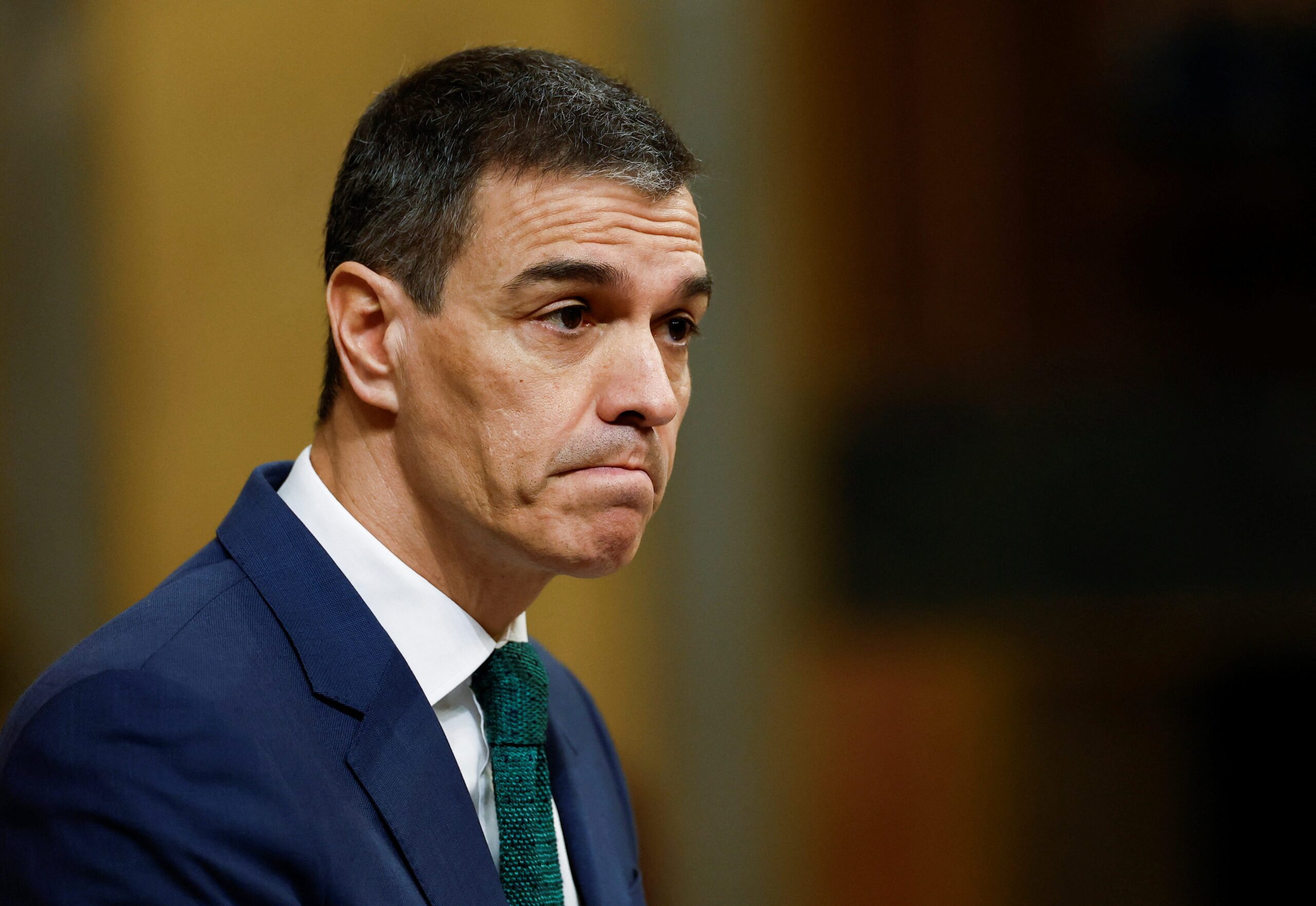
The political and legal pressure surrounding Spanish Prime Minister Pedro Sánchez intensified dramatically this week after a court ordered his wife to face a jury trial and his brother was convicted of misconduct in a public-hiring case.
The two developments, arriving within just 48 hours of each other, have deepened the crisis engulfing Sánchez’s family, government and ruling Socialist Workers’ Party, or PSOE.
Begoña Gómez, the prime minister’s wife, must stand trial before a jury on allegations of influence peddling and embezzlement, Madrid’s Provincial Court ruled on Thursday.
The court upheld two of the accusations against Gómez while dropping other elements of the case and lifting restrictions that had prevented her from travelling abroad. Gómez denies wrongdoing, while Sánchez and the PSOE maintain that the investigation is politically motivated.
No trial date has yet been announced, and Gómez remains legally innocent unless convicted. Nevertheless, the decision represents a major political blow to a prime minister who has repeatedly dismissed investigations surrounding his family and allies as an organised campaign by Spain’s conservative and far-right opposition.
The ruling came only two days after Sánchez’s younger brother, David Sánchez, was found guilty of administrative misconduct connected to his appointment to a publicly funded cultural position in Badajoz.
The court concluded that David Sánchez had improperly benefited from the hiring process and banned him from holding public office for nine years. He was, however, acquitted of influence peddling.
Taken together, the cases have produced an extraordinary situation: the prime minister’s wife is heading toward a corruption trial while his brother has already been convicted of misconduct involving public employment.
Neither case establishes criminal wrongdoing by Pedro Sánchez himself. The prime minister has not been charged in the investigations currently surrounding his family and party. But politically, the distinction is becoming increasingly difficult for Sánchez to use as a shield.
The controversy stretches far beyond his immediate family.
Spain’s High Court recently expanded a separate corruption investigation to include Juan Manuel Serrano, a former Sánchez chief of staff and former head of the state postal service. Investigators are examining allegations that public institutions may have been used to obstruct investigations connected to PSOE figures. Serrano has not been convicted, and Sánchez has not been implicated in that inquiry.
More than a dozen people linked to Sánchez, his family, his party or his political circle have reportedly been investigated or brought before the courts in a series of cases involving alleged graft, influence peddling and misuse of public resources.
The scandals have already spilled into parliament.
On June 25, Spain’s lower house approved a non-binding resolution calling on Sánchez to resign. The measure did not remove him from power, but it demonstrated the extent of his political isolation and handed the opposition a powerful symbolic victory.
Sánchez has refused to step down or call an early general election. His opponents have also stopped short of submitting a formal no-confidence motion because they appear to lack the parliamentary votes required to replace him.
That arithmetic remains Sánchez’s greatest protection.
His minority government survives through a fragile collection of left-wing, regionalist and Catalan separatist parties. As long as those groups conclude that keeping Sánchez in office serves their interests better than allowing the conservative opposition to take power, the prime minister may continue to survive—even as the scandals multiply.
Sánchez also received an important reprieve on Thursday when the European Union’s highest court upheld the central legality of Spain’s amnesty law for Catalan separatists.
The controversial legislation was part of the political arrangement that helped Sánchez secure enough parliamentary support to remain prime minister following Spain’s inconclusive 2023 election. The ruling could strengthen his relationship with Catalan parties whose votes remain essential to his government’s survival.
That means Sánchez is simultaneously experiencing one of the worst legal weeks of his political career and receiving a judgment that could help preserve his parliamentary majority.
But the broader picture is increasingly damaging.
His wife faces trial. His brother has been convicted. Former aides and senior party figures remain under investigation. Parliament has called for his resignation, and the opposition is portraying the scandals as evidence of a political system built around patronage, protection and personal loyalty.
The nickname “Dirty Sánchez” remains a piece of political mockery rather than a legal finding. There is currently no conviction or criminal charge proving that Pedro Sánchez personally participated in corruption.
Yet the legal noose around his political operation is unquestionably tightening.
For years, Sánchez has survived electoral defeats, internal party rebellions, separatist crises and repeated predictions of his political demise. He has earned a reputation as one of Europe’s most resilient—and ruthless—political survivors.
The question now is no longer whether the scandals are damaging him.
It is how many more convictions, trials and investigations his government can absorb before the parliamentary alliances keeping him in office finally begin to break.