
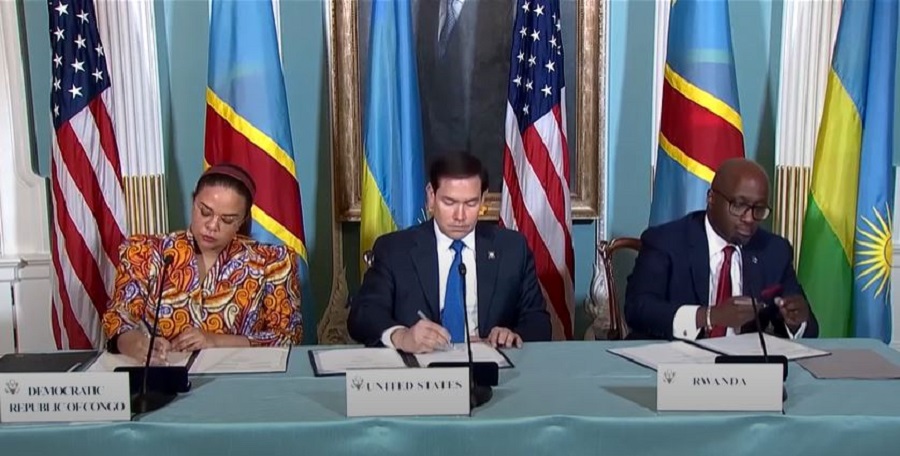
The United States announced Monday sanctions on Rwanda’s military, accusing a long-time partner of violating a peace agreement in the Democratic Republic of Congo.
Eastern DRC, rich in minerals, has endured decades of conflict, with violence surging last year as M23 captured key towns and mines.
President Donald Trump brokered a December peace deal between Rwanda and the DRC, calling it a “great miracle” for the region.
Despite the deal, M23 swiftly seized the strategic Congolese city of Uvira, undermining hopes for immediate stability and security across the region.
The sanctions target the Rwanda Defence Force and four senior officers, including army chief Vincent Nyakarundi, for supporting M23’s military advances.
“M23, a US- and UN-sanctioned group, commits horrific human rights abuses, including executions and violence against civilians,” said State Department spokesman Tommy Pigott.
Pigott added that RDF support enabled M23 to capture DRC territory and continue widespread atrocities against women, children, and local populations.
Trump had previously praised Rwandan President Paul Kagame’s cooperation, highlighting Rwanda’s role in accepting deported migrants from the United States.
Sanctions will freeze RDF and officers’ assets in the US and criminalise any financial transactions involving them, officials confirmed.
Treasury Secretary Scott Bessent demanded the immediate withdrawal of RDF troops, weapons, and equipment from eastern DRC, citing direct operational support for M23.
Rwanda condemned the sanctions as unfair, saying they misrepresent reality and distort facts of the conflict, claiming only defensive involvement in DRC.
Kigali argued that drone attacks and offensives by the DRC violated ceasefire agreements, and demanded action against Hutu militants responsible for past genocide.
Outmatched on the ground, DRC forces rely partly on US pressure on Rwanda to stabilise the frontline and counter better-equipped M23 troops.
The escalating tensions highlight the fragile peace in eastern Congo, where international diplomacy and military interventions continue to clash with local realities.