
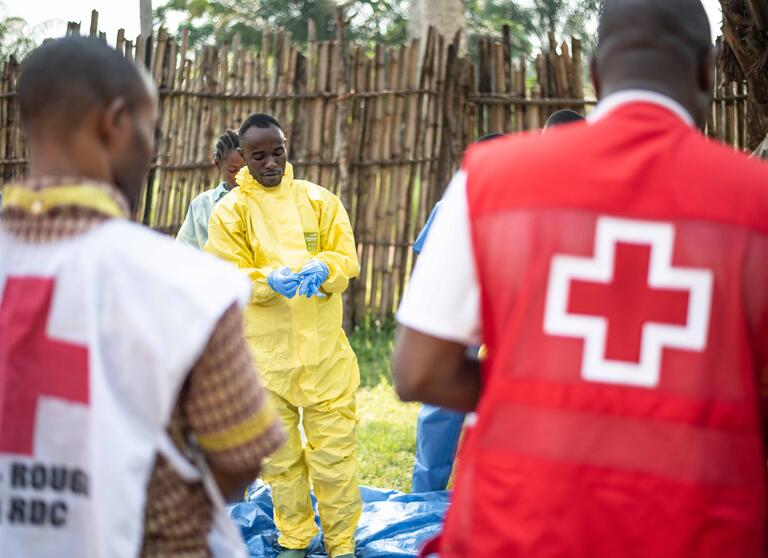
Three Red Cross volunteers have died in the Democratic Republic of Congo from suspected Ebola after likely contracting the virus while handling bodies in the country’s eastern Ituri province, the organisation said.
The International Federation of Red Cross and Red Crescent Societies said Alikana Udumusi Augustin, Sezabo Katanabo and Ajiko Chandiru Viviane were believed to have been infected on March 27 while working in Mongwalu, now considered the epicentre of the outbreak.
The volunteers were carrying out community work unrelated to Ebola before the outbreak had been officially identified. They died between May 5 and May 16.
The IFRC said the three had served their communities “with courage and humanity.”
Their deaths are among the earliest known fatalities linked to DR Congo’s latest Ebola outbreak, which has now caused more than 200 suspected deaths and more than 850 suspected cases.
Health officials say bodies of Ebola victims remain highly infectious after death because the virus can still be transmitted through bodily fluids. Safe burials have become a critical part of the response, but they have also triggered tensions in affected communities.
The outbreak involves the Bundibugyo strain of Ebola, a rare species of the virus for which there is no proven vaccine. It is estimated to kill about one-third of those infected.
On Friday, the World Health Organization raised the public health risk in DR Congo from “high” to “very high,” while saying the wider regional risk was high and the global risk remained low.
Uganda, which borders DR Congo, confirmed three new cases on Saturday, bringing its total to five. The Africa Centres for Disease Control and Prevention has warned that 10 other countries could be at risk, including South Sudan, Rwanda, Kenya, Tanzania, Zambia, Burundi, Angola, Ethiopia, the Central African Republic and the Republic of Congo.
In an effort to contain the outbreak, DR Congo suspended commercial and private flights to and from Bunia, the capital of Ituri province, where most suspected cases and deaths have been reported. Authorities said humanitarian, medical and emergency flights would require special approval.
Local media also reported that Ituri’s military governor had banned gatherings of more than 50 people and suspended funeral wakes, while ordering that burials be carried out only by trained “safe and dignified” burial teams.
The response has faced growing challenges. Médecins Sans Frontières said a tent it had provided for the Ebola response in Mongwalu was burned on Friday, a day after an angry crowd attacked part of a hospital after relatives of a suspected Ebola victim were prevented from taking his body for burial.
MSF said the incident showed the urgent need for community engagement and trust-building in a rapidly evolving crisis.
Cases have also been detected in North Kivu and South Kivu, where insecurity linked to fighting between government forces and the M23 rebel group has complicated efforts to track infections and deliver medical support.