
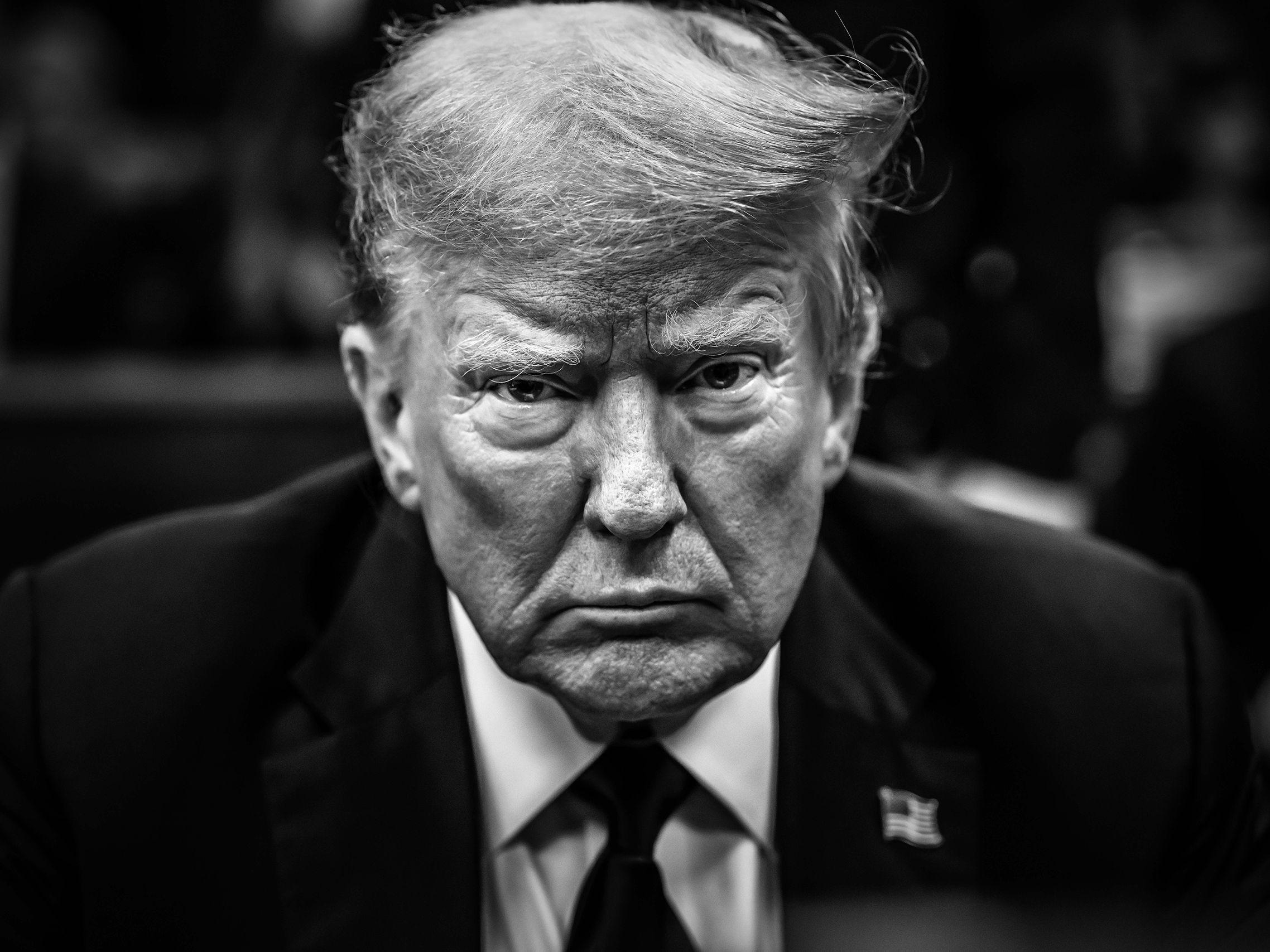
Donald Trump spent Tuesday trying to look like a wartime president.
By Thursday evening, he was back to being what he has always been: a man threatening fire, waiting for applause, then calling retreat a deal.
The latest Iran drama followed the familiar Trump script almost perfectly. First came the strikes. Then came the threats of more strikes. Then came the promise that Iran would be hit “very hard.” Then came the fantasy of taking Kharg Island, Iran’s vital oil hub, as if a regional war were a real-estate dispute waiting for a signature.
And then, just as the world waited for the “big one,” Trump folded.
He cancelled the planned strikes and bombings against Iran, claiming talks had reached the highest levels of Iranian leadership and had been approved by a long list of regional governments. Israel, Saudi Arabia, the UAE, Qatar, Turkey, Pakistan, Bahrain, Kuwait, Jordan, Egypt and others were all suddenly placed inside Trump’s diplomatic theater.
There it was again: the exit ramp.
Only this time, he did not even bother to dress it in the language of statecraft. He called it a “Transaction.”
That one word said everything about the presidency of a man who treats US national interests as bargaining chips in a private deal, to be traded, sold or abandoned whenever the performance requires it.
War, for Trump, is not strategy. It is leverage. Diplomacy is not diplomacy. It is branding. The lives of soldiers, civilians and entire populations become props in a performance designed to produce one final image: Trump at the center, Trump as dealmaker, Trump as the man who almost unleashed hell but chose not to.
TACO Tuesday became TACO Thursday.
Trump Always Chickens Out was born as a market joke, a way to describe the rhythm of his threats: he promises catastrophe, markets shake, pressure builds, then he backs down and calls the retreat a victory.
But for a while now the pattern has moved from tariffs to war.
On Tuesday, the United States launched strikes. On Wednesday, Trump said Iran had taken too long and would “pay the price.” On Thursday, he threatened to hit Iran “very hard” and floated the idea of seizing its oil infrastructure. Hours later, he cancelled the strikes and announced that some magical regional understanding was apparently near.
This is not strength. It is cowardice with a press release, panic dressed up as strategy, retreat choreographed to look like command.
Trump has been doing this for months. A deal is always coming. Peace is always two weeks away. Sometimes it is two or three weeks. Sometimes it is 60 days. Sometimes it is “very soon.” Sometimes Pakistan is about to call. Sometimes Qatar is the channel. Sometimes Saudi Arabia is in the room. Sometimes everyone has supposedly approved everything, even when no one else has confirmed the story.
The formula never changes.
Trump creates the cliff, walks everyone to the edge, then asks to be praised for stepping back.
And then there was Trump’s most ridiculous claim of all: that discussions had now been brought to the “highest level” of Iranian leadership.
Now?
After three months of war?
After strikes, counterstrikes, ceasefires, threats, oil shocks, blockade language, frozen-funds negotiations and endless promises that a deal was “very close”?
Who, exactly, has Washington been negotiating with until now?
The night shift?
A powerless envoy?
Some regime clerk with a burner phone?
A backchannel so low-level it could not even deliver an answer?
Trump wants credit for reaching Iran’s “highest level” while accidentally admitting that everything before it may have been theater with people who could not actually say yes.
Trump wants the world to believe that he has been negotiating a historic settlement with Iran while also admitting, almost accidentally, that the talks had only just reached the people who could actually approve it.
That is not diplomacy.
That is criminal negligence in the costume of foreign policy.
A president gambling with war, oil routes, markets and human lives, then pretending the smoke is strategy and the retreat is genius.
At this point, it would barely be shocking to learn that this administration spent three months confusing Iraqis for Iranians and negotiating with the wrong people.
For weeks, Trump has claimed progress. He has said deals were close. He has floated deadlines. He has threatened punishment when Iran “took too long.” He has spoken as if Tehran had already been presented with terms it could accept or reject.
But if the highest levels of Iranian leadership were only reached now, then all the previous drama was either bluffing, confusion or political theater.
And if those leaders have truly approved Trump’s so-called plan, where is Iran’s confirmation?
And even if they sign one, so what?
A signature is not peace. A ceremony is not implementation. A piece of paper does not release frozen funds, lift sanctions, secure oil routes, enforce a ceasefire or stop the next missile.
If this much chaos was needed just to manufacture a signing moment, how much more circus will the world have to endure before anything real happens?
And Iran knows this.
Tehran knows it can sign a paper and still drag the whole thing through months, maybe years, of “technical talks,” phased releases, verification disputes, sanctions arguments, oil exemptions and implementation committees.
Why wouldn’t it?
Across from them is Trump: a president who mistakes a signature for victory, a headline for peace and a photo opportunity for enforcement.
Iran can sign, stall, deny, reinterpret and renegotiate, because Trump does not need the agreement to work.
He only needs to say he got one.
That is the bar he has trained the MAGA crowd to accept: no peace, no enforcement, no results, no reality — just a fake victory lap around an imaginary deal.
The most revealing part of Thursday’s announcement was not that he cancelled the strikes. It was the way he tried to sell the cancellation. He did not simply say diplomacy was ongoing. He did not say the United States was giving negotiations space. He did not say war must be avoided.
And watching Fox News hosts and analysts turn on a dime was enough to make anyone with a shred of integrity sick. Fifteen minutes earlier, the attack was necessary. The strikes were needed. The job had to be finished. Then Trump blinked, called it a deal, and suddenly the same retreat became great news, brilliant strategy and proof of his genius.
This resembled a regime media learning the new line before the old one had even gone cold.
Trump said the “final points” had been approved and that the naval blockade would remain until the “Transaction” was finalized.
That is not the language of a commander-in-chief trying to prevent disaster.
That is the language of a conman turning a climbdown into an invoice.
A president threatening war in the morning, retreating by evening, then calling the collapse a “Transaction” because he has no vocabulary for sacrifice, sovereignty or national interest beyond the language of a bad deal.
It is also exactly why the “Pakistan call” theory mattered. Whether Pakistan literally called or not was never the real point. The point was that Trump needed a mediator, a phone call, a foreign leader, a diplomatic prop — anything that could turn a climbdown into a story of pressure working.
Now he has found his prop.
He did not blink, we are supposed to believe. The world came to him. Iran came to him. The region came to him. Everyone approved the deal. Everyone joined the “Transaction.” Everyone gave Trump the stage he needed to exit without admitting he was leaving.
The pattern was plain enough. Trump talked the region toward war, watched markets and oil prices react, forced governments to brace for impact, and then retreated into another claim of personal diplomacy.
It was the TACO trade, only this time the instrument was not tariffs. It was missiles.
That leaves the nastiest question of the day hanging over the whole performance: who made money between the threat and the climbdown?
Trump’s threats and reversals no longer move only headlines. They move oil, stocks, shipping risk, defense shares and entire markets. When a president threatens to seize Iran’s oil hub in the morning and cancels strikes by evening, fortunes can be made in the hours between panic and relief.
That does not prove market manipulation. But it guarantees suspicion.
The TACO trade was once a joke about tariffs. Traders learned the pattern: Trump threatens, markets fall, Trump retreats, markets rise. Buy the panic. Sell the relief.
Now that rhythm has moved from tariffs to war.
That is the danger. Presidential threats about missiles, blockades and oil chokepoints are not just rhetoric; they move markets before they become policy.
Trump may call it leverage. Traders may call it the TACO trade. Iran may call it bluffing. But the rest of the world is stuck reacting to a president who turns war scares into market events.
The next stage is almost predictable. Iran will deny, qualify or shrink Trump’s version. Officials will explain that talks are indirect, conditional or unfinished. Someone will leak that sanctions, frozen funds, oil exports and guarantees remain unresolved.
Then Trump will return with another deadline.
Two weeks. Two days. Very soon. Maybe after Pakistan calls.
That is why Thursday’s reversal is not stability. It is just another turn in the cycle: threaten escalation, move the markets, frighten allies, retreat under pressure, then call the retreat leverage.
A serious president would not threaten to seize Kharg Island in the morning and then announce a “Transaction” by evening. A serious president would not treat a regional war as a negotiating stunt. A serious president would not turn escalation into theater and restraint into self-advertisement.
Trump does, all the time.
Trump wanted the image of command without the discipline, the credit for toughness without the cost, the fear of war without the responsibility of war. He pushed the region to the edge, watched the markets react, then stepped back and demanded applause for not pushing harder.
That is the whole trick.
By Thursday night, the strikes had not been cancelled because a serious strategy had matured. They had been absorbed into the only language Trump understands: leverage, signature, transaction, victory lap.
War became a sales tactic.
Retreat became the product.
And the presidency became the showroom.
TACO Tuesday became TACO Thursday.
And Trump submitted again.