
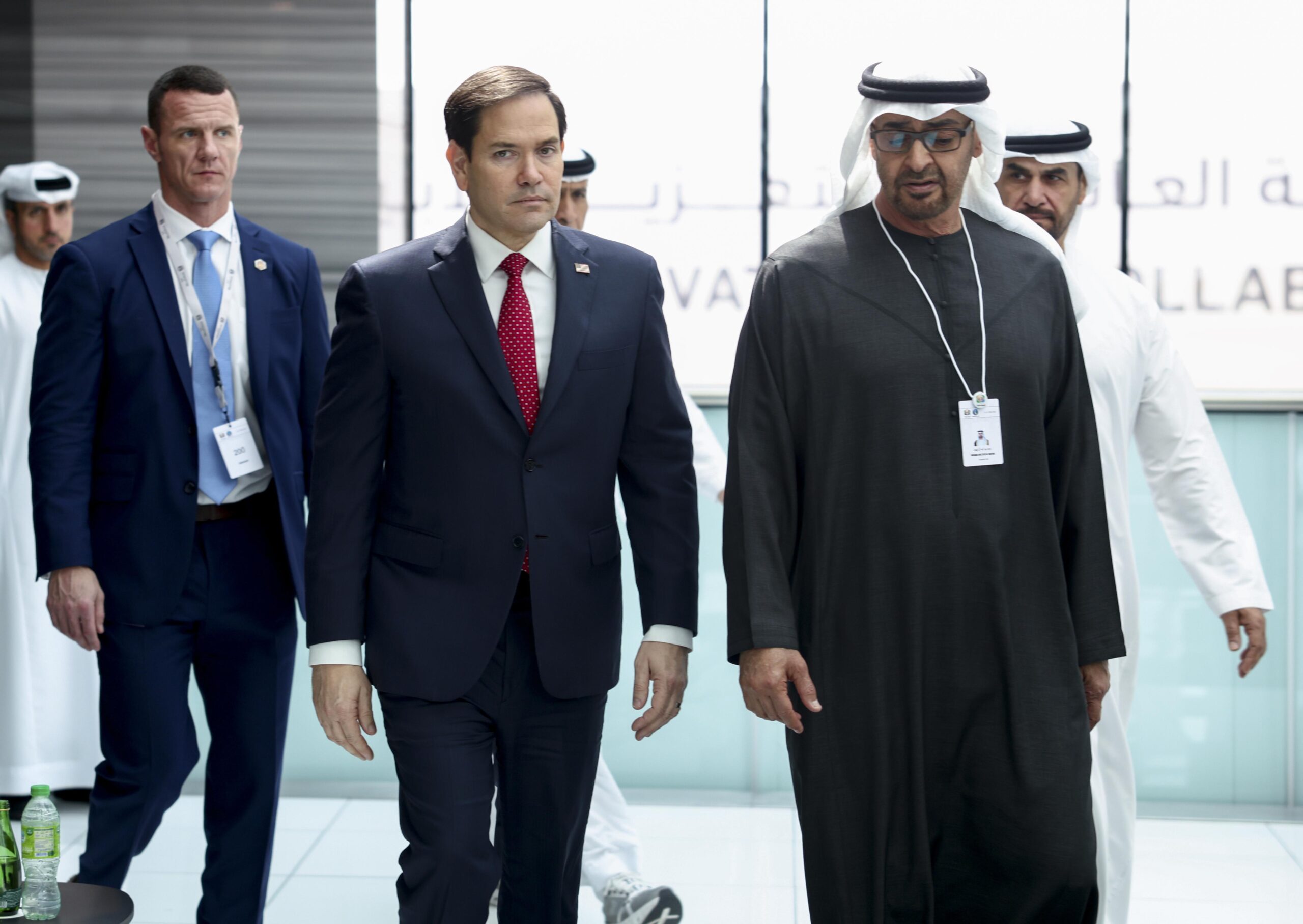
U.S. Secretary of State Marco Rubio is seeking to reassure Gulf Arab allies this week over Washington’s new Iran peace agreement, amid fears that the deal grants Tehran too many concessions and could shift the region’s security balance.
Rubio arrived in the United Arab Emirates late Tuesday and is expected to visit Kuwait and Bahrain in the coming days, where he will hold talks with officials from the Gulf Cooperation Council. The GCC includes Saudi Arabia, the UAE, Qatar, Kuwait, Bahrain and Oman.
Asked whether he would address concerns over the accord, Rubio told reporters the issue would “most certainly” come up during his meetings. He said the discussions would also cover matters not included in the memorandum of understanding.
The most contentious elements of the draft agreement include the absence of limits on Iran’s ballistic missile program, a proposed $300 billion reconstruction fund, and language that Gulf officials fear could expand Tehran’s influence across the region, including over vital oil shipping routes.
Rubio said he would not ask Gulf states to contribute to the reconstruction package during the trip, despite the MoU suggesting regional countries could be expected to help fund it. He said any funding for Tehran remained a matter for later discussions and would depend on Iran’s conduct.
“That’s far down the road,” Rubio said.
The diplomatic push comes after all six GCC states offered varying levels of logistical support to Washington during the four-month U.S.-Israeli war with Iran. Several were also hit by Iranian airstrikes during the conflict.
While Gulf governments publicly backed a diplomatic solution before and during the war, analysts and diplomats say many were privately shocked by the details of the interim agreement. Several Sunni-led Gulf states regard Shi’ite Iran as their main regional rival and fear the deal could open the way to a broader U.S.-Iran reset.
The UAE, Saudi Arabia, Qatar, Kuwait and Bahrain all host U.S. military facilities that form the backbone of Washington’s security posture in the Middle East. Any reassessment of those ties, even gradually, could complicate U.S. strategy in the region.
For Rubio, the trip presents a political balancing act. He must calm Gulf concerns without appearing to criticize an agreement strongly backed by President Donald Trump. Rubio has kept some distance from the Iran talks in recent weeks, with Vice President JD Vance and other Trump aides taking a leading role.
Critics within Trump’s own Republican Party have accused the administration of conceding too much to Tehran.
Andrew Peek, a former deputy assistant secretary of state for Iraq and Iran who served on Trump’s National Security Council, said Rubio could reassure allies by pointing to Trump’s past hardline record against Iran.
“I think you can just remind them that the president has conducted extremely hawkish policies toward Iran — and if this MoU falls through, he will have no compunction about going back to striking them,” said Peek, now with the Atlantic Council.
One of the Gulf states’ main concerns is Iran’s ballistic missile program. During the war, the Trump administration repeatedly said weakening Iran’s missile capacity was a central objective. That goal aligned closely with the interests of Gulf governments, which are all within range of Iranian missiles.
But the MoU does not address Iranian missiles. Trump has also said in recent days that denying Tehran such weapons would be “unfair.”
The proposed $300 billion reconstruction fund has also alarmed Gulf officials, who fear Tehran could use the money to rebuild military capabilities and increase support for allied groups across the region.
Bahrain’s Sunni leadership is seen as especially concerned. The island kingdom has a Shi’ite majority population and was shaken by major protests during the Arab Spring. Analysts say Manama fears a strengthened Iran could encourage renewed unrest.
Iran has denied covert efforts to destabilize Bahrain, though it has previously voiced public support for Bahraini Shi’ite activists.
Another sensitive issue is the Strait of Hormuz, the narrow waterway used by Gulf energy exporters to ship oil and gas. The agreement appears to acknowledge a future Iranian role in managing security around the strait, raising concerns among Gulf producers.
Rubio said Tuesday that Iran would not be allowed to impose tolls on shipping, saying such a move would violate international law.
More broadly, Gulf officials are wary of Washington’s language about a possible reset with Tehran. On Saturday, Vice President Vance said the United States was willing to “fundamentally transform” its relationship with Iran.
“The agreement rehabilitates Tehran’s regime as a regional power,” veteran Saudi columnist Abdulrahman Al-Rashed wrote in Arab News last week.
He warned that much of the money Tehran receives could go toward strengthening its military position rather than improving living conditions or rebuilding the economy.