
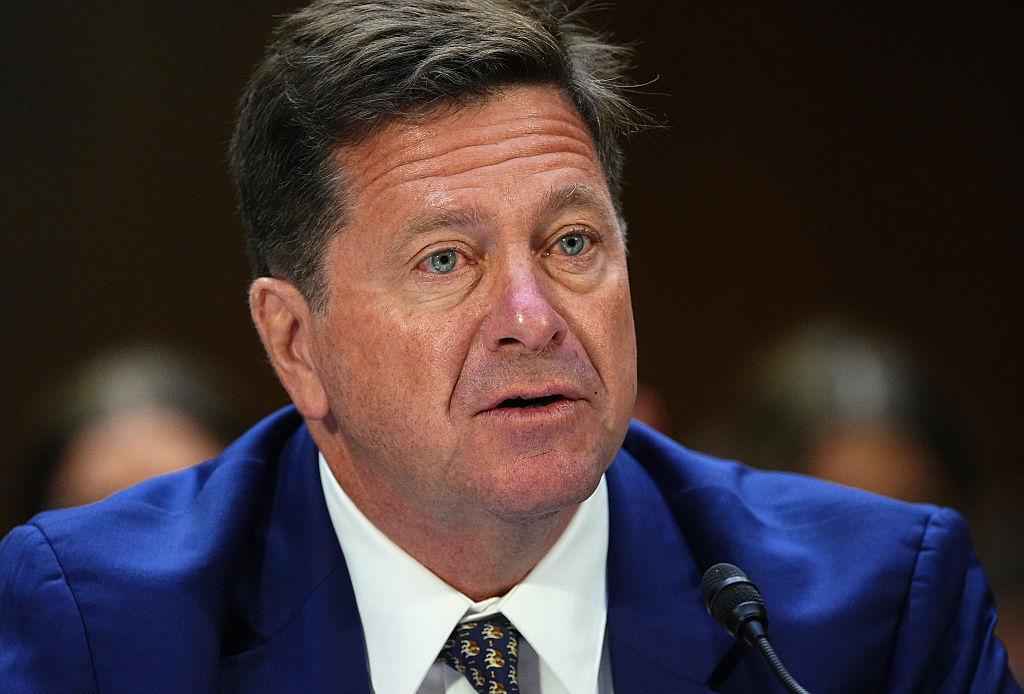
Following confirmation by the US Senate, Jay Clayton has taken office as director of national intelligence, placing him in charge of coordinating the work of 18 American intelligence agencies as President Donald Trump’s administration continues restructuring the intelligence community and reducing the size of the Office of the Director of National Intelligence.
Clayton’s confirmation came only hours after acting intelligence chief Bill Pulte announced another round of staff dismissals as part of a plan reportedly aimed at reducing the office’s workforce by nearly 30%, according to The New York Times.
The director of national intelligence is one of the most influential national security positions in the United States. The office was created following the September 11, 2001 attacks to improve coordination and information-sharing between the country’s intelligence agencies.
Trump selected Clayton largely because of his legal, regulatory and financial experience. He previously served as US attorney for the Southern District of New York and chaired the Securities and Exchange Commission during Trump’s first presidential term.
Legal and financial background
During his tenure at the SEC, Clayton was regarded as broadly supportive of the business sector while overseeing major regulatory actions involving financial markets and digital assets.
The commission also filed a case against billionaire Elon Musk over statements he posted on Twitter, years before Musk acquired the social media platform and renamed it X.
Before entering government, Clayton spent more than two decades at the New York law firm Sullivan & Cromwell, where he became a partner and worked on major corporate acquisitions, stock market listings and financial transactions.
While leading the federal prosecutor’s office in Manhattan, Clayton oversaw several cases with international dimensions.
These reportedly included charges against former Venezuelan president Nicolás Maduro in connection with drug trafficking allegations and a case involving an Iran-backed militia commander accused of plotting attacks against Jewish sites in the United States and targets in Europe.
His office also handled the federal case related to the killing of the chief executive of UnitedHealthcare.
Controversy over the 2020 election
Clayton’s nomination sparked controversy in the Senate after he declined during his confirmation hearing to state directly that former president Joe Biden had won the 2020 presidential election.
Instead, he said the election results had been certified.
He also called for stronger election-auditing mechanisms, arguing that the full extent of voter fraud could not be determined without improvements to monitoring and verification systems.
In one of his first political tests, Clayton defended the continued existence of the Office of the Director of National Intelligence, rejecting calls for it to be abolished.
However, he said the office should focus narrowly on coordination and oversight rather than expanding into operational responsibilities already carried out by agencies such as the CIA and National Security Agency.
His position is broadly aligned with the Trump administration’s stated goal of reducing bureaucracy and reshaping the intelligence establishment.
An outsider to the intelligence community
Unlike many previous intelligence chiefs, Clayton does not have a traditional background in agencies such as the CIA, NSA or military intelligence.
His career has instead been rooted in law, finance, regulation and corporate management.
Supporters within the Trump administration reportedly view that lack of institutional attachment as an advantage, arguing that it could allow him to reorganise the intelligence community without being constrained by its internal culture.
CIA Director John Ratcliffe personally recommended Clayton for the position, according to the report, reflecting the level of confidence he enjoys within the administration.
Clayton also has experience in cybersecurity. At Sullivan & Cromwell, he served as co-head of the firm’s cybersecurity practice and dealt with digital threats, data breaches and cyber-risk management.
As SEC chairman, he also worked on issues involving illicit finance, cyberattacks, digital assets and economic competition with China — areas that have become increasingly central to modern national security policy.
Early life and education
Clayton was born on July 11, 1966, at Fort Eustis military base in Virginia.
His father served as a US Army officer during the Vietnam War before later becoming a private-sector executive.
Clayton graduated with honours in engineering from the University of Pennsylvania, studied economics at the University of Cambridge and later earned a law degree from the University of Pennsylvania.
After working as a judicial clerk, he joined Sullivan & Cromwell, where he spent more than 20 years and helped manage some of the firm’s largest corporate and financial transactions.
After leaving the SEC, Clayton became non-executive chair of Apollo Global Management and joined the board of American Express, gaining further experience overseeing large institutions and coordinating work across multiple organisations.
His supporters argue that this combination of legal, regulatory and management experience makes him suited to Trump’s effort to redefine the Office of the Director of National Intelligence as a smaller body focused primarily on coordination and strategic oversight rather than direct operational activity.